

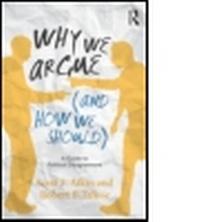
Why We Argue (And How We Should)
A Guide to Political Disagreement
1st Edition
Published on 9. October 2013
Book
Paperback/Softback
152 pages
978-0-415-85905-9 (ISBN)
Description
Why We Argue (And How We Should): A Guide to Political Disagreement presents an accessible and engaging introduction to the theory of argument, with special emphasis on the way argument works in public political debate.? The authors develop a view according to which proper argument is necessary for one's individual cognitive health; this insight is then expanded to the collective health of one's society.? Proper argumentation, then, is seen to play a central role in a well-functioning democracy.?
Written in a lively style and filled with examples drawn from the real world of contemporary politics, and questions following each chapter to encourage discussion, Why We Argue (And How We Should): A Guide to Political Disagreement reads like a guide for the participation in, and maintenance of, modern democracy. An excellent student resource for courses in critical thinking, political philosophy, and related fields, Why We Argue (And How We Should): A Guide to Political Disagreement is an important contribution to reasoned debate.
Written in a lively style and filled with examples drawn from the real world of contemporary politics, and questions following each chapter to encourage discussion, Why We Argue (And How We Should): A Guide to Political Disagreement reads like a guide for the participation in, and maintenance of, modern democracy. An excellent student resource for courses in critical thinking, political philosophy, and related fields, Why We Argue (And How We Should): A Guide to Political Disagreement is an important contribution to reasoned debate.
Reviews / Votes
"Why We Argue is a superb book for students of philosophy, politics, and argumentation. Moreover it is a necessary read for anyone seeking a clear introduction to the ethical importance of well-reasoned public argument. In my ideal world, this text would be required reading for college students and politicians alike."Lawrence Torcello, Rochester Institute of Technology, USA
"Aikin and Talisse offer a guide to political disagreement and argument that takes seriously both the cognitive health of the individual arguer and the collective health of democratic society. Their clear prose and theoretically engaged analyses of current case studies effectively skewer the argumentative foibles of both the political left and the political right. This lively and engaging book effectively connects the epistemology of argument quality with the political demands of decent democratic life."
Harvey Siegel, University of Miami, USA
"Why We Argue makes a compelling case for the significance of argument in our everyday lives, but what sets this book apart is the insistence on the importance of what we owe to others when we are arguing. This emphasis on the social aspects is an important contribution to the literature on teaching the nature and purpose of argument."
Emily Esch, College of Saint Benedict/Saint John's University, USA
More details
Language
English
Place of publication
London
United Kingdom
Publishing group
Taylor & Francis Ltd
Target group
College/higher education
Dimensions
Height: 229 mm
Width: 152 mm
Weight
249 gr
ISBN-13
978-0-415-85905-9 (9780415859059)
Copyright in bibliographic data and cover images is held by Nielsen Book Services Limited or by the publishers or by their respective licensors: all rights reserved.
Schweitzer Classification
Other editions
New editions
Scott Aikin | Robert Talisse
Why We Argue (And How We Should)
A Guide to Political Disagreement in an Age of Unreason
Book
08/2018
2nd Edition
Routledge
€61.60
Shipment within 10-20 days
Additional editions
Book
11/2013
1st Edition
Routledge
€163.42
Article exhausted; check for reprint
Persons
Robert B. Talisse is Professor of Philosophy and Political Science at Vanderbilt University. Talisse is the editor of the journal, Public Affairs Quarterly, and is co-host of the podcast, "New Books in Philosophy." He is the author of five books, including Engaging Political Philosophy: An Introduction (forthcoming), Pluralism and Liberal Politics (Routledge, 2011), and Democracy and Moral Conflict (2009), which was a finalist for the 2011 APA Book Prize, and he co-wrote with Scott F. Aikin, Pragmatism: A Guide for the Perplexed (2008).
Scott F. Aikin is Assistant Professor of Philosophy at Vanderbilt University. His previous books include, Epistemology and the Regress Problem (Routledge 2010) and Pragmatism: A Guide for the Perplexed (with Robert B, Talisse, 2008).?
Scott F. Aikin is Assistant Professor of Philosophy at Vanderbilt University. His previous books include, Epistemology and the Regress Problem (Routledge 2010) and Pragmatism: A Guide for the Perplexed (with Robert B, Talisse, 2008).?
Content
Preface Introduction Part One: A Conception of Argument 1. Why Do We Argue? 2. Why Argument Matters 3. Public Argument in a Democratic Society Part Two: Case Studies in Public Argument 4. The Simple Truth Thesis 5. Pushovers 6. Incredulous Tones 7. The Surprising Truth about Hypocrisy 8. Language, Spin, and Framing 9. Argument Online Conclusion: Civility in Argument
?
?