

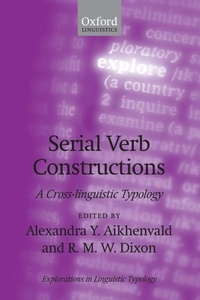
Serial Verb Constructions
A Cross-Linguistic Typology
Published on 2. August 2007
Book
Paperback/Softback
394 pages
978-0-19-923342-7 (ISBN)
Description
This volume of new work explores the forms and functions of serial verbs. The introduction sets out the cross-linguistic parameters of variation, and the final chapter draws out a set of conclusions. These frame fourteen explorations of serial verb constructions and similar structures in languages from Asia, Africa, North, Central and South America, and the Pacific. Chapters on well-known languages such as Cantonese and Thai are set alongside the languages of small hunter-gatherer and slash-and-burn agriculturalist groups.
A serial verb construction (sometimes just called serial verb) is a sequence of verbs which acts together as one. Each describes what can be conceptualized as a single event. They are monoclausal; their intonational properties are those of a monoverbal clause; they generally have just one tense, aspect, mood, and polarity value; and they are an important tool in cognitive packaging of events. Serial verb constructions are a pervasive feature of isolating languages of Asia and West Africa, and are also found in the languages of the Pacific, South, Central and North America, most of them endangered.
Serial verbs have been a subject of interest among linguists for some time. This outstanding book is the first to study the phenomenon across languages of different typological and genetic profiles. The authors, all experienced linguistic fieldworkers, follow a unified typological approach and avoid formalisms. The book will interest students, at graduate level and above, of syntax, typology, language universals, information structure, and language contact, in departments of linguistics and anthroplogy.
A serial verb construction (sometimes just called serial verb) is a sequence of verbs which acts together as one. Each describes what can be conceptualized as a single event. They are monoclausal; their intonational properties are those of a monoverbal clause; they generally have just one tense, aspect, mood, and polarity value; and they are an important tool in cognitive packaging of events. Serial verb constructions are a pervasive feature of isolating languages of Asia and West Africa, and are also found in the languages of the Pacific, South, Central and North America, most of them endangered.
Serial verbs have been a subject of interest among linguists for some time. This outstanding book is the first to study the phenomenon across languages of different typological and genetic profiles. The authors, all experienced linguistic fieldworkers, follow a unified typological approach and avoid formalisms. The book will interest students, at graduate level and above, of syntax, typology, language universals, information structure, and language contact, in departments of linguistics and anthroplogy.
Reviews / Votes
...the book is a feast for thought. Anyone with an interest in SVCs and related types of complex predicate must read it... * N.J.Enfield, Language *More details
Series
Language
English
Place of publication
Oxford
United Kingdom
Target group
Professional and scholarly
Dimensions
Height: 234 mm
Width: 156 mm
Thickness: 21 mm
Weight
597 gr
ISBN-13
978-0-19-923342-7 (9780199233427)
Copyright in bibliographic data and cover images is held by Nielsen Book Services Limited or by the publishers or by their respective licensors: all rights reserved.
Schweitzer Classification
Other editions
Additional editions
Book
12/2005
Oxford University Press
€246.70
Shipment within 15-20 days
Persons
Alexandra Y. Aikhenvald is Professor and Associate Director of the Research Centre for Linguistic Typology at La Trobe University. She has worked on descriptive and historical aspects of Berber languages and published, in Russian, a grammar of Modern Hebrew (1990). She is a major authority on typological and areal features of South American languages, particularly of the Arawak family: Bare (1995, based on work with the last speaker, who has since died), Warekena (1998), and Tariana (2003). Her monographs include Classifiers: a Typology of Noun Categorization Devices (2000, 2003), Language Contact in Amazonia (2002) and Evidentiality (2004), all published by OUP. She is currently working on a reference grammar of Manambu, from the Sepik area of New Guinea.
R.M.W. Dixon is Professor and Director of the Research Centre for Linguistic Typology at La Trobe University. He has published grammars of a number of Australian languages (including Dyirbal and Yidin), in addition to A Grammar of Boumaa Fijian (1988), The Jarawara Language of Southern Amazonia (2004) and A Semantic Approach to English Grammar (2005). His works on typological theory include Where have All the Adjectives Gone? and Other Essays (1982) and Ergativity (1994). His essay The Rise and Fall of Languages (1997) expounded a punctuated equilibrium model for language development which is the basis for his detailed case study Australian Languages: their Nature and Development (2002). He is currently working on an extensive study of the basic linguistic theory.
R.M.W. Dixon is Professor and Director of the Research Centre for Linguistic Typology at La Trobe University. He has published grammars of a number of Australian languages (including Dyirbal and Yidin), in addition to A Grammar of Boumaa Fijian (1988), The Jarawara Language of Southern Amazonia (2004) and A Semantic Approach to English Grammar (2005). His works on typological theory include Where have All the Adjectives Gone? and Other Essays (1982) and Ergativity (1994). His essay The Rise and Fall of Languages (1997) expounded a punctuated equilibrium model for language development which is the basis for his detailed case study Australian Languages: their Nature and Development (2002). He is currently working on an extensive study of the basic linguistic theory.
Content
1. Serial Verb Constructions in Typological Perspective ; 2. On Serial Verb Constructions in Cantonese ; 3. Serial Verb Constructions in Goemai ; 4. Serial Verb Constructions in Khwe (Central-Khoisan) ; 5. Ewe Serial Verb Constructions in their Grammatical Context ; 6. Verb Serialization in Eastern Kayah Li ; 7. Thai Serial Verbs: Cohesion and Culture ; 8. Serial Verb Constructions in Tariana ; 9. Serial Verb Constructions in Dumo ; 10. Serial Verb Constructions in Mwotlap ; 11. Serial Verbs in Tetun Dili ; 12. Serial Verb Constructions in Toqabaqita ; 13. Serial Verbs in Olutec (Mixean) ; 14. Serial Verbs in Lakota (Siouan) ; 15. Verbal Compounding in Wolaitta ; 16. Serial Verb Constructions: Conspectus and Coda ; Index of Authors ; Index of Subjects ; Index of Languages, Language Families, and Areas