

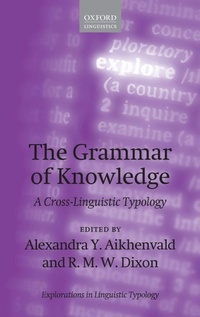
The Grammar of Knowledge
A Cross-Linguistic Typology
Published on 27. February 2014
Book
Hardback
312 pages
978-0-19-870131-6 (ISBN)
Description
The Grammar of Knowledge offers both a linguistic and anthropological perspective on the expression of information sources, as well as inferences, assumptions, probability and possibility, and gradations of doubt and beliefs in a range of languages. The book investigates twelve different languages, from families including Tibeto-Burman, Nakh-Dagestani, and Austronesian, all of which share the property of requiring the source of information to be specified in every sentence. In these languages, it may not be possible to say merely that 'the man went fishing'. Instead, the source of evidence for the statement must also be specified, usually through the use of evidential markers. For example, it may be necessary to indicate whether the speaker saw the man go fishing; has simply assumed that the man went fishing; or was told that he went fishing by a third party. Some languages, such as Hinuq and Tatar, distinguish between first-hand and non first-hand information sources; others, such as Ersu, mark three distinct types of information - directly required, inferred or assumed, and reported. Some require an even greater level of specification: Asheninka Perene, from South America, has a specific marker to express suspicions or misgivings. Like others in the series, the book illustrates and examines these aspects of language in different cultural and linguistic settings. It will interest linguists of all persuasions as well as linguistically-minded anthropologists.
Reviews / Votes
This outstanding collection of studies probes into one of the most critical areas of human cognition: knowledge. The systematic survey of 12 languages whose grammatical system includes epistemological devices reveals both fascinating differences and striking similarities in how different languages construe the nature of knowledge and its sources. * Edith Moravcsik, University of Wisconsin-Milwaukee *More details
Series
Language
English
Place of publication
Oxford
United Kingdom
Target group
College/higher education
Professional and scholarly
Illustrations
15 line drawings; 2 maps
Dimensions
Height: 240 mm
Width: 161 mm
Thickness: 21 mm
Weight
634 gr
ISBN-13
978-0-19-870131-6 (9780198701316)
Copyright in bibliographic data and cover images is held by Nielsen Book Services Limited or by the publishers or by their respective licensors: all rights reserved.
Schweitzer Classification
Other editions
Additional editions
Book
03/2016
Oxford University Press
€51.44
Shipment within 15-20 days
E-Book
02/2014
1st Edition
Pearson ELT
€22.99
Available for download
Persons
Alexandra Y. Aikhenvald is Distinguished Professor, Australian Laureate Fellow, and Director of the Language and Culture Research Centre at James Cook University. She is a major authority on languages of the Arawak family, from northern Amazonia, and has written grammars of Bare (1995) and Warekena (1998), plus A Grammar of Tariana, from Northwest Amazonia (Cambridge University Press, 2003), in addition to essays on various typological and areal features of South American languages. Her other major publications, with OUP, include Classifiers: A Typology of Noun Categorization Devices (2000), Language Contact in Amazonia(2002), Evidentiality (2004), The Manambu Language of East Sepik, Papua New Guinea, (2008), Imperatives and Commands (2010), Languages of the Amazon (2012), and The Art of Grammar (forthcoming).
R. M. W. Dixon is Adjunct Professor and Deputy Director of the Language and Culture Research Centre at James Cook University. He has published grammars of a number of Australian languages (including Dyirbal and YidiA+/-), in addition to A Grammar of Boumaa Fijian (University of Chicago Press, 1988), The Jarawara Language of Southern Amazonia (Oxford University Press, 2004;, paperback 2011) and A Semantic Approach to English Grammar (Oxford University Press, 2005). He is also the author of the three volume work Basic Linguistic Theory (Oxford University Press, 2010-12) and of an academic autobiography I am a linguist (Brill, 2011).
R. M. W. Dixon is Adjunct Professor and Deputy Director of the Language and Culture Research Centre at James Cook University. He has published grammars of a number of Australian languages (including Dyirbal and YidiA+/-), in addition to A Grammar of Boumaa Fijian (University of Chicago Press, 1988), The Jarawara Language of Southern Amazonia (Oxford University Press, 2004;, paperback 2011) and A Semantic Approach to English Grammar (Oxford University Press, 2005). He is also the author of the three volume work Basic Linguistic Theory (Oxford University Press, 2010-12) and of an academic autobiography I am a linguist (Brill, 2011).
Editor
Distinguished Professor, Australian Laureate Fellow, and Director of the Language and Culture Research CentreDistinguished Professor, Australian Laureate Fellow, and Director of the Language and Culture Research Centre, James Cook University
Adjunct Professor and Deputy Director of the Language and Culture Research CentreAdjunct Professor and Deputy Director of the Language and Culture Research Centre, James Cook University
Content
1. The grammar of knowledge: a cross-linguistic view of evidentials and the expression of information source ; 2. The grammar of knowledge in Hinuq ; 3. Expression of knowledge in Tatar ; 4. The grammar of knowledge in Saaroa ; 5. The grammar of knowledge in Kurtop: evidentiality, mirativity, and expectation of knowledge ; 6. Evidentiality in Ersu ; 7. Evidentiality in Kalmyk ; 8. The non-visible marker in Dyirbal ; 9. The grammar of knowledge in Maaka (Western Chadic, Nigeria) ; 10. Expression of information-source meanings in Asheninca Perene ; 11. Nominalization, knowledge, and information source in Aguarana ; 12. The grammar of knowledge in Tima ; 13. Saying, seeing, and knowing among the Karawari of Papua New Guinea