

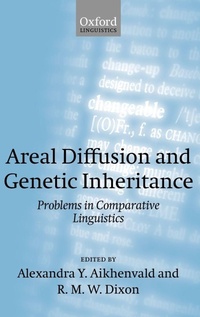
Areal Diffusion and Genetic Inheritance
Problems in Comparative Linguistics
Published on 22. November 2001
Book
Hardback
472 pages
978-0-19-829981-3 (ISBN)
Description
Two languages can resemble each other in the categories, constructions, and types of meaning they use, and in the forms they employ to express these. Such resemblances may be the consequence of universal characteristics of language, of chance or coincidence, of the borrowing by one language of another's words, or of the diffusion of grammatical, phonetic, and phonological characteristics that takes place when languages come into contact. Languages sometimes show likeness because they have borrowed not from each other but from a third language. Languages that come from the same ancestor may have similar grammatical categories and meanings expressed by similar forms: such languages are said to be genetically affiliated.
This book considers how and why forms and meanings of different languages at different times may resemble one another. Its editors and authors aim (a) to explain and identify the relationship between areal diffusion and the genetic development of languages, and (b) to discover the means of distinguishing what may cause one language to share the characteristics of another. The introduction outlines the issues that underlie these aims, introduces the chapters which follow, and comments on recurrent conclusions by the contributors. The problems are formidable and the pitfalls numerous: for example, several of the authors draw attention to the inadequacy of the family tree diagram as the main metaphor for language relationship.
The authors range over Ancient Anatolia, Modern Anatolia, Australia, Amazonia, Oceania, Southeast and East Asia, and Sub-Saharan Africa. The book includes an archaeologist's view on what material evidence offers to explain cultural and linguistic change, and a general discussion of which kinds of linguistic feature can and cannot be borrowed. The chapters are accessibly-written and illustrated by twenty maps. The book will interest all students of the causes and consequences of language change and evolution.
This book considers how and why forms and meanings of different languages at different times may resemble one another. Its editors and authors aim (a) to explain and identify the relationship between areal diffusion and the genetic development of languages, and (b) to discover the means of distinguishing what may cause one language to share the characteristics of another. The introduction outlines the issues that underlie these aims, introduces the chapters which follow, and comments on recurrent conclusions by the contributors. The problems are formidable and the pitfalls numerous: for example, several of the authors draw attention to the inadequacy of the family tree diagram as the main metaphor for language relationship.
The authors range over Ancient Anatolia, Modern Anatolia, Australia, Amazonia, Oceania, Southeast and East Asia, and Sub-Saharan Africa. The book includes an archaeologist's view on what material evidence offers to explain cultural and linguistic change, and a general discussion of which kinds of linguistic feature can and cannot be borrowed. The chapters are accessibly-written and illustrated by twenty maps. The book will interest all students of the causes and consequences of language change and evolution.
Reviews / Votes
extremely rich, competent, and well-edited. * Language, * ... invaluable volume ... the uniformly high quality of the contributions demonstrates that all contributors know whereof they speak ... The geographical range of the contributions is impressive ... The quality of the production is high. * The Journal of The Royal Anthropological Institute * ... certainly a book worth acquiring and reading. * Journal of Linguistics * This book is a pleasure to sample, and will serve as a resource for years to come. The salutary lesson that emerges from every chapter is that diffusion studies are necessarily complementary to genetic studies, and that our methodology for studying various types of contact needs to be extended and refined. * Diachronica * This book is highly recommended for all those interested in historical linguistics, linguistic typology, language contact and language change ... this book represents a good opportunity to meditate, on the one side, on models of language evolution and, on the other side, on actual phenomena of language change. * LINGUIST List *More details
Series
Language
English
Place of publication
Oxford
United Kingdom
Target group
Professional and scholarly
Illustrations
numerous figures and maps
Dimensions
Height: 240 mm
Width: 161 mm
Thickness: 30 mm
Weight
869 gr
ISBN-13
978-0-19-829981-3 (9780198299813)
Copyright in bibliographic data and cover images is held by Nielsen Book Services Limited or by the publishers or by their respective licensors: all rights reserved.
Schweitzer Classification
Other editions
Additional editions
Alexandra Y. Aikhenvald | R. M. W. Dixon
Areal Diffusion and Genetic Inheritance
Problems in Comparative Linguistics
Book
03/2006
Oxford University Press
€99.70
Shipment within 15-20 days
Persons
Alexandra Y. Aikhenvald is Associate Director of the Research Centre for Linguistic Typology at La Trobe University in Melbourne. She has published on the Berber languages of North Africa, the Manambu language of New Guinea, and the Arawak languages of South America (grammars of Bare and Warekena have appeared and a comprehensive study of Tariana is almost complete). She is author of A Grammar of Modern Hebrew (1990), and her Grammar of Biblical Hebrew is in press. Her theoretical publications include work on evidentiality and Classifiers: A Typology of Noun Categorization Devices (OUP 2000). She is currently working on language contact and universals of borrowings.
R. M. W. Dixon, who is Director of the Research Centre for Linguistic Typology, has written grammars of five Australian languages -- most notably Dyirbal (1972) and Yidiny (1977) -- and of Boumaa Fijian (1988), in addition to A New Approach to English Grammar, on Semantic Principles (OUP 1991). His theoretical contributions have included work on noun classes, adjective classes, the volume Ergativity (1994), and his acclaimed essay 'The Rise and Fall of Languages' (1997). He is currently completing a full-scale comparative study of the Australian lingusitic area, and a comprehensive study of the Jarawara language (Arawa family, Brazil).
R. M. W. Dixon, who is Director of the Research Centre for Linguistic Typology, has written grammars of five Australian languages -- most notably Dyirbal (1972) and Yidiny (1977) -- and of Boumaa Fijian (1988), in addition to A New Approach to English Grammar, on Semantic Principles (OUP 1991). His theoretical contributions have included work on noun classes, adjective classes, the volume Ergativity (1994), and his acclaimed essay 'The Rise and Fall of Languages' (1997). He is currently completing a full-scale comparative study of the Australian lingusitic area, and a comprehensive study of the Jarawara language (Arawa family, Brazil).
Content
1. Introduction ; 2. Archaeology and the Historical Determinants of Punctuation in Language-Family Origins ; 3. An Indo-European Linguistic Area and its Characteristics: Ancient Anatolia. Areal Diffusion as a Challenge to the Comparative Method? ; 4. The Australian Linguistic Area ; 5. Descent and Diffusion: The Complexity of the Pilbara Situation ; 6. Contact-Induced Change in Oceanic Languages in North-West Melanesia ; 7. Areal Diffusion, Genetic Inheritance, and Problems of Subgrouping: A North Arawak Case Study ; 8. Linguistic Diffusion in Present-Day East Anatolia: From Top to Bottom ; 9. The Role of Migration and Language Contact in the Development of the Sino-Tibetan Language Family ; 10. On Genetic and Areal Linguistics in Mainland South-East Asia: Parallel Polyfunctionality of 'Acquire' ; 11. Genetic Versus Contact Relationship: Prosodic Diffusibility in South-East Asian Languages ; 12. Language Contact and Areal Diffusion in Sinitic Languages ; 13. Areal Diffusion Versus Genetic Inheritance: An African Perspective ; 14. Convergence and Divergence in the Development of African Lanaguages ; 15. What Language Features can be 'Borrowed'?