

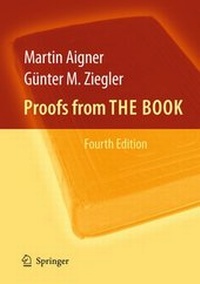
Proofs from THE BOOK
4th Edition
Published on 13. October 2009
Book
Hardback
VIII, 274 pages
978-3-642-00855-9 (ISBN)
Description
PaulErdos ? likedtotalkaboutTheBook,inwhichGodmaintainstheperfect proofsformathematicaltheorems,followingthedictumofG. H. Hardythat there is no permanent place for ugly mathematics. Erdos ? also said that you need not believe in God but, as a mathematician, you should believe in The Book. A few years ago, we suggested to him to write up a ?rst (and very modest) approximation to The Book. He was enthusiastic about the idea and, characteristically, went to work immediately, ?lling page after page with his suggestions. Our book was supposed to appear in March 1998 as a present to Erdos ? ' 85th birthday. With Paul's unfortunate death in the summer of 1996, he is not listed as a co-author. Instead this book is dedicated to his memory. ? Paul Erdos We have no de?nition or characterization of what constitutes a proof from The Book: all we offer here is the examples that we have selected, h- ing that our readers will share our enthusiasm about brilliant ideas, clever insights and wonderful observations. We also hope that our readers will enjoy this despite the imperfections of our exposition. The selection is to a ? great extent in?uencedby Paul Erdos himself. A largenumberof the topics were suggested by him, and many of the proofs trace directly back to him, or were initiated by his supreme insight in asking the right question or in makingthe rightconjecture. So to a largeextentthisbookre?ectstheviews of Paul Erdos ? as to what should be considered a proof from The Book.
Reviews / Votes
From the reviews of the fourth edition: "This is the fourth edition of a book that became a classic on its first appearance in 1998. . The authors have tried, in homage to Erdos, to approximate this tome; successive editions appear to be achieving uniform convergence. . Five new chapters have been added . . there is enough new material that libraries certainly should do so. For individuals who do not yet have their own copies, the argument for purchase has just grown stronger." (Robert Dawson, Zentralblatt MATH, February, 2010) "This book is the fourth edition of Aigner and Ziegler's attempt to find proofs that Erdos would find appealing. . this one is a great collection of remarkable results with really nice proofs. The authors have done an excellent job choosing topics and proofs that Erdos would have appreciated. . the proofs are largely accessible to readers with an undergraduate-level mathematics background. . I love the fact that the chapters are relatively short and self-contained. . this is a very nice book." (Donald L. Vestal, The Mathematical Association of America, May, 2010)"Martin Aigner and Günter Ziegler succeeded admirably in putting together a broad collection of theorems and their proofs that would undoubtedly be in the Book of Erdos. The theorems are so fundamental, their proofs so elegant, and the remaining open questions so intriguing that every mathematician, regardless of speciality, can benefit from reading this book. The book has five parts of roughly equal length." (Mikl?s B?na, The Book Review Column, 2011)"Paul Erdos . had his own way of judging the beauty of various proofs. He said that there was a book somewhere, possibly in heaven, and that book contained the nicest and most elucidating proof of every theorem in mathematics. . Martin Aigner and Günter Ziegler succeeded admirably in putting together a broad collection of theorems . that would undoubtedly be in the Book of Erdos. The theorems are so fundamental . that every mathematician, regardless of speciality, can benefit from reading this book." (Miklós Bóna, SIGACT News, Vol. 42. (3), September, 2011)From the reviews of the third edition:"... It is unusual for a reviewer to have the opportunity to review the first three editions of a book - the first edition was published in 1998, the second in 2001 and the third in 2004. ... I was fortunate enough to obtain a copy of the first edition while travelling in Europe in 1999 and I spent many pleasant hours reading it carefully from cover to cover. The style is inviting and it is very hard to stop part way through a chapter. Indeed I have recommended the book to talented undergraduates and to mathematically literate friends. All report that they are captivated by the material and the new view of mathematics it engenders. By now a number of reviews of the earlier editions have appeared and I must simply agree that the book is a pleasure to hold and to look at, it has striking photographs, instructive pictures and beautiful drawings. The style is clear and entertaining and the proofs are brilliant and memorable. ... David Hunt, The Mathematical Gazette, Vol. 32, Issue 2, p. 127-128"The newest edition contains three completely new chapters. . The approach is refreshingly straightforward, all the necessary results from analysis being summarised in boxes, and a short appendix discusses the importance of the zeta-function in number theory. . this edition also contains additional material interpolated in the original text, notably the Calkin-Wilf enumeration of the rationals." (Gerry Leversha, The Mathematical Gazette, March, 2005)"A lot of solid mathematics is packed into Proofs. Its thirty chapters, divided into sections on Number Theory, Geometry, Analysis . . Each chapter is largely independent; some include necessary background as an appendix. . The key to the approachability of Proofs lies not so much in the accessibility of its mathematics, however, as in the rewards it offers: elegant proofs of interesting results, which don't leave the reader feeling cheated or disappointed." (Zentralblatt für Didaktik de Mathematik, July, 2004)More details
Edition
4th ed. 2010. Corr. 3rd printing 2013
Language
English
Place of publication
Heidelberg
Germany
Publishing group
Springer Berlin
Target group
Professional and scholarly
Lower undergraduate
Edition type
Revised edition
Illustrations
250 s/w Abbildungen
250 black & white illustrations, biography
Dimensions
Height: 15.5 cm
Width: 23.5 cm
Weight
860 gr
ISBN-13
978-3-642-00855-9 (9783642008559)
DOI
10.1007/978-3-642-00856-6
Schweitzer Classification
Other editions
New editions
Martin Aigner | Günter M. Ziegler
Proofs from THE BOOK
Book
08/2018
6th Edition
Springer
€64.19
Available immediately
Martin Aigner | Günter M. Ziegler
Proofs from THE BOOK
Book
08/2014
5th Edition
Springer
€48.14
Article exhausted; check for reprint
Additional editions
Martin Aigner | Günter M. Ziegler
Proofs from THE BOOK
E-Book
01/2010
4th Edition
Springer
€41.64
Available for download
Previous edition
Martin Aigner | Günter M. Ziegler
Proofs from THE BOOK
Book
10/2003
3rd Edition
Springer
€85.59
Article exhausted; check for reprint
Persons
Content
Number Theory.- Six proofs of the infinity of primes.- Bertrand's postulate.- Binomial coefficients are (almost) never powers.- Representing numbers as sums of two squares.- The law of quadratic reciprocity.- Every finite division ring is a field.- Some irrational numbers.- Three times ?²/6.- Geometry.- Hilbert's third problem: decomposing polyhedra.- Lines in the plane and decompositions of graphs.- The slope problem.- Three applications of Euler's formula.- Cauchy's rigidity theorem.- Touching simplices.- Every large point set has an obtuse angle.- Borsuk's conjecture.- Analysis.- Sets, functions, and the continuum hypothesis.- In praise of inequalities.- The fundamental theorem of algebra.- One square and an odd number of triangles.- A theorem of Pólya on polynomials.- On a lemma of Littlewood and Offord.- Cotangent and the Herglotz trick.- Buffon's needle problem.- Combinatorics.- Pigeon-hole and double counting.- Tiling rectangles.- Three famous theorems on finite sets.- Shuffling cards.- Lattice paths and determinants.- Cayley's formula for the number of trees.- Identities versus bijections.- Completing Latin squares.- Graph Theory.- The Dinitz problem.- Five-coloring plane graphs.- How to guard a museum.- Turán's graph theorem.- Communicating without errors.- The chromatic number of Kneser graphs.- Of friends and politicians.- Probability makes counting (sometimes) easy.