

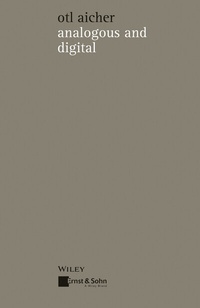
analogous and digital
writings on the philosophy of making
2nd Edition
Published on 11. March 2015
Book
Paperback/Softback
188 pages
978-3-433-03119-3 (ISBN)
Description
Otl Aicher (1922-1991) was an outstanding personality in modern design, he was a co-founder of the legendary Hochschule für Gestaltung (HfG), the Ulm School of Design, Germany. His works since the fifties of the last century in the field of corporate design and his pictograms for the 1972 Summer Olympics in Munich are major achievements in the visual communication of our times.
"An integral component of Aicher's work is that it is anchored in a "philosophy of making" inspired by such thinkers as Ockham, Kant or Wittgenstein, a philosophy concerned with the prerequisites and aims, the objects and claims, of design. Aicher's complete theoretical and practical writings on design (which include all other aspects of visual creativity, such as architecture) are available with this new edition of the classic work.
If Aicher prefers the analogous and concrete to the digital and abstract he does it with a philosophical intention. He relativizes the role of pure reason. He criticizes the rationality of Modernism as a result of the dominance of purely abstract thinking. Anyone who prefers the abstract to the concrete does not only misunderstand the mutual dependence of concept and view. In Aicher's judgement he is also creating a false hierarchy, a rank order that is culturally fatal. Things that are digital and abstract are not greater, higher and more important than things that are analogous and concrete."
Wilhelm Vossenkuhl
"An integral component of Aicher's work is that it is anchored in a "philosophy of making" inspired by such thinkers as Ockham, Kant or Wittgenstein, a philosophy concerned with the prerequisites and aims, the objects and claims, of design. Aicher's complete theoretical and practical writings on design (which include all other aspects of visual creativity, such as architecture) are available with this new edition of the classic work.
If Aicher prefers the analogous and concrete to the digital and abstract he does it with a philosophical intention. He relativizes the role of pure reason. He criticizes the rationality of Modernism as a result of the dominance of purely abstract thinking. Anyone who prefers the abstract to the concrete does not only misunderstand the mutual dependence of concept and view. In Aicher's judgement he is also creating a false hierarchy, a rank order that is culturally fatal. Things that are digital and abstract are not greater, higher and more important than things that are analogous and concrete."
Wilhelm Vossenkuhl
More details
Edition
2. Auflage
Language
English
Place of publication
Berlin
Germany
Target group
College/higher education
Professional and scholarly
Illustrations
4
4 s/w Abbildungen
Dimensions
Height: 21.6 cm
Width: 14 cm
Thickness: 1.4 cm
Weight
216 gr
ISBN-13
978-3-433-03119-3 (9783433031193)
Schweitzer Classification
Other editions
Additional editions
Previous edition

Book
07/1994
2nd Edition
Ernst & Sohn
€32.90
Article exhausted; check for reprint
Person
Otl Aicher (1922-1991) was an outstanding personality in modern design, he was a co-founder of the legendary Hochschule für Gestaltung (HfG), the Ulm School of Design, Germany. His works since the fifties of the last century in the field of corporate design, e.g. Lufthansa, and his pictograms for the 1972 Summer Olympics in Munich are major achievements in the visual communication of our times.
Prof. Dr. em. Wilhelm Vossenkuhl is a professor of Philosophy at Ludwig Maximilian University Munich.
Prof. Dr. em. Wilhelm Vossenkuhl is a professor of Philosophy at Ludwig Maximilian University Munich.
Content
preface by sir norman foster
introduction
grasping with the hand and mind
extensions of the ego
the eye; visual thinking
analogous and digital
universals and capitals
buridan and peirce
reading scores
honourable burial for descartes
design and philosophy
architecture and epistemology
use as philosophy
planning and control
development; a concept
an apple
something quite ordinary
cultures of thinking
afterword
sources
introduction
grasping with the hand and mind
extensions of the ego
the eye; visual thinking
analogous and digital
universals and capitals
buridan and peirce
reading scores
honourable burial for descartes
design and philosophy
architecture and epistemology
use as philosophy
planning and control
development; a concept
an apple
something quite ordinary
cultures of thinking
afterword
sources