

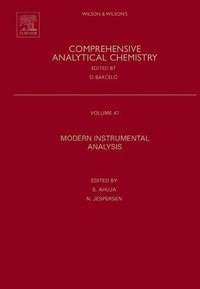
Modern Instrumental Analysis: Volume 47
Published on 17. October 2006
Book
Hardback
896 pages
978-0-444-52259-7 (ISBN)
Description
Modern Instrumental Analysis covers the fundamentals of instrumentation and provides a thorough review of the applications of this technique in the laboratory. It will serve as an educational tool as well as a first reference book for the practicing instrumental analyst. The text covers five major sections:1. Overview, Sampling, Evaluation of Physical Properties, and Thermal Analysis2. Spectroscopic Methods 3. Chromatographic Methods 4. Electrophoretic and Electrochemical Methods 5. Combination Methods, Unique Detectors, and Problem Solving Each section has a group of chapters covering important aspects of the titled subject, and each chapter includes applications that illustrate the use of the methods. The chapters also include an appropriate set of review questions.
More details
Series
Language
English
Place of publication
Oxford
United Kingdom
Publishing group
Elsevier Science & Technology
Target group
Professional and scholarly
For graduate students, laboratory personnel and managers in academia, industrial, and government laboratories
Product notice
Laminated cover
Dimensions
Height: 234 mm
Width: 156 mm
Thickness: 48 mm
Weight
1423 gr
ISBN-13
978-0-444-52259-7 (9780444522597)
Copyright in bibliographic data and cover images is held by Nielsen Book Services Limited or by the publishers or by their respective licensors: all rights reserved.
Schweitzer Classification
Other editions
Additional editions
Satinder Ahuja | Neil Jespersen
Modern Instrumental Analysis
E-Book
10/2006
Elsevier
€355.00
Available for download
Persons
Satinder Ahuja is a leading expert on water quality improvement. He earned his PhD in analytical chemistry from the University of the Sciences in Philadelphia. He worked for Novartis Corp. in various leadership positions for over 25 years and taught as an adjunct professor at Pace University for over 10 years. As president of Ahuja Consulting, he advises on water quality issues relating to chemicals and pharmaceuticals. A member of the executive committee of the Rivers of the World Foundation (ROW), Dr. Ahuja has organized numerous global symposia on improving water quality, including presentations for the American Chemical Society and UNESCO. Dr. Ahuja has published numerous papers and more than 25 books. His latest books are Contaminants in Our Water (ACS, 2020); Evaluating Water Quality to Prevent Future Disasters (Elsevier, 2019); Advances in Water Purification Techniques (Elsevier, 2019); and Chemistry and Water (Elsevier, 2017).
Content
Chapter 1. Overview (S. Ahuja).
Chapter 2. Sampling and sample preparation (S. Ahuja, D. Diehl).
Chapter 3. Evaluation of basic physical properties
(N. Jespersen).
Chapter 4. Thermal analysis (H.G. Brittain, R.D. Bruce).
Chapter 5. General principles of spectroscopy and spectroscopic analysis (N. Jespersen).
Chapter 6. Near-infrared spectroscopy (E.W. Ciurczak).
Chapter 7. X-ray diffraction and x-ray fluorescence
(H.G. Brittain).
Chapter 8. Atomic spectroscopy (T.H. Risby).
Chapter 9. Emission methods (C.H. Lochmueller).
Chapter 10. Nuclear magnetic resonance spectroscopy(L. Lohr et al.).
Chapter 11. Mass spectrometry (D.J. Burinsky).
Chapter 12. Theory of separation methods (C.H. Lochmueller).
Chapter 13. Thin-layer chromatography (P.M. Grillini).
Chapter 14. Gas chromatography (N.H. Snow).
Chapter 15. High-pressure liquid chromatography
(S. Ahuja).
Chapter 16. Supercritical fluid chromatography (M.E.P. McNally).
Chapter 17. Electromigration methods: origins, principles, and applications (M. Jimidar).
Chapter 18a. Potentiometry (M. Telting-Diaz, Yu Qin).
Chapter 18b.Voltammetry: Dynamic electrochemical techniques (A. Hussam).
Chapter 19. Hyphenated methods (T.R. Sharp, B.L. Marquez).
Chapter 20a. Optical sensors (E. Wang).
Chapter 20b. Bioactivity detectors (S.M. Ford).
Chapter 20c. Drug detectors (S.M. Ford).
Chapter 21. Problem solving and guidelines for method selection (A.H. Ullman, D.E. Raynie).
Chapter 2. Sampling and sample preparation (S. Ahuja, D. Diehl).
Chapter 3. Evaluation of basic physical properties
(N. Jespersen).
Chapter 4. Thermal analysis (H.G. Brittain, R.D. Bruce).
Chapter 5. General principles of spectroscopy and spectroscopic analysis (N. Jespersen).
Chapter 6. Near-infrared spectroscopy (E.W. Ciurczak).
Chapter 7. X-ray diffraction and x-ray fluorescence
(H.G. Brittain).
Chapter 8. Atomic spectroscopy (T.H. Risby).
Chapter 9. Emission methods (C.H. Lochmueller).
Chapter 10. Nuclear magnetic resonance spectroscopy(L. Lohr et al.).
Chapter 11. Mass spectrometry (D.J. Burinsky).
Chapter 12. Theory of separation methods (C.H. Lochmueller).
Chapter 13. Thin-layer chromatography (P.M. Grillini).
Chapter 14. Gas chromatography (N.H. Snow).
Chapter 15. High-pressure liquid chromatography
(S. Ahuja).
Chapter 16. Supercritical fluid chromatography (M.E.P. McNally).
Chapter 17. Electromigration methods: origins, principles, and applications (M. Jimidar).
Chapter 18a. Potentiometry (M. Telting-Diaz, Yu Qin).
Chapter 18b.Voltammetry: Dynamic electrochemical techniques (A. Hussam).
Chapter 19. Hyphenated methods (T.R. Sharp, B.L. Marquez).
Chapter 20a. Optical sensors (E. Wang).
Chapter 20b. Bioactivity detectors (S.M. Ford).
Chapter 20c. Drug detectors (S.M. Ford).
Chapter 21. Problem solving and guidelines for method selection (A.H. Ullman, D.E. Raynie).