

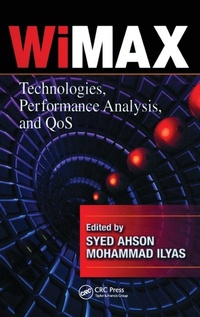
WiMAX
Technologies, Performance Analysis, and QoS
1st Edition
Published on 7. September 2007
Book
Hardback
294 pages
978-1-4200-4525-3 (ISBN)
Description
As the demand for broadband services continues to grow worldwide, traditional solutions, such as digital cable and fiber optics, are often difficult and expensive to implement, especially in rural and remote areas. The emerging WiMAX system satisfies the growing need for high data-rate applications such as voiceover IP, video conferencing, interactive gaming, and multimedia streaming. WiMAX deployments not only serve residential and enterprise users but can also be deployed as a backhaul for Wi-Fi hotspots or 3G cellular towers. By providing affordable wireless broadband access, the technology of WiMAX will revolutionize broadband communications in the developed world and bridge the digital divide in developing countries.
Part of the WiMAX Handbook, this volume focuses on the technologies behind WiMAX, its performance capabilities, and its control mechanisms. The book introduces programmable baseband processors suited for WiMAX systems, describes an innovative methodology for the design of multi-band WiMAX antennas, addresses space-time block codes, and reviews space-frequency/space-time-frequency code design criteria. It also proposes a combined call admission control and scheduling scheme, focuses on the performance analysis of the IEEE 802.16 mesh mode, and analyzes the performance of both single-input-single-output and space-time-block-coded OFDM systems in mobile environments. The final section establishes a framework of an ideal reservation period controller, examines the ecosystem in which scheduling for IEEE 802.16e systems must be performed, and presents a fuzzy logic controller for admission control.
With the revolutionary technology of WiMAX, the lives of many will undoubtedly improve, thereby leading to greater economic empowerment.
Part of the WiMAX Handbook, this volume focuses on the technologies behind WiMAX, its performance capabilities, and its control mechanisms. The book introduces programmable baseband processors suited for WiMAX systems, describes an innovative methodology for the design of multi-band WiMAX antennas, addresses space-time block codes, and reviews space-frequency/space-time-frequency code design criteria. It also proposes a combined call admission control and scheduling scheme, focuses on the performance analysis of the IEEE 802.16 mesh mode, and analyzes the performance of both single-input-single-output and space-time-block-coded OFDM systems in mobile environments. The final section establishes a framework of an ideal reservation period controller, examines the ecosystem in which scheduling for IEEE 802.16e systems must be performed, and presents a fuzzy logic controller for admission control.
With the revolutionary technology of WiMAX, the lives of many will undoubtedly improve, thereby leading to greater economic empowerment.
More details
Series
Language
English
Place of publication
Bosa Roca
United States
Publishing group
Taylor & Francis Inc
Target group
Professional and scholarly
Illustrations
119 s/w Abbildungen, 9 s/w Tabellen
9 Tables, black and white; 119 Illustrations, black and white
Dimensions
Height: 240 mm
Width: 161 mm
Thickness: 20 mm
Weight
608 gr
ISBN-13
978-1-4200-4525-3 (9781420045253)
Copyright in bibliographic data and cover images is held by Nielsen Book Services Limited or by the publishers or by their respective licensors: all rights reserved.
Schweitzer Classification
Other editions
Additional editions
E-Book
10/2018
CRC Press
€225.99
Available for download
Persons
Motorola Inc., Plantation, Florida, USA Florida Atlantic University, Boca Raton, USA
Content
Design of Baseband Processors for WiMAX Systems. Fractal Based Methodologies for WiMAX Antennas Design. Space-Time Coding and Application in WiMAX. Exploiting Diversity in MIMO-OFDM Systems for Broadband Wireless Communications. Performance Analysis of IEEE 802.16 Fixed Broadband Wireless Access Systems. System Performance Analysis for the Mesh Mode of IEEE 802.16. Performance Analysis and Simulations Results under Mobile Environments. IEEE 802.16 Multiple Access Control: Resources Allocation for Reservation-Based Traffic. Scheduling Algorithms for OFDMA-based WiMAX Systems with QoS Constraints. Resource Allocation and Admission Control Using Fuzzy Logic for OFDMA-Based IEEE 802.16 Broadband Wireless Networks.