

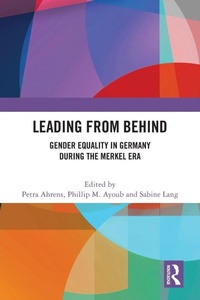
Leading from Behind
Gender Equality in Germany During the Merkel Era
1st Edition
Published on 26. August 2024
Book
Paperback/Softback
200 pages
978-1-032-40867-5 (ISBN)
Description
This book takes stock of German gender equality in several policy fields after 16 years of governments led by Angela Merkel and her conservative Christian Democratic Party (CDU). While maintaining its status as an economic engine in Europe, Germany has historically been a laggard in adopting gender equality measures. The European Gender Equality Index, however, now ranks Germany relatively high and shows substantial progress since 2005. While this has gone mostly unnoticed, Germany has passed far-reaching legislation in major policy fields relevant for gender equality.
Investigating the effects of Merkel's tenure on gender equality, the chapters in this volume assess policy output and outcomes with a focus on internal power dynamics in Germany, as well as international and European Union (EU)-level pressures in the policy domains of political representation, LGBTI rights, migration, the labor market, and care. It examines how policy measures introduced by conservative governments affect gender norms and gender culture, and if they ultimately lead to effective implementation and greater equality. The book argues that Merkel often led "from behind," indirectly facilitating claims-making instead of proactively pushing them. This nonetheless contributed to transformative change in Germany, by Merkel not blocking policy proposals and allowing civil society groups and rival parties to push many progressive gender policies.
Leading from Behind: Gender Equality in Germany During the Merkel Era is a fascinating read for students, researchers, and academics interested in European politics, political leadership, gender equality and LGBTI politics. This book was originally published as a special issue of German Politics.
Investigating the effects of Merkel's tenure on gender equality, the chapters in this volume assess policy output and outcomes with a focus on internal power dynamics in Germany, as well as international and European Union (EU)-level pressures in the policy domains of political representation, LGBTI rights, migration, the labor market, and care. It examines how policy measures introduced by conservative governments affect gender norms and gender culture, and if they ultimately lead to effective implementation and greater equality. The book argues that Merkel often led "from behind," indirectly facilitating claims-making instead of proactively pushing them. This nonetheless contributed to transformative change in Germany, by Merkel not blocking policy proposals and allowing civil society groups and rival parties to push many progressive gender policies.
Leading from Behind: Gender Equality in Germany During the Merkel Era is a fascinating read for students, researchers, and academics interested in European politics, political leadership, gender equality and LGBTI politics. This book was originally published as a special issue of German Politics.
More details
Language
English
Place of publication
London
United Kingdom
Publishing group
Taylor & Francis Ltd
Target group
College/higher education
Professional and scholarly
Academic, Postgraduate, and Undergraduate
Dimensions
Height: 234 mm
Width: 156 mm
Thickness: 12 mm
Weight
330 gr
ISBN-13
978-1-032-40867-5 (9781032408675)
Copyright in bibliographic data and cover images is held by Nielsen Book Services Limited or by the publishers or by their respective licensors: all rights reserved.
Schweitzer Classification
Other editions
Additional editions
Petra Ahrens | Phillip M. Ayoub | Sabine Lang
Leading from Behind
Gender Equality in Germany During the Merkel Era
E-Book
12/2022
1st Edition
Routledge
€55.49
Available for download
Petra Ahrens | Phillip M. Ayoub | Sabine Lang
Leading from Behind
Gender Equality in Germany During the Merkel Era
Book
12/2022
1st Edition
Routledge
€185.90
Shipment within 10-20 days
Petra Ahrens | Phillip M. Ayoub | Sabine Lang
Leading from Behind
Gender Equality in Germany During the Merkel Era
E-Book
12/2022
1st Edition
Routledge
€55.49
Available for download
Persons
Petra Ahrens is Academy of Finland Research Fellow at Tampere University, Finland. She focuses on gender equality in the EU and Germany, gender-sensitive parliaments, and transnational civil society. Alongside articles, she is the author of Actors, Institutions, and the Making of EU Gender Equality Programs (2018).
Phillip M. Ayoub is a professor in the Department of Political Science at University College London, UK. His research bridges insights from international relations and comparative politics, with a focus on transnational politics, sexuality politics, and the study of social movements. He is the author of When States Come Out (2016).
Sabine Lang is Jean Monnet Chair of Civil Society, Inclusion & Diversity in the European Union, and Professor of European & International Studies in the Henry M. Jackson School of International Studies at the University of Washington, USA. Her work focuses on gender politics and civil society in comparative perspective and in the EU.
Phillip M. Ayoub is a professor in the Department of Political Science at University College London, UK. His research bridges insights from international relations and comparative politics, with a focus on transnational politics, sexuality politics, and the study of social movements. He is the author of When States Come Out (2016).
Sabine Lang is Jean Monnet Chair of Civil Society, Inclusion & Diversity in the European Union, and Professor of European & International Studies in the Henry M. Jackson School of International Studies at the University of Washington, USA. Her work focuses on gender politics and civil society in comparative perspective and in the EU.
Content
Introduction: Leading from Behind? Gender Equality in Germany During the Merkel Era 1. Against All Odds: Angela Merkel, Ursula von der Leyen, Anngret Kramp-Karrenbauer and the German Paradox of Female CDU Leadership 2. Angela Merkel and the CDU Quota Curse 3. From Private Wrongs to Public Rights: The Politics of Intersex Activism in the Merkel Era 4. Marriage Equality in Germany: Conservative Normalisation Instead of Successful Anti-Gender Mobilisation 5. A Rainbow Bundestag? An Intersectional Analysis of LGBTI Representation in Angela Merkel's Germany 6. Gender and the Integration of Newcomers in Merkel's Germany 7. Angela Merkel's Record on Immigration and Gender 8. Game-Changers for Gender Equality in Germany's Labour Market? Corporate Board Quotas, Pay Transparency and Temporary Part-Time Work 9. Gender Equality in the Field of Care: Policy Goals and Outcomes During the Merkel Era