

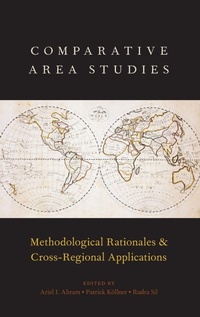
Comparative Area Studies
Methodological Rationales and Cross-Regional Applications
Published on 15. March 2018
Book
Hardback
322 pages
978-0-19-084637-4 (ISBN)
Description
In the post-World War II era, the emergence of 'area studies' marked a signal development in the social sciences. As the social sciences evolved methodologically, however, many dismissed area studies as favoring narrow description over general theory. Still, area studies continues to plays a key, if unacknowledged, role in bringing new data, new theories, and valuable policy-relevant insights to social sciences. In Comparative Area Studies, three leading figures in the field have gathered an international group of scholars in a volume that promises to be a landmark in a resurgent field. The book upholds two basic convictions: that intensive regional research remains indispensable to the social sciences and that this research needs to employ comparative referents from other regions to demonstrate its broader relevance. Comparative Area Studies (CAS) combines the context-specific insights from traditional area studies and the logic of cross- and inter-regional empirical research. This first book devoted to CAS explores methodological rationales and illustrative applications showing how area-based expertise can link into cutting-edge comparative analytical frameworks.
Reviews / Votes
"This book offers a bold, original, and necessary statement about the dual promise of comparative area studies research: new theoretical insights of broad utility and novel understandings of particular cases from multiple world regions."-James Mahoney, Northwestern University"This volume stakes out a new and provocative position in the old debate between social science and area studies. The contributions are clear-eyed about the challenges of this style of work, but make a compelling case that it belongs in the comparativist's toolkit." - Thomas Pepinsky, Cornell University
"Comparative Area Studies poses challenges that future generations of comparative research will need to confront. Researchers in the field may take issue with the balance that various authors strike between contextualization and theory, or even with whether it is possible for an integrated methodological framework to reconcile these often contradictory concerns. But anyone who grapples with the fundamental issues that the contributors address, and
everyone who seeks a guide for how to design comparative research, will benefit from a close reading of this instructive collection." - Jefferey M. Sellers, University of Southern California
More details
Language
English
Place of publication
New York
United States
Target group
Professional and scholarly
Dimensions
Height: 240 mm
Width: 161 mm
Thickness: 22 mm
Weight
649 gr
ISBN-13
978-0-19-084637-4 (9780190846374)
Copyright in bibliographic data and cover images is held by Nielsen Book Services Limited or by the publishers or by their respective licensors: all rights reserved.
Schweitzer Classification
Other editions
Additional editions
Ariel I. Ahram | Patrick Koellner | Rudra Sil
Comparative Area Studies
Methodological Rationales and Cross-Regional Applications
Book
03/2018
Oxford University Press Inc
€53.40
Shipment within 15-20 days
Ariel I. Ahram | Patrick Köllner | Rudra Sil
Comparative Area Studies
Methodological Rationales and Cross-Regional Applications
E-Book
01/2018
OUP eBook
€23.99
Available for download
Ariel I. Ahram | Patrick Köllner | Rudra Sil
Comparative Area Studies
Methodological Rationales and Cross-Regional Applications
E-Book
01/2018
OUP eBook
€23.99
Available for download
Persons
Ariel I. Ahram is associate professor of government and international affairs in Virginia Tech's School of Public and International Affairs.
Patrick Koellner is vice president of the German Institute of Global and Area Studies (GIGA), director of the GIGA Institute of Asian Studies, and professor of political science at the University of Hamburg, Germany.
Rudra Sil is professor of political science at the University of Pennsylvania where he is also SAS Director of the Huntsman Program in International Studies & Business.
Patrick Koellner is vice president of the German Institute of Global and Area Studies (GIGA), director of the GIGA Institute of Asian Studies, and professor of political science at the University of Hamburg, Germany.
Rudra Sil is professor of political science at the University of Pennsylvania where he is also SAS Director of the Huntsman Program in International Studies & Business.
Content
Introduction
1. Comparative Area Studies: What It Is, What It Can Do
Patrick Koellner, Rudra Sil and Ariel I. Ahram
Part One: What Comparative Area Studies Brings to the Table
2. Comparative Area Studies: The Golden Mean between Area Studies and Universalist Approaches?
Dirk Berg-Schlosser
3. Depth-Perception: Improving Analytical Focus Through Cross- and Inter-regional Comparisons
Laurence Whitehead
4. Comparing Across World Regions: Assets and Pitfalls
Christian von Soest and Alexander Stroh
5. Context, Concepts, and Comparison in Southeast Asia
Mikko Huotari and Juergen Rueland
6. American Political Development in the Mirror of Europe: Democracy Expansion and
the Evolution of Electoral Systems in the 19th Century
Amel Ahmed
7. Comparative Area Studies and the Study of Middle East Politics after the Arab Uprisings
Andre Bank
Part Two: CAS in Action: Leveraging Cross-Regional Comparison
8. Comparing Post-Communist Authoritarianism in Russia and China:
The Case of Anti-Corruption Campaigns
Cheng Chen
9. Comparative Area Studies and the Analytical Challenge of Diffusion: Explaining Outcomes
in the Arab Spring and Beyond
Ariel I. Ahram
10. Comparing Separatism Across Regions: Rebellious Legacies in Aceh, Balochistan and Kurdistan
Benjamin Smith
11. Gaining by Shedding Case Selection Strictures: Natural Resource Booms and
Institution Building in Latin America and Africa
Ryan Saylor
12. Organizing Production Across Regions: The Wenzhou Model in China and Italy
Calvin P. Chen
Conclusion
13. Triangulating Area Studies, Not Just Methods: How Cross-Regional Comparison Aids
Qualitative and Mixed-Method Research
Rudra Sil
Bibliography
1. Comparative Area Studies: What It Is, What It Can Do
Patrick Koellner, Rudra Sil and Ariel I. Ahram
Part One: What Comparative Area Studies Brings to the Table
2. Comparative Area Studies: The Golden Mean between Area Studies and Universalist Approaches?
Dirk Berg-Schlosser
3. Depth-Perception: Improving Analytical Focus Through Cross- and Inter-regional Comparisons
Laurence Whitehead
4. Comparing Across World Regions: Assets and Pitfalls
Christian von Soest and Alexander Stroh
5. Context, Concepts, and Comparison in Southeast Asia
Mikko Huotari and Juergen Rueland
6. American Political Development in the Mirror of Europe: Democracy Expansion and
the Evolution of Electoral Systems in the 19th Century
Amel Ahmed
7. Comparative Area Studies and the Study of Middle East Politics after the Arab Uprisings
Andre Bank
Part Two: CAS in Action: Leveraging Cross-Regional Comparison
8. Comparing Post-Communist Authoritarianism in Russia and China:
The Case of Anti-Corruption Campaigns
Cheng Chen
9. Comparative Area Studies and the Analytical Challenge of Diffusion: Explaining Outcomes
in the Arab Spring and Beyond
Ariel I. Ahram
10. Comparing Separatism Across Regions: Rebellious Legacies in Aceh, Balochistan and Kurdistan
Benjamin Smith
11. Gaining by Shedding Case Selection Strictures: Natural Resource Booms and
Institution Building in Latin America and Africa
Ryan Saylor
12. Organizing Production Across Regions: The Wenzhou Model in China and Italy
Calvin P. Chen
Conclusion
13. Triangulating Area Studies, Not Just Methods: How Cross-Regional Comparison Aids
Qualitative and Mixed-Method Research
Rudra Sil
Bibliography