

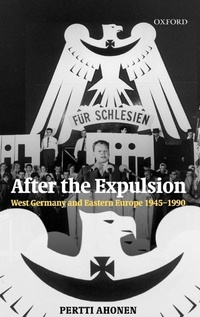
After the Expulsion
West Germany and Eastern Europe 1945-1990
Published on 6. November 2003
Book
Hardback
324 pages
978-0-19-925989-2 (ISBN)
Description
This book breaks new ground by connecting two central problems faced by the Federal Republic of Germany prior to reunification in 1990, both of them rooted in the Second World War. Domestically, the country had to integrate eight million expellees forced out of their homes in Central and Eastern Europe as a result of the lost war. Externally, it had to re-establish relations with Eastern Europe, despite the burdens of the Nazi past, the expulsions, and the ongoing East-West struggle in the Cold War. This study shows how the long-term consequences of the expellee problem significantly hindered West German efforts to develop normal ties to the East European states. In particular, it emphasizes a point largely overlooked in the existing literature: the way in which the political integration of the expellees into the Federal Republic had unanticipated negative consequences for the country's Ostpolitik.
Reviews / Votes
...an easily accessible and very readable contribution * Thomas Horber, Francia 32/3 * ...superb... * Annual Bulletin of Historical Literature *More details
Language
English
Place of publication
Oxford
United Kingdom
Target group
Professional and scholarly
Dimensions
Height: 240 mm
Width: 161 mm
Thickness: 22 mm
Weight
652 gr
ISBN-13
978-0-19-925989-2 (9780199259892)
Copyright in bibliographic data and cover images is held by Nielsen Book Services Limited or by the publishers or by their respective licensors: all rights reserved.
Schweitzer Classification
Person
Content
Introduction ; PART I. ESTABLISHING THE PATTERN 1949-1955 ; 1. From the Expulsions to the Rise of the Expellee Organizations ; 2. The Programmes and Strategies of the Expellee Organizations ; 3. The Responses and Policies of the Main Parties ; 4. Adenauer's Foreign Policy and the Expellees ; PART II. THE PATTERN IN PRACTICE 1949-1966 ; 5. Ostpolitik Options and Expellee Influence 1955-1959 ; 6. Ostpolitik Options and Expellee Influence 1959-1966 ; PART III. THE COLLAPSE OF THE PATTERN 1966-1969 ; 7. The Grand Coalition as the Turning-Point 1966-1969 ; 8. From the New Ostpolitik to Reunification 1969-1970 ; Conclusion ; Bibliography ; Index