

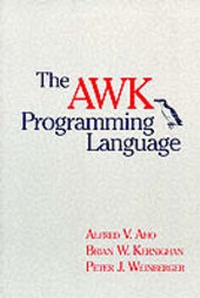
The AWK Programming Language
Published on 1. January 1988
Book
Hardback
224 pages
978-0-201-07981-4 (ISBN)
Description
Originally developed by Alfred Aho, Brian Kernighan, and Peter Weinberger in 1977, AWK is a pattern-matching language for writing short programs to perform common data-manipulation tasks. In 1985, a new version of the language was developed, incorporating additional features such as multiple input files, dynamic regular expressions, and user-defined functions. This new version is available for both Unix and MS-DOS. This is the first book on AWK. It begins with a tutorial that shows how easy AWK is to use. The tutorial is followed by a comprehensive manual for the new version of AWK. Subsequent chapters illustrate the language by a range of useful applications, such as: *Retrieving, transforming, reducing, and validating data *Managing small, personal databases *Text processing *Little languages *Experimenting with algorithms The examples illustrates the book's three themes: showing how to use AWK well, demonstrating AWK's versatility, and explaining how common computing operations are done. In addition, the book contains two appendixes: summary of the language, and answers to selected exercises. 020107981XB04062001
More details
Other editions
New editions
Alfred Aho | Alfred V. Aho | Brian W. Kernighan
The AWK Programming Language
Book
10/2023
2nd Edition
Addison Wesley
€39.49
Shipment within 15-20 days
Persons
Brian W. Kernighan works in the Computing Science Research Center at Bell Laboratories, Lucent Technologies. He is Consulting Editor for Addison-Wesley's Professional Computing Series and the author, with Dennis Ritchie, of The C Programming Language.
020107981XAB04062001
020107981XAB04062001
Content
Preface.
1. An AWK Tutorial.
Getting Started.
Simple Output.
Fancier Output.
Selection.
Computing with AWK.
Control-Flow Statements.
Arrays.
A Handful of Useful "One-liners."
What Next?
2. The AWK Lanaguage.
Patterns.
Actions.
User-Defined Functions.
Output.
Input.
Interaction with Other Programs.
Summary.
3. Data Processing.
Data Transformation and Reduction.
Data Validation.
Bundle and Unbundle.
Multiline Records.
Summary.
4. Reports and Databases.
Generating Reports.
Packaged Queries.
A Relational Database System.
Summary.
5. Processing Words.
Random Text Generation.
Interactive Text-Manipulation.
Text Processing.
Summary.
6. Little Languages.
An Assembler and Interpreter.
A Language for Drawing Graphs.
A Sort Generator.
A Reverse-Polish Calculator.
An Infix Calculator.
Recursive-Descent Parsing.
Summary.
7. Experiments with Algorithms.
Sorting.
Profiling.
Topological Sorting.
Make: A File Updating Program.
Summary.
8. Epilog.
AWK as a Language.
Performance.
Conclusion.
Appendix A: AWK Summary.
Appendix B: Answers to Selected Exercises.
Index.
1. An AWK Tutorial.
Getting Started.
Simple Output.
Fancier Output.
Selection.
Computing with AWK.
Control-Flow Statements.
Arrays.
A Handful of Useful "One-liners."
What Next?
2. The AWK Lanaguage.
Patterns.
Actions.
User-Defined Functions.
Output.
Input.
Interaction with Other Programs.
Summary.
3. Data Processing.
Data Transformation and Reduction.
Data Validation.
Bundle and Unbundle.
Multiline Records.
Summary.
4. Reports and Databases.
Generating Reports.
Packaged Queries.
A Relational Database System.
Summary.
5. Processing Words.
Random Text Generation.
Interactive Text-Manipulation.
Text Processing.
Summary.
6. Little Languages.
An Assembler and Interpreter.
A Language for Drawing Graphs.
A Sort Generator.
A Reverse-Polish Calculator.
An Infix Calculator.
Recursive-Descent Parsing.
Summary.
7. Experiments with Algorithms.
Sorting.
Profiling.
Topological Sorting.
Make: A File Updating Program.
Summary.
8. Epilog.
AWK as a Language.
Performance.
Conclusion.
Appendix A: AWK Summary.
Appendix B: Answers to Selected Exercises.
Index.