

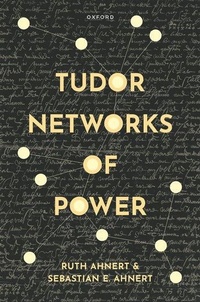
Tudor Networks of Power
Published on 12. October 2023
Book
Hardback
304 pages
978-0-19-885897-3 (ISBN)
Description
Tudor Networks of Power is the product of a groundbreaking collaboration between an early modern book historian and a physicist specializing in complex networks. Together they have reconstructed and computationally analysed the networks of intelligence, diplomacy, and political influence across a century of Tudor history (1509-1603), based on the British State Papers.
The 130,000 letters that survive in the State Papers from the Tudor period provide crucial information about the textual organization of the social network centred on the Tudor government. Whole libraries have been written using this archive, but until now nobody has had access to the macroscopic tools that allow us to ask questions such as: What are the reasons for the structure of the Tudor government's intelligence network? What was it geographical reach and coverage? Can we use network data to show patterns of surveillance? What role did women play in these government networks? And what biases are there in the data?
The authors employ methods from the field of network science, translating key concepts and approaches into a language accessible to literary scholars and historians, and illustrating them with examples drawn from this fantastically rich archive. Each chapter is the product of a set of thematically organized 'experiments', which show how particular methods can help to ask and answer research questions specific to the State Papers archive, but also have applications for other large bodies of humanities data. The fundamental aim of this book, therefore, is not merely to provide an innovative perspective on Tudor politics; it also aspires to introduce an entirely new audience to the methods and applications of network science, and to suggest the suitability of these methods for a range of humanistic inquiry.
The 130,000 letters that survive in the State Papers from the Tudor period provide crucial information about the textual organization of the social network centred on the Tudor government. Whole libraries have been written using this archive, but until now nobody has had access to the macroscopic tools that allow us to ask questions such as: What are the reasons for the structure of the Tudor government's intelligence network? What was it geographical reach and coverage? Can we use network data to show patterns of surveillance? What role did women play in these government networks? And what biases are there in the data?
The authors employ methods from the field of network science, translating key concepts and approaches into a language accessible to literary scholars and historians, and illustrating them with examples drawn from this fantastically rich archive. Each chapter is the product of a set of thematically organized 'experiments', which show how particular methods can help to ask and answer research questions specific to the State Papers archive, but also have applications for other large bodies of humanities data. The fundamental aim of this book, therefore, is not merely to provide an innovative perspective on Tudor politics; it also aspires to introduce an entirely new audience to the methods and applications of network science, and to suggest the suitability of these methods for a range of humanistic inquiry.
Reviews / Votes
I enthusiastically recommend Tudor Networks of Power, especially for grad students and younger researchers in the digital humanities. The authors' description of this project provides useful information for academics and other analysts who wish to perform network and link analysis, especially on data sets that require significant processing. * Technology and Society Book Reviews *More details
Language
English
Place of publication
Oxford
United Kingdom
Target group
College/higher education
Illustrations
60 b&w/colour figures/illustrations
Dimensions
Height: 251 mm
Width: 175 mm
Thickness: 21 mm
Weight
754 gr
ISBN-13
978-0-19-885897-3 (9780198858973)
Copyright in bibliographic data and cover images is held by Nielsen Book Services Limited or by the publishers or by their respective licensors: all rights reserved.
Schweitzer Classification
Other editions
Additional editions
Ruth Ahnert | Sebastian E. Ahnert
Tudor Networks of Power
E-Book
02/2024
1st Edition
OUP eBook
€33.99
Available for download
Ruth Ahnert | Sebastian E. Ahnert
Tudor Networks of Power
E-Book
11/2023
1st Edition
OUP eBook
€33.99
Available for download
Persons
Ruth Ahnert is Professor of Literary History and Digital Humanities at Queen Mary University of London. Her work focuses on Tudor culture, book history, and digital humanities. She is author of The Rise of Prison Literature in the Sixteenth Century (2013), and co-author of The Network Turn: Changing Perspectives in the Humanities (2020). Recent collaborative work has taken place through AHRC-funded projects 'Living with Machines' and 'Networking the Archives: Assembling and analysing a meta-archive of correspondence, 1509-1714'. With Elaine Treharne she is series editor of Stanford University Press's Text Technologies series.
Sebastian Ahnert is a University Lecturer at the Department of Chemical Engineering & Biotechnology, University of Cambridge, and a Senior Research Fellow at The Alan Turing Institute in London. He gained his PhD in theoretical physics from the University of Cambridge and then undertook postdoctoral research at the Institut Curie in Paris, before returning to Cambridge for a Leverhulme Fellowship, followed by a Royal Society University Research Fellowship and a Gatsby Career Development Fellowship. His research interests lie in the intersection of theoretical physics, biology, mathematics, and computer science, with a particular interest in the interdisciplinary application of network analysis. He has published over sixty articles across a wide range of academic journals in the sciences and humanities. The Network Turn: Changing Perspectives in the Humanities, which he co-authored with Ruth Ahnert, Catherine Nicole Coleman, and Scott B. Weingart was published in 2020.
Sebastian Ahnert is a University Lecturer at the Department of Chemical Engineering & Biotechnology, University of Cambridge, and a Senior Research Fellow at The Alan Turing Institute in London. He gained his PhD in theoretical physics from the University of Cambridge and then undertook postdoctoral research at the Institut Curie in Paris, before returning to Cambridge for a Leverhulme Fellowship, followed by a Royal Society University Research Fellowship and a Gatsby Career Development Fellowship. His research interests lie in the intersection of theoretical physics, biology, mathematics, and computer science, with a particular interest in the interdisciplinary application of network analysis. He has published over sixty articles across a wide range of academic journals in the sciences and humanities. The Network Turn: Changing Perspectives in the Humanities, which he co-authored with Ruth Ahnert, Catherine Nicole Coleman, and Scott B. Weingart was published in 2020.
Content
Foreword Part I: Groundwork 1: Tudor Letters in the Digital Age 2: The Shape of the Archive Part II: Structure 3: Betweenness 4: Network Profiles and 'Intelligence Producers' 5: Surveillance Measures 6: Women: Petitioning, Power, and Mediation Part III: Movement 7: Information Flow 8: Itineraries Afterword