

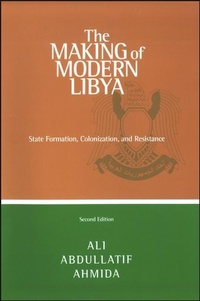
The Making of Modern Libya
2nd Edition
Published on 18. November 2009
Book
Hardback
276 pages
978-1-4384-2891-8 (ISBN)
Description
Second edition of the provocative study analyzing the social, cultural, and historical roots of modern Libya.
The Making of Modern Libya is a thorough examination of the social, cultural, and historical background of modern Libya. Ali Abdullatif Ahmida examines the reaction of the ordinary Libyan people to colonialism and nationalism, from the early nineteenth century through the end of anticolonial resistance, to the rise of the modern Libyan state in 1951. Weaving together insights drawn from Arabic, French, English, and Italian sources, he challenges Eurocentric theories of social change that ignore the internal dynamics of native social history. Among other things, he shows that Sufi Islam, tribal military organization, and oral traditions were crucial in the fight against colonialism. The political and cultural legacy of the resistance has been powerful, strengthening Libyan nationalism and leading to the revival of strong attachments to Islam. The memory of this period has not yet faded, and appreciation of this background is essential to understanding modern Libya. This new edition also investigates Libya's postcolonial nationalist policies, bringing the argument up to the present.
The Making of Modern Libya is a thorough examination of the social, cultural, and historical background of modern Libya. Ali Abdullatif Ahmida examines the reaction of the ordinary Libyan people to colonialism and nationalism, from the early nineteenth century through the end of anticolonial resistance, to the rise of the modern Libyan state in 1951. Weaving together insights drawn from Arabic, French, English, and Italian sources, he challenges Eurocentric theories of social change that ignore the internal dynamics of native social history. Among other things, he shows that Sufi Islam, tribal military organization, and oral traditions were crucial in the fight against colonialism. The political and cultural legacy of the resistance has been powerful, strengthening Libyan nationalism and leading to the revival of strong attachments to Islam. The memory of this period has not yet faded, and appreciation of this background is essential to understanding modern Libya. This new edition also investigates Libya's postcolonial nationalist policies, bringing the argument up to the present.
More details
Series
Edition
Second Edition
Language
English
Place of publication
Albany, NY
United States
Target group
Professional and scholarly
US School Grade: College Graduate Student and over
Product notice
sewn/stitched
Cloth over boards
With dust jacket
Illustrations
5 Figures; 3 Maps
Dimensions
Height: 231 mm
Width: 155 mm
Thickness: 25 mm
Weight
522 gr
ISBN-13
978-1-4384-2891-8 (9781438428918)
Copyright in bibliographic data and cover images is held by Nielsen Book Services Limited or by the publishers or by their respective licensors: all rights reserved.
Schweitzer Classification
Other editions
Additional editions
Ali Abdullatif Ahmida
The Making of Modern Libya
E-Book
03/2011
2nd Edition
State University of New York Press
€36.49
Available for download
Person
Ali Abdullatif Ahmida is Professor of Political Science at the University of New England. He is the author of Forgotten Voices: Power and Agency in Colonial and Postcolonial Libya and the editor of Beyond Colonialism and Nationalism in the Maghrib: History, Culture, and Politics.
Content
List of Illustrations
Acknowledgments
Abbreviations
A Note on the Transliteration
Preface to the Second Edition
Introduction
1. Ecological and Social Origins of Regionalism and Pastoralism: The Myth of the Hilali Conquest
2. Ottoman Social Formation: A Trading and Communal Political Economy, 1830-1911
3. Markets, States, and Class Formation in Tripolitania and Fezzan, 1830-1911
4. The Political Economy of the Sanusiyya: Religion, Trade, and State Formation
5. Reactions to Colonialism: The Politics of Collaboration and Resistance, 1911-1932
Conclusion: Toward the Recovery of Libya's Civil Society
Afterword
Appendixes
Appendix A. The Rates of Exchange of Other Currencies
Appendix B. Libya's Major Trading Partners, 1885-1910
Appendix C. Volume of Libyan Exports and Imports in 1900
Appendix D. Trading Partners 1899-1902; Imports
Appendix E. Major Trading Partners; Libyan Exports
Appendix F. Transit Trade Export from Tripoli (1862-1904)
Notes
Glossary
References
Index
Acknowledgments
Abbreviations
A Note on the Transliteration
Preface to the Second Edition
Introduction
1. Ecological and Social Origins of Regionalism and Pastoralism: The Myth of the Hilali Conquest
2. Ottoman Social Formation: A Trading and Communal Political Economy, 1830-1911
3. Markets, States, and Class Formation in Tripolitania and Fezzan, 1830-1911
4. The Political Economy of the Sanusiyya: Religion, Trade, and State Formation
5. Reactions to Colonialism: The Politics of Collaboration and Resistance, 1911-1932
Conclusion: Toward the Recovery of Libya's Civil Society
Afterword
Appendixes
Appendix A. The Rates of Exchange of Other Currencies
Appendix B. Libya's Major Trading Partners, 1885-1910
Appendix C. Volume of Libyan Exports and Imports in 1900
Appendix D. Trading Partners 1899-1902; Imports
Appendix E. Major Trading Partners; Libyan Exports
Appendix F. Transit Trade Export from Tripoli (1862-1904)
Notes
Glossary
References
Index