

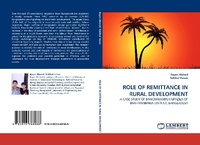
Role of Remittance in Rural Development
A CASE STUDY OF BANCHARAMPUR UPAZILA OF BRAHMANBARIA DISTRICT, BANGLADESH
Published on 28. October 2010
Book
Paperback/Softback
116 pages
978-3-8433-6898-8 (ISBN)
Description
Over the past 25 years labour migration from Bangladesh has registered a steady increase. From 1990 onwards on an average 2,25,000 Bangladeshis are migrating on short-term employment. The recent trend of the bulk of the migrants is more towards semi and unskilled labour migration. Major outflow of Bangladeshi labour generated significant financial flow to the country in the form of remittance. However, due to increase in the flow of unskilled and semi- skilled labour, remittance is increasing at a much lower rate than the labour flow. Remittance is crucial for Bangladesh''s economy. It constitutes almost one-third of the foreign exchange earning. In 1998-99, remittance contributed 22 percent in financing imports. Studies have shown it has strong positive impact on GDP, and also on consumption and investment. This research assesses to identify the role of remittance in rural development. It also evaluates current uses and impacts of remittance, the characteristics of remittance sending and remittance receiving persons. The research also explores the problems and possible potentials in effective uses of remittance for rural development through investment in productive sectors.
More details
Language
English
Place of publication
Germany
Product notice
Paperback (trade)
Unsewn / adhesive bound
Dimensions
Height: 220 mm
Width: 150 mm
Thickness: 7 mm
Weight
191 gr
ISBN-13
978-3-8433-6898-8 (9783843368988)
Copyright in bibliographic data and cover images is held by Nielsen Book Services Limited or by the publishers or by their respective licensors: all rights reserved.
Schweitzer Classification
Persons
Bayes Ahmed is studying (Erasmus Mundus) Masters of Science in Geospatial Technologies. Rakibul Hasan is doing Masters in Spatial Planning and Development in Umeå University, Sweden. Both authors completed Bachelor from the Department of Urban and Regional Planning, Bangladesh University of Engineering and Technology (BUET), Dhaka, Bangladesh.