

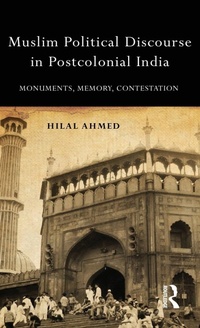
Muslim Political Discourse in Postcolonial India
Monuments, Memory, Contestation
1st Edition
Published on 8. August 2014
Book
Hardback
344 pages
978-1-138-02016-0 (ISBN)
Description
The book examines the postcolonial Muslim political discourse through monuments. It establishes a link between the process by which historic buildings become monuments and the gradual transformation of these historic/legal entities into political objects. The author studies the multiple interpretations of Indo-Islamic historical buildings as 'political sites' as well as emerging Muslim religiosities and the internal configurations of Muslim politics in India. He also looks at the modes by which a memory of a royal Muslim past is articulated for political mobilisation.
Raising critical questions such as whether Muslim responses to political questions are homogenous, the book will greatly interest researchers and students of political science, modern Indian history, sociology, as well as the general reader interested in contemporary India.
Raising critical questions such as whether Muslim responses to political questions are homogenous, the book will greatly interest researchers and students of political science, modern Indian history, sociology, as well as the general reader interested in contemporary India.
Reviews / Votes
'Hilal Ahmed's book is a pioneering exploration of the politics of historical monuments, an interdisciplinary work linking the analysis of law, history and politics. It offers a remarkable analysis of the ways in which reinterpreted images of the past work as resources for mobilization and action in the political present. The book also offers a fascinating analysis of the politics around the Jama Masjid in Delhi - showing how religious monuments transform into sites of the political public sphere. Ahmed provides an insightful examination of the construction of historical memory and a sophisticated exploration of the complex effects of democratic mobilization on the political identity of Indian Muslims.'-Sudipta Kaviraj, Professor of Indian Politics and Intellectual History, Middle Eastern, South Asian and African Studies, Columbia University, New York'What could be more concrete, more singular in meaning than a building? In fact, many different actors have made signage, use, disputation, and rituals have made India's built past centrally important in defining nationalism and belonging. Citizens absorb the assumptions of national identities as wholly natural, and the historical meanings attached to sites and buildings are part of those identities. Hilal Ahmed's book provides a fresh and original analysis to understanding cultural and political life in India's culturally plural society today.'-Barbara Metcalf, Professor of History Emerita, University of California, Davis
'Hilal Ahmed analyses the way in which political groups, both Hindu and Muslim, have used the great monuments of the Indo-Islamic tradition for political mobilisation. His book is one of the most important and innovative pieces of research of recent times. No scholar in the field should ignore it.'-Francis Robinson, Professor of the History of South Asia, Royal Holloway, University of London
'Ahmed's study is exceptionally successful in placing Indian Muslim political discourses into the wider context of postcolonial socio-political processes without having to compromise with the internal dynamics of the community" - Jahfar Shareef, Centre for the Study of Social Systems, Jawaharlal Nehru University, New Delhi (South Asia Research)
"A highly significant contribution to a comprehensive understanding of the political significance of India's Islamic architecture." - Santhi Kavuri-Bauer, South Asia: Journal of South Asian Studies Vol. 39, 301-302
More details
Language
English
Place of publication
London
United Kingdom
Publishing group
Taylor & Francis Ltd
Target group
College/higher education
Product notice
Unsewn / adhesive bound
Paper over boards
With dust jacket
Dimensions
Height: 222 mm
Width: 145 mm
Thickness: 22 mm
Weight
567 gr
ISBN-13
978-1-138-02016-0 (9781138020160)
Copyright in bibliographic data and cover images is held by Nielsen Book Services Limited or by the publishers or by their respective licensors: all rights reserved.
Schweitzer Classification
Other editions
New editions
Book
approx. 12/2025
2nd Edition
Routledge India
€208.20
Not yet published
Additional editions
Book
04/2019
1st Edition
Routledge India
€55.00
Shipment within 15-20 days
Person
Hilal Ahmed is Assistant Professor, Centre for the Study of Developing Societies (CSDS), New Delhi.
Content
Preface. Acknowledgements. 1. Introduction 2. Monumentalisation in Colonial India: Discovery of an 'Indian Muslim Architectural Heritage' 3. Monumentalisation in Postcolonial India: Conservation, Law and Muslim Politics 4. Jama Masjid and the Political Memory of a Royal Muslim Past 5. Babri Masjid and the Muslim Politics of Right to Heritage 6. Conclusion. Appendices. Select Bibliography. About the Author. Index