

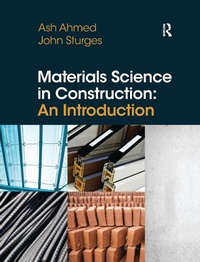
Materials Science In Construction: An Introduction
An Introduction
1st Edition
Published on 2. November 2015
Book
Hardback
394 pages
978-1-138-16841-1 (ISBN)
Description
Materials Science in Construction explains the science behind the properties and behaviour of construction's most fundamental materials (metals, cement and concrete, polymers, timber, bricks and blocks, glass and plaster). In particular, the critical factors affecting in situ materials are examined, such as deterioration and the behaviour and durability of materials under performance. An accessible, easy-to-follow approach makes this book ideal for all diploma and undergraduate students on construction-related courses taking a module in construction materials.
More details
Language
English
Place of publication
London
United Kingdom
Publishing group
Taylor & Francis Ltd
Target group
College/higher education
Illustrations
291 s/w Abbildungen, 39 s/w Tabellen
39 Tables, black and white; 291 Illustrations, black and white
Dimensions
Height: 260 mm
Width: 208 mm
Thickness: 26 mm
Weight
1069 gr
ISBN-13
978-1-138-16841-1 (9781138168411)
Copyright in bibliographic data and cover images is held by Nielsen Book Services Limited or by the publishers or by their respective licensors: all rights reserved.
Schweitzer Classification
Other editions
Additional editions
Book
11/2014
1st Edition
Elsevier
€94.70
Shipment within 10-15 days
Arshad Ahmed | John Sturges
Materials Science In Construction: An Introduction
E-Book
11/2014
1st Edition
Routledge
€86.99
Available for download
Arshad Ahmed | John Sturges
Materials Science In Construction: An Introduction
E-Book
11/2014
1st Edition
Routledge
€86.99
Available for download
Persons
Ash Ahmed is a senior lecturer in construction materials science and module leader of several undergraduate and postgraduate materials science modules at the School of the Built Environment and Engineering at Leeds Beckett University. His research specialises in the evaluation of the mechanical and physical properties of commercial materials as well as novel sustainable materials in civil engineering.
John Sturges is a visiting professor at the School of the Built Environment and Engineering at Leeds Beckett University. His research interests include the environmental impact of materials, the energy efficiency of buildings and the whole area of sustainability and its impact on UK industry.
John Sturges is a visiting professor at the School of the Built Environment and Engineering at Leeds Beckett University. His research interests include the environmental impact of materials, the energy efficiency of buildings and the whole area of sustainability and its impact on UK industry.
Content
1. Introduction to Materials Part 1: Basic Principles - Materials Structures and Properties 2. Atomic Structure/Arrangement 3. Dislocations, Imperfections & Strengthening Mechanisms 5. Microstructure/Phase Transformation 6. Thermal Properties of Materials 7. Structures Part 2: Individual Types & Classes of MaterialsMetals 8. Ferrous Metals 9. Non-ferrous Metals Inorganics 10. Glass 11. Concrete and Cement 12. Bricks and Mortar 13. Autoclaved Aerated Concrete Organics 14. Polymer Structures 15. Characteristics, Applications and Processing of Polymers 16. Timber 17. Soils 18. Composite Materials Part 3: In-Service Aspects of Materials - Durability and Failure 19. Failure 1: Effects of Stress & Applied Loadings 20. Failure 2: Effects of Environmental Degradation 21. Failure 3: Effects of Fire Part 4: Conclusion - Sustainability of Materials 22. Environmental Impact of Materials