

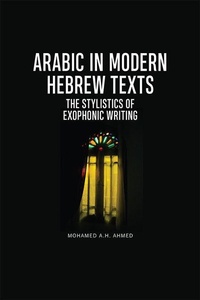
Arabic in Modern Hebrew Texts
The Stylistics of Exophonic Writing
Published on 16. October 2019
Book
Hardback
200 pages
978-1-4744-4443-9 (ISBN)
Description
In the late 1950s, Iraqi Jews were either forced or chose to leave Iraq for Israel. Finding it impossible to continue writing in Arabic in Israel, many Iraqi Jewish novelists faced the literary challenge of switching to Hebrew. Focusing on the literary works of the writers Shimon Ballas, Sami Michael and Eli Amir, this book examines their use of their native Iraqi Arabic in their Hebrew works. It examines the influence of Arabic language and culture and explores questions of language, place and belonging from the perspective of sociolinguistics and multilingualism.
In addition Ahmed applies stylistics as a framework to investigate the range of linguistic phenomena that can be found in these exophonic texts, such as code-switching, borrowing, language and translation strategies. This new stylistic framework for analysing exophonic texts offers a future model for the study of other languages.
The social and political implications of this dilemma, as it finds expression in creative writing, are also manifold. In an age of mass migration and population displacement, the conflicted loyalties explored in this book through the prism of Arabic and Hebrew are relevant in a range of linguistic contexts.
In addition Ahmed applies stylistics as a framework to investigate the range of linguistic phenomena that can be found in these exophonic texts, such as code-switching, borrowing, language and translation strategies. This new stylistic framework for analysing exophonic texts offers a future model for the study of other languages.
The social and political implications of this dilemma, as it finds expression in creative writing, are also manifold. In an age of mass migration and population displacement, the conflicted loyalties explored in this book through the prism of Arabic and Hebrew are relevant in a range of linguistic contexts.
Reviews / Votes
Mohamed A.H. Ahmed excellently explores the influence of Arabic language and culture on Hebrew literary writing of Arab-Jewish writers. Demonstrating intimate familiarity with the vast majority of literature dedicated to the study of these writers and with relevant theoretical tools, the book is by any criteria a solid piece of scholarship and a remarkable critical performance. -- Professor Reuven Snir, Department of Arabic Language and Literature, the University of HaifaMore details
Language
English
Place of publication
Edinburgh
United Kingdom
Target group
Professional and scholarly
Product notice
sewn/stitched
Cloth over boards
Illustrations
12 black and white illustrations
Dimensions
Height: 231 mm
Width: 160 mm
Thickness: 15 mm
Weight
386 gr
ISBN-13
978-1-4744-4443-9 (9781474444439)
Copyright in bibliographic data and cover images is held by Nielsen Book Services Limited or by the publishers or by their respective licensors: all rights reserved.
Schweitzer Classification
Other editions
Additional editions
E-Book
09/2019
1st Edition
Edinburgh University Press
€0.00
Available for download
Person
Mohamed A. H. Ahmed is Visiting Researcher in the Faculty of Asian and Middle Eastern Studies at the University of Cambridge
Content
List of Tables; List of Figures; Typography, Translations and Transcription; Transcription; Abbreviations; AknowledgementsIntroductionFrom Baghdad to a Transit CampWhy Study the Use of Arabic in Modern Hebrew Texts?The Structure of the BookLimitations of the Study1. Arabic and Hebrew in One Text: Early Potentials, Current Perspective1.1 Judaeo-Arabic: General Remarks1.2 Judaeo-Arabic Texts: Early Potentials of Arabic/Hebrew in One Text1.3 Iraqi Judaeo-Arabic1.3.1 Literature Written in Iraqi Judaeo-Arabic1.3.2 The Linguistic Features of Iraqi Judaeo-Arabic: General Remarks1.4 Iraqi Jewish Novelists: From Arabic to Hebrew1.4.1 Shimon Ballas: Adib Al-Qa?? 1.4.2 Sami Michael: 'Saleh-Menashe' or 'Samir-Marid'?1.4.3 Eli Amir: Ibn-'Arab1.5 The Novels1.5.1 Scapegoat - Eli Amir (1983)1.5.2 All Men are Equal - But Some are More - Sami Michael (1974)1.5.3 The Transit Camp - Shimon Ballas (1964)1.5.4 Farewell Baghdad - Eli Amir (1992)1.5.5 Victoria - Sami Michael (1993)1.5.6 The Other One - Shimon Ballas (1991)1.5.7 What's Left - Eli Amir (2010a)1.5.8 The End of the Visit - Shimon Ballas (2008)1.5.9 A Diamond from the Desert - Sami Michael (2011)2. Exophonic Writing, Stylistics and the Study of Iraqi Jewish Fiction 2.1 Stylistics: An Approach to Exophonic Texts 2.1.1 Exophonic Texts2.1.2 Approaches to Exophonic Texts2.1.3 Aspects of Non-code-switching in Exophonic Texts 2.1.4 Toward a New Approach to Exophonic Text 2.2 The Analysis of Arabic Use in the Iraqi Hebrew Novels2.2.1 Data2.2.2 Code-switching in the Hebrew Novels2.2.3 Syntagmatic/Paradigmatic Deviations2.3 Conclusion3. The Use of Arabic Between Authors and Novels3.1 A Diachronic Analysis of Arabic Use in the Selected Hebrew Novels3.1.1 Early Hebrew Novels, Corpus 13.1.2 Hebrew Novels Written in the Middle Period, Corpus 23.1.3 The Late Hebrew Novels, Corpus 33.1.4 General Remarks on the Diachronic Analysis of Arabic Use 3.2 Arabic Use as Compared Between Novels and Authors3.2.1 Shimon Ballas 3.2.2 Sami Michael3.2.3 Eli Amir3.3 Iraqi Judaeo-Arabic and Arabic Dialects in the Novels3.3.1 Iraqi Judaeo-Arabic3.3.2 Arabic Dialects3.4 Conclusion4. Final Remarks 4.1 Why Arabic?4.1.1 Ha-ma?abara: The Narratives of Baghdad and Israel4.1.2 Baghdad4.1.3 Israel4.2 Summary and Concluding Remarks4.2.1 The Model4.2.2 Stylistic Analysis of Arabic Use of the Iraqi Jewish Authors.4.2.3 The Style of Arabic Use According to Each Author5. Bibliography5.1 The Novels in the Analysis:5.2 Consulted References6. Appendices6.1 A List of Arabic Lexical Items with Frequencies6.2 Code-switching Instances in the Hebrew Novels6.2.1 List 1. Hard-access Code-switching Instances6.2.2 List 2. Easy-Access Code-Switching Instances