

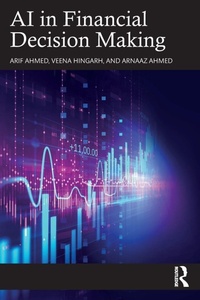
AI in Financial Decision Making
1st Edition
Will be published approx. on 22. December 2025
Book
Paperback/Softback
336 pages
978-1-041-01976-3 (ISBN)
Description
Written by experts who have trained global audiences in finance and designed real-life solutions, this book provides exactly what financial decision-makers need: a survival kit for disruptive times.
The increasing use of AI has posed challenges and brought benefits at organizational and individual levels. However, financial decision-makers are often not equipped with the necessary skills and may even feel threatened by the speed at which AI is automating the decision-making process. This book takes a balanced look at how AI and ML are applied across operations, finance, and risk management. It is not meant to turn finance professionals into coders; instead it shows clearly how these tools can be used to tackle real business problems. This will help financial decision-makers actively engage with projects involving the implementation of ML tools in their organizations. Beyond simple ML tool identification, the book goes one step further and provides representative codes that the reader can use by tweaking information to make it relevant to their own situation. To keep up with the rapid developments in AI and ML, this book is accompanied by a website where tools and codes will be regularly updated as standards change.
Anyone involved in financial decision-making will find this book to be an invaluable resource, whether a CFO, finance director, management accountant, budget officer, auditor, strategic planner, or early career professional.
The increasing use of AI has posed challenges and brought benefits at organizational and individual levels. However, financial decision-makers are often not equipped with the necessary skills and may even feel threatened by the speed at which AI is automating the decision-making process. This book takes a balanced look at how AI and ML are applied across operations, finance, and risk management. It is not meant to turn finance professionals into coders; instead it shows clearly how these tools can be used to tackle real business problems. This will help financial decision-makers actively engage with projects involving the implementation of ML tools in their organizations. Beyond simple ML tool identification, the book goes one step further and provides representative codes that the reader can use by tweaking information to make it relevant to their own situation. To keep up with the rapid developments in AI and ML, this book is accompanied by a website where tools and codes will be regularly updated as standards change.
Anyone involved in financial decision-making will find this book to be an invaluable resource, whether a CFO, finance director, management accountant, budget officer, auditor, strategic planner, or early career professional.
More details
Language
English
Place of publication
London
United Kingdom
Publishing group
Taylor & Francis Ltd
Target group
College/higher education
Professional and scholarly
Postgraduate and Professional Practice & Development
Illustrations
20 s/w Abbildungen, 46 s/w Tabellen, 1 s/w Photographie bzw. Rasterbild, 19 s/w Zeichnungen
46 Tables, black and white; 19 Line drawings, black and white; 1 Halftones, black and white; 20 Illustrations, black and white
Dimensions
Height: 229 mm
Width: 152 mm
Thickness: 19 mm
Weight
499 gr
ISBN-13
978-1-041-01976-3 (9781041019763)
Copyright in bibliographic data and cover images is held by Nielsen Book Services Limited or by the publishers or by their respective licensors: all rights reserved.
Schweitzer Classification
Other editions
Additional editions

Arif Ahmed | Veena Hingarh | Arnaaz Ahmed
AI in Financial Decision Making
Book
approx. 12/2025
1st Edition
Routledge
€208.40
Not yet published

Arif Ahmed | Veena Hingarh | Arnaaz Ahmed
AI in Financial Decision Making
E-Book
12/2025
Routledge
€61.99
Available for download

Arif Ahmed | Veena Hingarh | Arnaaz Ahmed
AI in Financial Decision Making
E-Book
12/2025
Routledge
€61.99
Available for download
Persons
Arif Ahmed, ACMA (CIMA), CGMA (CIMA-AICPA), is a chartered accountant from the UK and India. He holds an MBA and a doctorate in finance. His professional certifications include one on artificial intelligence. Arif has served as a member of the Sustainability Reporting Standards Board and Expert Advisory Committee of the Institute of Chartered Accountants of India. He has over 35 years of consulting and training experience.
Veena Hingarh, ACMA (CIMA), CGMA (CIMA-AICPA), is a chartered accountant from the UK and India. She also holds an MSc and a professional certificate in artificial intelligence, and is a company secretary from India. She has served on the boards of listed companies as an independent director and has been on the Expert Advisory Committee of the Institute of Chartered Accountants of India. Veena has over 25 years of training and consulting experience.
Arnaaz Ahmed, ACMA (CIMA), CGMA (CIMA-AICPA). She also holds an MSc in international accounting and finance from Heriot-Watt University, Edinburgh. She holds a professional certificate in IFRS and is currently pursuing her doctoral studies. Arnaaz enjoys creating codes to solve financial problems.
Veena Hingarh, ACMA (CIMA), CGMA (CIMA-AICPA), is a chartered accountant from the UK and India. She also holds an MSc and a professional certificate in artificial intelligence, and is a company secretary from India. She has served on the boards of listed companies as an independent director and has been on the Expert Advisory Committee of the Institute of Chartered Accountants of India. Veena has over 25 years of training and consulting experience.
Arnaaz Ahmed, ACMA (CIMA), CGMA (CIMA-AICPA). She also holds an MSc in international accounting and finance from Heriot-Watt University, Edinburgh. She holds a professional certificate in IFRS and is currently pursuing her doctoral studies. Arnaaz enjoys creating codes to solve financial problems.
Content
Chapter 1: Introduction. Chapter 2: Financial Forecasting and Budgeting. Chapter 3: Cost Management and Optimization. Chapter 4: Performance Measurement and Management. Chapter 5: Strategic Planning and Decision Support. Chapter 6: Inventory and Supply Chain Management. Chapter 7: Capital Budgeting and Investment Analysis. Chapter 8: Customer Profitability and Segmentation. Chapter 9: Risk Management and Compliance. Chapter 10: Conclusion