

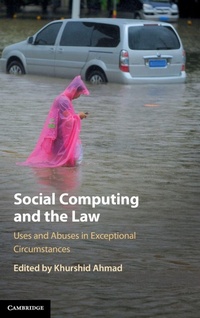
Social Computing and the Law
Uses and Abuses in Exceptional Circumstances
Published on 11. October 2018
Book
Hardback
176 pages
978-1-108-42865-1 (ISBN)
Description
This innovative book sets itself at the crossroads of several rapidly developing areas of research in legal and global studies related to social computing, specifically in the context of how public emergency responders appropriate content on social media platforms for emergency and disaster management. The book - a collaboration between computer scientists, ethicists, legal scholars and practitioners - should be read by anyone concerned with the ongoing debate over the corporatization and commodification of user-generated content on social media and the extent to which this content can be legally and ethically harnessed for emergency and disaster management. The collaboration was made possible by EU's FP 7 Project Slandail (# 607691, 2014-17).
More details
Language
English
Place of publication
Cambridge
United Kingdom
Target group
Professional and scholarly
Product notice
sewn/stitched
Cloth over boards
Illustrations
Worked examples or Exercises
Dimensions
Height: 238 mm
Width: 159 mm
Thickness: 17 mm
Weight
364 gr
ISBN-13
978-1-108-42865-1 (9781108428651)
Copyright in bibliographic data and cover images is held by Nielsen Book Services Limited or by the publishers or by their respective licensors: all rights reserved.
Schweitzer Classification
Other editions
Additional editions
E-Book
10/2018
Cambridge University Press
€83.99
Available for download
E-Book
09/2018
Cambridge University Press
€100.99
Available for download
Person
Khurshid Ahmad is Professor of Computer Science at Trinity College, Dublin. He specializes in artificial intelligence with research interests in information extraction from images and texts, fuzzy logic, sentiment analysis, neural networks, and terminology and ontology. Ahmad holds a Ph.D. in Theoretical Nuclear Physics from the University of Surrey (1975). He is an elected Fellow of the British Computer Society and of Trinity College, as well as a Chartered Engineer. He has taught at the Universities of Karachi and Surrey and has been a Visiting Professor at Copenhagen Business School. Ahmad has published over 250 research papers. His books include Computers, Language Learning and Language Teaching (Cambridge, 1985), Translator's Workbench: Tools and Terminology for Translation and Text Processing (1995), and Affective Computing and Sentiment Analysis: Emotion, Metaphor, and Terminology (2011).
Content
1. Introduction; 1.1. A note on terminology; 1.2. Security, privacy, and dignity during an emergency; 1.3. Our contribution: disasters, technology, law and ethics; 1.4. Structure of the book; 2. Social computing systems and ethical considerations; 2.1. Introduction; 2.2. Key ethical challenges posed by social computing systems; 2.3. Technology mediated protection of data and persons; 2.4. Conclusion; 3. Internet laws; 3.1. Introduction; 3.2. Internet governance systems: self-regulation, technical regulation and governmental regulation; 3.3. Ownership of personal data harvested from social computing systems; 3.4. Protection for monitoring and harvesting information on social media; 3.5. Summary findings; 4. Copyright law and data protection law; 4.1. Introduction; 4.2. EU copyright directives and German copyright law; 4.3. The ontology of copyright; 4.4. Copyright and exceptional circumstances: disaster management; 4.5. Exceptions and limitations; 4.6. Summary; 5. EU human rights framework; 5.1. Introduction; 5.2. Approach; 5.3. Disaster management and human rights; 5.4. EU fundamental rights framework and disaster management; 5.5. Conclusion; 6. Conclusion: legally using social computing streams and privacy protection; 6.1. Introduction; 6.2. Social computing analysis in exceptional circumstances; 6.3. Checklist of legal issues; 6.4. Risk analysis; 6.5. Conclusion.