

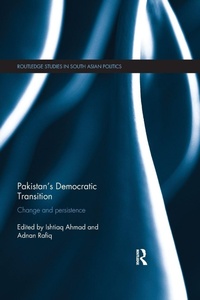
Pakistan's Democratic Transition
Change and Persistence
1st Edition
Published on 12. December 2019
Book
Paperback/Softback
248 pages
978-0-367-87742-2 (ISBN)
Description
Politics in Pakistan has traditionally been understood in the context of civil-military relationship. In May 2013, for the first time in history, Pakistan saw an elected government complete a full term in office and transfer power through the ballot box to another civilian government.
In view of such an important development, this book offers critical perspectives on Pakistan's current democratic transition and its implications for national politics, security and foreign policy. It critically analyses the emerging political trends in the country, including their underlying sources, attributes, constraints, and prospects of sustainability. Drawing on history, diverse theoretical perspectives, and empirical evidence, it explains the dynamics of the democratic process, contested borders and spaces, and regionalism. Contributions are from 13 prominent scholars in the field, who provide a wide-ranging analysis of Pakistan's contemporary national and regional challenges, as well as the opportunities they entail for its viability as a democratic state.
Taking the debate on Pakistan beyond the outmoded notions of praetorian politics and security, the book explores the future prospects of civilian supremacy in the country. It will be of interest to students and scholars of South Asian Politics, Political Sociology and Security Studies, as well as policy-makers, diplomats, security experts and military professionals.
In view of such an important development, this book offers critical perspectives on Pakistan's current democratic transition and its implications for national politics, security and foreign policy. It critically analyses the emerging political trends in the country, including their underlying sources, attributes, constraints, and prospects of sustainability. Drawing on history, diverse theoretical perspectives, and empirical evidence, it explains the dynamics of the democratic process, contested borders and spaces, and regionalism. Contributions are from 13 prominent scholars in the field, who provide a wide-ranging analysis of Pakistan's contemporary national and regional challenges, as well as the opportunities they entail for its viability as a democratic state.
Taking the debate on Pakistan beyond the outmoded notions of praetorian politics and security, the book explores the future prospects of civilian supremacy in the country. It will be of interest to students and scholars of South Asian Politics, Political Sociology and Security Studies, as well as policy-makers, diplomats, security experts and military professionals.
More details
Series
Language
English
Place of publication
London
United Kingdom
Publishing group
Taylor & Francis Ltd
Target group
College/higher education
Postgraduate
Dimensions
Height: 234 mm
Width: 156 mm
Thickness: 14 mm
Weight
404 gr
ISBN-13
978-0-367-87742-2 (9780367877422)
Copyright in bibliographic data and cover images is held by Nielsen Book Services Limited or by the publishers or by their respective licensors: all rights reserved.
Schweitzer Classification
Other editions
Additional editions
E-Book
11/2016
Routledge
€61.99
Available for download
E-Book
11/2016
Routledge
€61.99
Available for download
Book
10/2016
1st Edition
Routledge
€223.21
Shipment within 10-20 days
Persons
Ishtiaq Ahmad is Director of the School of Politics and International Relations at Quaid-i-Azam University in Islamabad, Pakistan.
Adnan Rafiq is DPhil candidate at the Department of Politics and International Relations at University of Oxford, UK.
Adnan Rafiq is DPhil candidate at the Department of Politics and International Relations at University of Oxford, UK.
Content
Introduction
1. Pakistan's Third Democratic Transition
2. Enduring Challenges to Democracy
3. Mapping the 'Establishment'
4. New Politics of the Middle Class
5. Social Drivers of Democratic Change
6. Military, Militancy, and the Crisis of Governance
7. Pluralist Society Vs. Monist State
8. Judicial Activism, and the Rule of Law
9. Demographic Dividend, and Democracy
10. Understanding the Baloch Ethnic Question post 18th Amendment
11. The Challenges of a Resilient Economy
12. Civil-Military Convergence for Stability
13. Great Powers, Military Supremacy, and Persistent Contestation
1. Pakistan's Third Democratic Transition
2. Enduring Challenges to Democracy
3. Mapping the 'Establishment'
4. New Politics of the Middle Class
5. Social Drivers of Democratic Change
6. Military, Militancy, and the Crisis of Governance
7. Pluralist Society Vs. Monist State
8. Judicial Activism, and the Rule of Law
9. Demographic Dividend, and Democracy
10. Understanding the Baloch Ethnic Question post 18th Amendment
11. The Challenges of a Resilient Economy
12. Civil-Military Convergence for Stability
13. Great Powers, Military Supremacy, and Persistent Contestation