

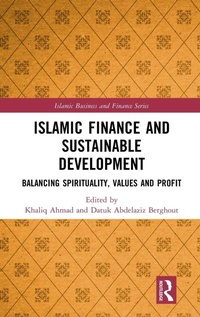
Islamic Finance and Sustainable Development
Balancing Spirituality, Values and Profit
1st Edition
Published on 5. March 2025
Book
Hardback
238 pages
978-1-032-80382-1 (ISBN)
Description
This book uncovers a new dimension in the study of sustainability, offering balanced development from a spiritual and cultural values perspective. The authors of this edited volume investigate the role of religion in the debate concerning the Sustainable Development Goals (SDGs) and offer an Islamic perspective to environment, social and governance (ESG) issues.
Applying a multidimensional approach to socio-economic development, this book contends that Islam offers a unique perspective and framework for sustainable development that is holistic and rooted in spirituality, morality and ethics. For example, the book explains how Islam lays emphasis on human talents development (SDGs 3 and 4), which is a key element in accelerating socio-economic growth (SDG-8). It also offers a wide range of social financial tools such as Zakat and Waqf that can be used to address SDGs 1 (poverty), 2 (hunger), 5 (gender equality) and 10 (reducing inequality). Islamic finance offers a number of tools for long-term financing such as sukuk that can masterfully be used for building sustainable infrastructure (SDG-9). The study also reviews some Islamic principles from the Holy Qur'an that can positively SDGs.
Students, scholars and researchers in the fields of Islamic economics and finance, sustainable development and socio-economic and environmental issues will find the book a valuable resource.
Applying a multidimensional approach to socio-economic development, this book contends that Islam offers a unique perspective and framework for sustainable development that is holistic and rooted in spirituality, morality and ethics. For example, the book explains how Islam lays emphasis on human talents development (SDGs 3 and 4), which is a key element in accelerating socio-economic growth (SDG-8). It also offers a wide range of social financial tools such as Zakat and Waqf that can be used to address SDGs 1 (poverty), 2 (hunger), 5 (gender equality) and 10 (reducing inequality). Islamic finance offers a number of tools for long-term financing such as sukuk that can masterfully be used for building sustainable infrastructure (SDG-9). The study also reviews some Islamic principles from the Holy Qur'an that can positively SDGs.
Students, scholars and researchers in the fields of Islamic economics and finance, sustainable development and socio-economic and environmental issues will find the book a valuable resource.
More details
Series
Language
English
Place of publication
London
United Kingdom
Publishing group
Taylor & Francis Ltd
Target group
College/higher education
Postgraduate
Illustrations
16 s/w Tabellen, 19 s/w Abbildungen, 2 s/w Photographien bzw. Rasterbilder, 17 s/w Zeichnungen
16 Tables, black and white; 17 Line drawings, black and white; 2 Halftones, black and white; 19 Illustrations, black and white
Dimensions
Height: 240 mm
Width: 161 mm
Thickness: 19 mm
Weight
567 gr
ISBN-13
978-1-032-80382-1 (9781032803821)
Copyright in bibliographic data and cover images is held by Nielsen Book Services Limited or by the publishers or by their respective licensors: all rights reserved.
Schweitzer Classification
Other editions
Additional editions
Khaliq Ahmad | Datuk AbdelAziz Berghout
Islamic Finance and Sustainable Development
Balancing Spirituality, Values and Profit
Book
approx. 07/2026
1st Edition
Routledge
€57.50
Not yet published
Khaliq Ahmad | Datuk AbdelAziz Berghout
Islamic Finance and Sustainable Development
Balancing Spirituality, Values and Profit
E-Book
03/2025
Routledge
€60.49
Available for download
Khaliq Ahmad | Datuk AbdelAziz Berghout
Islamic Finance and Sustainable Development
Balancing Spirituality, Values and Profit
E-Book
03/2025
Routledge
€60.49
Available for download
Persons
Khaliq Ahmad is Professor at the International Institute of Islamic Thought and Civilization (ISTAC), International Islamic University Malaysia (IIUM), Kuala Lumpur, Malaysia.
Datuk Abdelaziz Berghout is full Professor of Islamic studies and Civilization at International Islamic University Malaysia (IIUM), Kuala Lumpur, Malaysia.
Datuk Abdelaziz Berghout is full Professor of Islamic studies and Civilization at International Islamic University Malaysia (IIUM), Kuala Lumpur, Malaysia.
Content
Part 1. Values of Sustainability and Spirituality 1. Introduction 2. Maqasid for Re-Envisioning Islamic Higher Education for Sustainability and Socio-economic Development 3.Islamic View of Spirituality and Sustainability: Some Personal Reflections 4. Religiosity as a Core Factor of Intercultural Competence (IC) Part 2. Spirituality and Overall Ecosystems 5. Ethical Foundations of Monetary Transactions in Islamic Economics: Promoting Equity, Justice and Sustainable Development 6. The Islamization of Economics - An Analysis of the Linkage Between Islamic Economics, Sustainability and the Islamic Financial System 7. Pathways to Prosperity: Bridging Faith and Sustainability in Contemporary Consumption Behavior 8. Ethical and Sustainable Finance: Integrating Islamic Principles 9. Islamic Social Finance as a Catalyst for Socio-Economic Sustainability - The Role of FinTech 10. Humanising Governance and Management with Spirituality Part 3. Sustainable Finance Governance and Application - Case Studies 11. Financial Inclusion of the Deprived in India: Historical Perspectives 12. Sustainability Through Purposeful Leadership - The Maybank Case Study 13. The Viability of Integrating ESG As an Additional Screening in Shariah Stock Screening 14. Concluding Remarks