

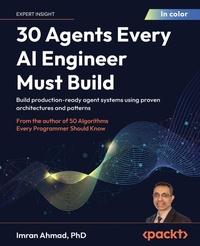
30 Agents Every AI Engineer Must Build
Transform LLMs into autonomous decision-making vertical agents in healthcare, finance, and beyond
Will be published approx. on 27. March 2026
Book
Paperback/Softback
542 pages
978-1-80610-901-2 (ISBN)
Description
From the author of 50 Algorithms Every Programmer Should Know. Learn to design and implement 30 intelligent agents that combine core architecture patterns with domain-specific solutions.
Key Features
Get to grips with foundational agent principles including perception, memory, reasoning, and planning
Integrate advanced frameworks like LangChain and AutoGPT in your AI agent development
Design agents using advanced prompting, knowledge retrieval, and multi-agent orchestration
Purchase of the print or Kindle book includes a free PDF eBook
Book DescriptionAs AI evolves from passive tools into proactive collaborators, intelligent agents lead this transformative shift. This guide equips you with critical knowledge on agent architectures, practical tools, and industry insights to develop robust, autonomous AI systems. You'll start by mastering foundational agent capabilities such as perception, memory, reasoning, planning, and learning. Gain insight into the cognitive loops essential for autonomous systems and build agent architectures using state-of-the-art frameworks like LangChain and LangGraph. Practical industry applications are explored across healthcare, finance, manufacturing, and education-illustrating how agents can optimize workflows, enhance advisory systems, automate quality control, and enable adaptive learning environments. Through numerous real-world examples, this book guides you in creating intelligent agents capable of contextual reasoning, effective tool utilization, real-time responsiveness, and seamless collaboration with humans. Additionally, you'll learn crucial strategies for the deployment, management, and ethical development of responsible AI systems. Whether you're developing your first intelligent agent or enhancing critical business operations, this book provides clear, actionable guidance for creating scalable and ethically robust AI solutions.What you will learn
Use LangChain and LangGraph to construct autonomous agents with modular, scalable architectures
Establish robust evaluation frameworks to measure agent performance, reliability, and alignment
Deploy production-ready agent systems that scale securely in enterprise environments
Implement ethical guardrails and explainability features to ensure responsible AI deployment
Navigate ethical concerns around explainability, bias, and safe deployment
Implement ethical guardrails and explainability features to ensure responsible AI deployment
Who this book is forThis book is for AI engineers, software developers, ML researchers, and technical leads building intelligent systems. Ideal for those deploying LLM-powered applications or transitioning from traditional ML to agentic frameworks. Python experience and basic ML knowledge are recommended.
Key Features
Get to grips with foundational agent principles including perception, memory, reasoning, and planning
Integrate advanced frameworks like LangChain and AutoGPT in your AI agent development
Design agents using advanced prompting, knowledge retrieval, and multi-agent orchestration
Purchase of the print or Kindle book includes a free PDF eBook
Book DescriptionAs AI evolves from passive tools into proactive collaborators, intelligent agents lead this transformative shift. This guide equips you with critical knowledge on agent architectures, practical tools, and industry insights to develop robust, autonomous AI systems. You'll start by mastering foundational agent capabilities such as perception, memory, reasoning, planning, and learning. Gain insight into the cognitive loops essential for autonomous systems and build agent architectures using state-of-the-art frameworks like LangChain and LangGraph. Practical industry applications are explored across healthcare, finance, manufacturing, and education-illustrating how agents can optimize workflows, enhance advisory systems, automate quality control, and enable adaptive learning environments. Through numerous real-world examples, this book guides you in creating intelligent agents capable of contextual reasoning, effective tool utilization, real-time responsiveness, and seamless collaboration with humans. Additionally, you'll learn crucial strategies for the deployment, management, and ethical development of responsible AI systems. Whether you're developing your first intelligent agent or enhancing critical business operations, this book provides clear, actionable guidance for creating scalable and ethically robust AI solutions.What you will learn
Use LangChain and LangGraph to construct autonomous agents with modular, scalable architectures
Establish robust evaluation frameworks to measure agent performance, reliability, and alignment
Deploy production-ready agent systems that scale securely in enterprise environments
Implement ethical guardrails and explainability features to ensure responsible AI deployment
Navigate ethical concerns around explainability, bias, and safe deployment
Implement ethical guardrails and explainability features to ensure responsible AI deployment
Who this book is forThis book is for AI engineers, software developers, ML researchers, and technical leads building intelligent systems. Ideal for those deploying LLM-powered applications or transitioning from traditional ML to agentic frameworks. Python experience and basic ML knowledge are recommended.
More details
Language
English
Place of publication
Birmingham
United Kingdom
Target group
Professional and scholarly
Dimensions
Height: 235 mm
Width: 191 mm
Thickness: 30 mm
Weight
1000 gr
ISBN-13
978-1-80610-901-2 (9781806109012)
Copyright in bibliographic data and cover images is held by Nielsen Book Services Limited or by the publishers or by their respective licensors: all rights reserved.
Schweitzer Classification
Person
Imran Ahmad is the author of the "50 Algorithms every programmer should know". He has been a part of cutting-edge research about algorithms and machine learning for many years. He completed his PhD in 2010, in which he proposed a new linear programming-based algorithm that can be used to optimally assign resources in a large-scale cloud computing environment. In 2017, Imran developed a real-time analytics framework named StreamSensing. He has since authored multiple research papers that use StreamSensing to process multimedia data for various machine learning algorithms. Imran is currently working at Advanced Analytics Solution Center (A2SC) at the Canadian Federal Government as a data scientist. He is using machine learning algorithms for critical use cases. Imran is a visiting professor at Carleton University, Ottawa. He has also been teaching for Google and Learning Tree for the last few years.
Content
Table of Contents
Foundations Of Agent Engineering
The Agent Engineer's Toolkit
The Art Of Agent Prompting
Agent Deployment & Responsible Development
Foundational Cognitive Architectures
Information Retrieval & Knowledge Agents
Tool Manipulation & Orchestration Agents
Data Analysis & Reasoning Agents
Software Development Agents
Conversational & Content Creation Agents
Multi-Modal Perception Agents
Ethical & Explainable Agents
Healthcare & Scientific Agents
Financial & Legal Domain Agents
Education & Knowledge Agents
Embodied & Physical World Agents
Foundations Of Agent Engineering
The Agent Engineer's Toolkit
The Art Of Agent Prompting
Agent Deployment & Responsible Development
Foundational Cognitive Architectures
Information Retrieval & Knowledge Agents
Tool Manipulation & Orchestration Agents
Data Analysis & Reasoning Agents
Software Development Agents
Conversational & Content Creation Agents
Multi-Modal Perception Agents
Ethical & Explainable Agents
Healthcare & Scientific Agents
Financial & Legal Domain Agents
Education & Knowledge Agents
Embodied & Physical World Agents