

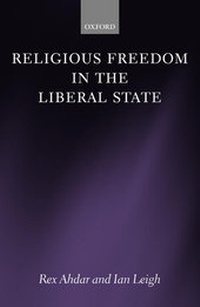
Religious Freedom in the Liberal State
Published on 13. October 2005
Book
Hardback
448 pages
978-0-19-925362-3 (ISBN)
Description
There is a growing recognition of the challenge that religions pose for pluralist, multicultural democracies. 'Fundamentalist' beliefs and practices test the limits of religious freedom, and seem to contradict the very basis on which liberal states protect religious liberty. Religions, moreover, are often associated with intolerance and persecution, yet insist upon religious liberty for themselves. This book inverts these stereotypes by presenting a sustained critique of how religious liberty ought to be understood in liberal legal systems and develops an alternative, Christian response. In Part One the prevailing liberal approach to religious freedom is compared with historic and contemporary understandings developed by Christian theorists, and an alternative principled basis for religious liberty, from a distinctively Christian position, is developed. Part Two analyses the variety of stances the liberal state may take towards organised religions, and explains the nature of the guarantees for religious freedom in domestic and international law. The difficult question of precisely when and how far religious liberty should be limited is carefully analysed.Part Three deals with concrete contemporary controversies involving the recognition and protection of religious beliefs and conduct, looking at issues such as family and parenting, medical treatment, education, employment, religious group autonomy, and freedom of expression and protest.
Extensive reference is made throughout the analysis to UK law and the European Convention on Human Rights, also the laws of other jurisdictions such as the US, Canada, South Africa, Australia and New Zealand, making this a wide-ranging, timely, and thoughtful examination of a perplexing contemporary controversy.
Extensive reference is made throughout the analysis to UK law and the European Convention on Human Rights, also the laws of other jurisdictions such as the US, Canada, South Africa, Australia and New Zealand, making this a wide-ranging, timely, and thoughtful examination of a perplexing contemporary controversy.
Reviews / Votes
This is a very good book, for at least three distinct reasons. First, it is a major and coherent treatment of a topic which, although benefiting from a growing periodical literature in this country, has few such contributions compared with European or other Anglo-American jurisdictions. Secondly, it tackles the interaction between law and religion at several different levels: at the level of ideological conflict, at the level of competing constitutional models, and in the detail of several areas of legal regulation. Finally, it sets about its task with a high level of theoretical sophistication and against a remarkably broad scholarly background. The authors move effortlessly between biblical exegesis, theology, sociology of religion, political theory, constitutional principle, European and comparative jurisprudence and detailed statutory analysis. In doing so, they amply demonstrate the sheer complexity and interconnectedness of questions of law and religion.More details
Language
English
Place of publication
Oxford
United Kingdom
Target group
Professional and scholarly
Dimensions
Height: 239 mm
Width: 163 mm
Thickness: 29 mm
Weight
784 gr
ISBN-13
978-0-19-925362-3 (9780199253623)
Copyright in bibliographic data and cover images is held by Nielsen Book Services Limited or by the publishers or by their respective licensors: all rights reserved.
Schweitzer Classification
Other editions
New editions
Rex Ahdar | Ian Leigh
Religious Freedom in the Liberal State
Book
03/2013
2nd Edition
Oxford University Press
€192.10
Shipment within 15-20 days
Content
Introduction; PART I; 1. Christian Perspectives; 2. Liberal Perspectives; PART II; 3. Models of Religion-State Relations; 4. The Legal Protection of Religious Freedom; 5. Religious Establishment; 6. Limiting Religious Freedom; PART III; 7. Family and Parenting; 8. Education; 9. Medical Treatment; 10. Employment; 11. Religious Group Autonomy; 12. Religious Expression and Protest; Conclusion