

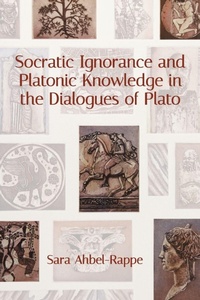
Socratic Ignorance and Platonic Knowledge in the Dialogues of Plato
Published on 2. January 2019
Book
Paperback/Softback
296 pages
978-1-4384-6926-3 (ISBN)
Description
Argues that Socrates' fundamental role in the dialogues is to guide us toward self-inquiry and self-knowledge.
In this highly original and provocative book, Sara Ahbel-Rappe argues that the Platonic dialogues contain an esoteric Socrates who signifies a profound commitment to self-knowledge and whose appearances in the dialogues are meant to foster the practice of self-inquiry. According to Ahbel-Rappe, the elenchus, or inner examination, and the thesis that virtue is knowledge, are tools for a contemplative practice that teaches us how to investigate the mind and its objects directly. In other words, the Socratic persona of the dialogues represents wisdom, which is distinct from and serves as the larger space in which Platonic knowledge-ethics, epistemology, and metaphysics-is constructed. Ahbel-Rappe offers complete readings of the Apology, Charmides, Alcibiades I, Euthyphro, Lysis, Phaedrus, Theaetetus, and Parmenides, as well as parts of the Republic. Her interpretation challenges two common approaches to the figure of Socrates: the thesis that the dialogues represent an "early" Plato who later disavows his reliance on Socratic wisdom, and the thesis that Socratic ethics can best be expressed by the construct of eudaimonism or egoism.
In this highly original and provocative book, Sara Ahbel-Rappe argues that the Platonic dialogues contain an esoteric Socrates who signifies a profound commitment to self-knowledge and whose appearances in the dialogues are meant to foster the practice of self-inquiry. According to Ahbel-Rappe, the elenchus, or inner examination, and the thesis that virtue is knowledge, are tools for a contemplative practice that teaches us how to investigate the mind and its objects directly. In other words, the Socratic persona of the dialogues represents wisdom, which is distinct from and serves as the larger space in which Platonic knowledge-ethics, epistemology, and metaphysics-is constructed. Ahbel-Rappe offers complete readings of the Apology, Charmides, Alcibiades I, Euthyphro, Lysis, Phaedrus, Theaetetus, and Parmenides, as well as parts of the Republic. Her interpretation challenges two common approaches to the figure of Socrates: the thesis that the dialogues represent an "early" Plato who later disavows his reliance on Socratic wisdom, and the thesis that Socratic ethics can best be expressed by the construct of eudaimonism or egoism.
Reviews / Votes
"Socrates stands at the root of our Western philosophical traditions. But, as becomes clear in this revolutionary book, the fullness of Socrates's presence, his life, and his wisdom, have been overlooked in our scholarship, and so has the continued tradition of Socratic wisdom as represented by the later Platonic thinkers ... Ahbel-Rappe reveals an existential dimension of the Socratic tradition that is essential for anyone interested not only in the origins of Platonism but in what made Platonism the most compelling philosophic tradition of the ancient world." - Gnosis"...Ahbel-Rappe's book ... should be regarded as an attempt to revolutionize the way we envision and engage Platonic and Socratic philosophy. Unabashedly overturning and flouting developmentalist approaches to Plato, Ahbel-Rappe invites readers to see not merely the continuity between Plato and his depiction of Socrates in the so-called early dialogues but also their complementarity, i.e. the mutual co-belonging and co-determination between the Socratic way of life and Plato's metaphysics. In doing so, she advances a nuanced, esoteric reading of Socrates that is neither Straussian nor in accord with the Tubingen school (though she does not reject these forms of esotericism in Plato)." - Polis
"The questions that Rappe raises are interesting and her analyses are thought-provoking ... I found the book stimulating, as it encourages the reader to reflect anew about the numerous facets of the Socrates persona." - Michael Erler, Journal of the History of Philosophy
"...[Ahbel-Rappe] provides something of a manifesto for understanding the figure of Socrates in Plato's Dialogues against dominant interpretations ... Refreshing for its firm articulation of an esoteric reading of Socrates and its comparison with elements of Eastern thought, this volume breaks new ground in an otherwise well-tilled area of classical philosophy." - CHOICE
More details
Series
Language
English
Place of publication
Albany, NY
United States
Target group
Professional and scholarly
US School Grade: College Graduate Student and over
Product notice
Paperback (trade)
Illustrations
1 Tables, black and white
Dimensions
Height: 229 mm
Width: 152 mm
Thickness: 18 mm
Weight
487 gr
ISBN-13
978-1-4384-6926-3 (9781438469263)
Copyright in bibliographic data and cover images is held by Nielsen Book Services Limited or by the publishers or by their respective licensors: all rights reserved.
Schweitzer Classification
Other editions
Additional editions
Sara Ahbel-Rappe
Socratic Ignorance and Platonic Knowledge in the Dialogues of Plato
E-Book
05/2018
1st Edition
State University of New York Press
from
€84.99
Available for download
Person
Sara Ahbel-Rappe is Professor of Greek and Latin at the University of Michigan. She is the author of Socrates: A Guide for the Perplexed and Reading Neoplatonism: Non-discursive Thinking in the Texts of Plotinus, Proclus, and Damascius; translator of Damascius's Problems and Solutions Concerning First Principles; and coeditor (with Rachana Kamtekar) of A Companion to Socrates.
Content
Preface: Socrates as an Esoteric Figure
Acknowledgments
Introduction: Socratic Ignorance and Platonic Knowledge
1. Socratic Philosophy
2. Socratic Receptions
3. Socrates and Self-Knowledge
4. Euthydemus: Native and Foreign
5. Alcibiades I: The Mirror of Socrates
6. Lysis: The Aporetic Identity of the First Friend
7. From Virtues to Forms in the Phaedrus
8. Theaetetus: Socrates's Interrogation of Platonic Knowledge
9. "He Who Is Wisest among You": Socratic Ignorance between the Parmenides and the Apology
Conclusion. The Socratic Paradigm
Notes
Works Cited
Index
Acknowledgments
Introduction: Socratic Ignorance and Platonic Knowledge
1. Socratic Philosophy
2. Socratic Receptions
3. Socrates and Self-Knowledge
4. Euthydemus: Native and Foreign
5. Alcibiades I: The Mirror of Socrates
6. Lysis: The Aporetic Identity of the First Friend
7. From Virtues to Forms in the Phaedrus
8. Theaetetus: Socrates's Interrogation of Platonic Knowledge
9. "He Who Is Wisest among You": Socratic Ignorance between the Parmenides and the Apology
Conclusion. The Socratic Paradigm
Notes
Works Cited
Index