

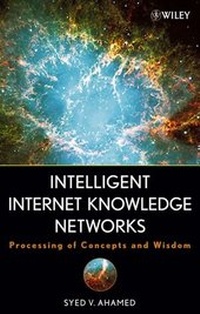
Intelligent Internet Knowledge Networks
Processing of Concepts and Wisdom
1st Edition
Will be published approx. on 14. November 2006
Book
Hardback
548 pages
978-0-471-78856-0 (ISBN)
Description
An introduction to wisdom-based computers and networks: the next generation in computing
This revolutionary book introduces wisdom, virtue, values, and ethics within the context of processing data, information, knowledge, and intelligence. The author sets forth a new approach for designing information systems that emphasizes the interaction of modern computers and communication systems with human beings.
In the past, computer system designers and network planners have ignored the knowledge, wisdom, and values that are an essential part of society. This book introduces "wisdom machine," which scans large amounts of Internet data and applies artificial intelligence strategies to filter the data and derive initial knowledge bases. These knowledge bases are reprocessed with human oversight to discover underlying axioms of wisdom and then evaluated to identify a value structure that leads to the greatest benefits to society.
Intelligent Internet Knowledge Networks is a fascinating text that expands your vision of how computers can be programmed and designed. Following the author's carefully structured logic, you will discover:
* Basic concepts in total program control of intelligent agents and machines
* Methodologies to track actions and decisions within an organization that infringe upon its ethical, legal, and social codes of conduct
* Software architectures and hardware configurations that facilitate a consistent and accountable flow of data, information, and procedures
* Programs that learn the consequences of management decisions and use this knowledge to develop guidelines for more effective and ethical procedures
* Technically sound IT platforms that can work for any organization
This is a must-read for all students, researchers, engineers, and executives interested in exploring the potential of the next generation of computers and how they will benefit both their organizations and society.
Reviews / Votes
"A thought-provoking work, written to expand reader horizons...a foundational book and a must read." (CHOICE, May 2007)More details
Product info
GB
Edition
1., Auflage
Language
English
Place of publication
United States
Publishing group
John Wiley & Sons Inc
Target group
Professional and scholarly
Dimensions
Height: 23.7 cm
Width: 16.3 cm
Thickness: 3.3 cm
Weight
884 gr
ISBN-13
978-0-471-78856-0 (9780471788560)
Schweitzer Classification
Other editions
Additional editions
E-Book
01/2007
Wiley
€144.99
Available for download
Person
SYED V. AHAMED, PhD, DSc, MBA, is Professor of Computer Science at The City University of New York (CUNY), College of Staten Island and Graduate Center, and Professor of Medical Informatics at the University of Medicine and Dentistry of New Jersey. Coauthor of five books, Dr. Ahamed's research focuses on specialty telecommunications, IT, MIS, knowledge processing, and intelligent, medical, and educational networks. Dr. Ahamed holds more than twenty U.S. and European patents.
Content
Foreword.
Preface.
Introduction.
PART I HUMAN THOUGHT AND MACHINE PROCESS.
Chapter 1 Processing of Knowledge.
Chapter 2 Network Perspective.
Chapter 3 Embedded Intelligence.
PART I1 STABILITY OF ENVIRONMENTS.
Chapter 4 Sensing and Monitoring Networks.
Chapter 5 Intelligent Knowledge Sharing.
Chapter 6 Intelligent Control Systems.
Chapter 7 Audio-Visual Sensing in Humans.
PART I11 HUMAN THOUGHT AND MACHINE PROCESS.
Chapter 8 Framework for Processing Knowledge.
Chapter 9 A New Breed Of Machines.
Chapter 10 Concepts and Constructs for a Wisdom Machine (WM).
Chapter 11 Knowledge Environments.
Chapter 12 Wealth of Knowledge.
PART IV PERSISTENT MINDS AND TIRELESS MACHINES.
Chapter 13 Human Needs and Machines.
Chapter 14 The Practice of Wisdom.
Chapter 15 Looking Ahead: Social and Ethical Implications.
List ofAcronyms for the Entire Book.
Indices.
Classification of Eight Indices.
I-Index of Established Concepts.
11-Index of New Concepts.
111-Index of Human Aspects.
IV-Index for Knowledge.
V-Index of Social Setting.
VI-Index of Technology.
VII-Index of Wisdom.
VIII-Index of Information (Words).
About the Author.