

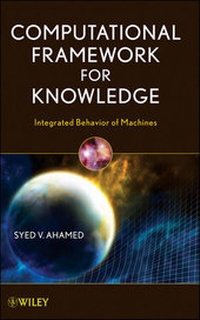
Computational Framework for Knowledge
Integrated Behavior of Machines
1st Edition
Published on 28. August 2009
Book
Hardback
538 pages
978-0-470-44686-7 (ISBN)
Description
"Intriguing. [filled with] new ideas about overarching intellectual themes that govern our technologies and our society."
--Nikil Jayant, Eminent Scholar, Georgia Research Alliance
"Dr. Ahamed is correct in observing that 'silicon and glass have altered the rhythm of mind' and that computers need to be more 'human.'"
--Bishnu S. Atal, Member, National Academy of Engineering
This book combines philosophical, societal, and artificial intelligence concepts with those of computer science and information technology to demonstrate novel ways in which computers can simplify data mining on the Internet. It describes numerous innovative methods that go well beyond information retrieval to allow computers to accomplish such tasks as processing, classifying, prioritizing, and reconstituting knowledge.
The book is divided into five parts:
* New knowledge sensing and filtering environments
* Concept building and wisdom machines
* General structure and theory of knowledge
* Verb functions and noun objects
* Humanistic and semi-human systems
This book offers new mathematical methodologies and concrete HW/SW/FW configurations for the IT specialist to help their corporations explore, exploit, compete, and win global market share.
More details
Product info
GB
Edition
1., Auflage
Language
English
Place of publication
New York
United States
Target group
Professional and scholarly
Product notice
sewn/stitched
Paper over boards
Dimensions
Height: 240 mm
Width: 161 mm
Thickness: 35 mm
Weight
1012 gr
ISBN-13
978-0-470-44686-7 (9780470446867)
Schweitzer Classification
Other editions
Additional editions
E-Book
08/2009
Wiley
€166.99
Available for download
Person
Syed V. Ahamed, PhD, DSc, MBA, is Professor Emeritus of Computer Science at CUNY, College of Staten Island, and a Professor of Medical Informatics at the University of Medicine and Dentistry of New Jersey. He has been affiliated with Bell Laboratories, Lucent Technologies, and Bell Labs Innovations for the last forty years. Dr. Ahamed's research includes knowledge machines, IT, MIS, knowledge processing units, and intelligent, medical, and educational networks. He is the author or coauthor of six other books and holds more than twenty U.S. and European patents.
Content
Forward.
Preface.
Introduction.
Chapter 1: New Knowledge Environments.
Chapter Summary.
1.1 The Need to Know.
1.2 Role of Technology.
1.3 Knowledge and Wealth.
1.4 Evolving Knowledge Environments.
1.5 Structure and Communication of Knowledge.
1.6 Intelligent Internet And Knowledge Society.
1.7 Knowledge Networks.
1.8 Conclusions.
References.
Chapter 2: Wisdom Machines.
Chapter Summary.
2.1 Many Flavors Of Wisdom.
2.2 Three Orientations Of Wisdom.
2.3 Optimization of Wise Choices.
2.4 Three Level Functions.
2.5 Knowledge Machines Building Blocks.
2.6 Machine Clusters.
2.7 From Wisdom to Behavior.
2.8 Order, Awareness, and Search.
2.9 Conclusions.
References.
Chapter 3: General Theory of Knowledge.
Chapter Summary.
3.1 A Basis For Theory Of Knowledge.
3.2 Comprehension, Nature, and Knowledge.
3.3 Central Processing and Knowledge Processing.
3.4 Accumulation of Information, Knowledge, and Wisdom.
3.5 The Enhanced Knowledge Trail.
3.6 Sequencing of Events At Nodes.
3.7 Transitions at I, K, C Nodes.
3.8 Transition Management at Nodes.
3.9 Simplified Transition Diagram.
3.10 Origin And Destination.
3.11 The Entropy of Knowledge.
3.12 Conclusions.
References.
Chapter 4: Verb Functions and Noun Objects.
Chapter Summary.
4.1 Positive and Negative Social Forces.
4.2 Framework of Knowledge.
4.3 Compilation of Knowledge.
4.4 Derivation of Knowledge.
4.5 Knowledge Machine Software Hierarchy.
4.6 Knowledge Hardware And Software Systems.
4.7 Classical Migration Path Of Knowledge.
4.8 Conclusions.
References.
Chapter 5: Humanistic and Semi-Human Systems.
5.0 Chapter Summary.
5.1 Humanistic Chipsets.
5.2 Essence Of Human Activity.
5.3 Smart Verbs and Intelligent Nouns.
5.4 Effects of Intelligent Response.
5.5 Gradation of KPU Responses.
5.6 Fragments of Overall Human Activity.
5.7 Dual KPU Human Interaction Model.
5.8 References.
Appendix A: Human Interactions.
A.1 Nonlinear Responses.
A.2 Oscillatory Response of Intelligent Objects.
Appendix B: Knowledge Machines for Human Interactions.
B.1 KM For Human Interactive Processes.
B.2 KM For Labor Management (LM) Negotiation.
B.3 KM For Corporate Interactions.
Chapter 6: Information and Knowledge Filters.
Chapter Summary.
6.1 Junk Information and Hype Knowledge.
6.2 Design of Conventional Signal Filters.
6.3 Signal Waves and Knowledge Flow.
6.4 The (I (r)¯ K) Filters.
6.5 The Design of (I (r)¯ K) Filters.
6.6 Configuration of (I (r)¯ K) Systems.
6.7 Selection of NOS And VFS in Samples.
6.8 Systems for (I (r)¯ K) Filters.
6.9 Four-Port Knowledge Network.
6.10 Knowledge Gates.
6.11 Contamination of (I (r)¯ K).
6.12 Decontamination of Knowledge.
6.13 Conclusions.
References.
Appendix A: A Two-Stage "TR" Filter (Henry Higgins).
A.1 T-Zero Filtering And Output BOK1-T.
A.2 R-Zero Filtering And Output BOK1-R.
A 3 TR-Zero Filtering And Output BOK2-Tr.
Appendix B: A Three-Stage "Set" Filter (John Tyndall).
B.1 S-Zero Filtering And Output BOK1-S.
B.2 Generality of Information Filtering.
Appendix C: A Practical Information Filter (Plato and Einstein).
C.1 Application to Three Positive Noun Objects.
C.2 Filter Template Based on TVB.
C.3 New Filter Template Based on TVB And Soul.
Appendix D: Application to Three Negative Noun Objects.
Chapter 7: Process and Change Of Entropy.
Chapter Summary.
7.1 Actions And Entropy.
7.2 Knowledge Centric Objects (KCO).
7.3 Classification of KCOS.
7.4 Clusters of Complex KCOS.
7.5 Single Process Kopcodes for Generic KCOS.
7.6 Multiple Process Instructions.
7.7 Passive Kopcs.
7.8 Active Kopcs.
7.9 Multiple Process Instructions.
7.10 Iterative And Reflexive Processing.
7.11 Macro Instructions For KPU.
7.12 KPU Architectures For Kopc01-12 Instructions.
7.13 Conclusions.
References.
Chapter 8: Knowledge System Architectures.
Chapter Summary.
8.1 From CPU to KPU.
8.2 The Philosophic Dimension.
8.3 Iterative Cyclic Social Processes.
8.4 The Scientific Dimension.
8.5 Varieties of Processors and Machines.
8.6 The Trend of Concepts.
8.7 Recent Trends Towards Wisdom.
8.8 The Trend of Values and Ethics.
8.9 Conclusions.
References.
Chapter 9: Humans, Machines and Networks.
Chapter Summary.
9.1 Ethics And Values In High-Tech Society.
9.2 Needs That Drive.
9.3 Networks That Transport.
9.4 Overlap Of Needs And Networks.
9.5 Rationality of Humanistic Machines.
9.6 Wisdom Domain and Knowledge Rush.
9.7 Need Pyramid of a Society.
9.8 Self Perpetuating Power Loops.
9.9 Convergence of K & M Hierarchies.
9.10 Knowledge Machines on Knowledge.
9.11 Conclusions.
References.
Chapter 10: Architecture of Knowledge.
Chapter Summary.
10.1 A New Breed of Knowledge.
10.2 The Knowledge Loop and its Stability.
10.3 Continuity of Knowledge.
10.4 Three Orientations of Wisdom.
10.5 Long-Term Movements Within The K-Loop.
10.6 Conflictive Roles of TVB??DAH Orientations.
10.7 Tracking of the K-Loops.
10.8 Details of the Upward Migration.
10.9 Details of the Downward Migration.
10.10 Knowledge Loops in X And Y Dimensions.
10.11 Four Ports of Super Node-K.
10.12 Construction of a Knowledge Plane.
10.13 Knowledge Bases in Primary K-Plane.
10.14 Successive K-Loops In T (Time) Dimension.
10.15 The Nebula of Knowledge (Knowbula).
10.16 Hindsight and Foresight.
10.17 Knowledge, Freedom and Creativity.
10.18 Knowledge and Money.
10.19 Pinnacle of Mind and Infinity of Thought.
10.20 Social Migration and Political Agenda.
10.21 Conclusions.
Acronyms.
Index.
Author Biography.