

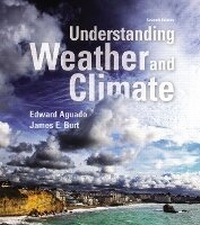
Understanding Weather and Climate
7th Edition
Published on 27. November 2014
Book
Paperback/Softback
608 pages
978-0-321-98730-3 (ISBN)
Description
&> For Introductory Meteorology Science Courses.
Engage Students in Learning About Atmospheric Processes Aguado/Burt's Understanding Weather and Climate illustrates meteorology and climatology using everyday occurrences and inspired technology tutorials to engage students in learning about atmospheric processes and patterns. The Seventh Edition extends coverage of global climate change with new and unique sections covering oceans and climate in the Earth system. Each chapter also focuses on the human aspect of weather and climate, covering high interest weather-related hazards that draw students into the course, while incorporating the latest science and the most relevant issues.
MasteringMeteorology with eText for Understanding Weather and Climate is an online homework, tutorial, and assessment product designed to improve results by helping your students quickly master concepts. The book and MasteringMeteorology work together to create a classroom experience that is tightly integrated to help students succeed both in and outside of the classroom.
Note: If you are purchasing the standalone text or electronic version, MasteringMeteorology does not come automatically packaged with the text. To purchase MasteringMeteorology please visit www.masteringmeteorology.com or you can purchase a package of the physical text + MasteringMeteorology by searching for 0321984439 / 9780321984432. MasteringMeteorology is not a self-paced technology and should only be purchased when required by an instructor.
Engage Students in Learning About Atmospheric Processes Aguado/Burt's Understanding Weather and Climate illustrates meteorology and climatology using everyday occurrences and inspired technology tutorials to engage students in learning about atmospheric processes and patterns. The Seventh Edition extends coverage of global climate change with new and unique sections covering oceans and climate in the Earth system. Each chapter also focuses on the human aspect of weather and climate, covering high interest weather-related hazards that draw students into the course, while incorporating the latest science and the most relevant issues.
MasteringMeteorology with eText for Understanding Weather and Climate is an online homework, tutorial, and assessment product designed to improve results by helping your students quickly master concepts. The book and MasteringMeteorology work together to create a classroom experience that is tightly integrated to help students succeed both in and outside of the classroom.
Note: If you are purchasing the standalone text or electronic version, MasteringMeteorology does not come automatically packaged with the text. To purchase MasteringMeteorology please visit www.masteringmeteorology.com or you can purchase a package of the physical text + MasteringMeteorology by searching for 0321984439 / 9780321984432. MasteringMeteorology is not a self-paced technology and should only be purchased when required by an instructor.
More details
Other editions
Previous edition
Edward Aguado | James E. Burt
Understanding Weather and Climate
Book
12/2011
6th Edition
Pearson
€128.74
Article exhausted; check for reprint
Persons
Ed Aguado
Ed Aguado is Professor of Geography and Master's Program Advisor in the Department of Geography of San Diego State University. He received his Ph.D. from the University of Wisconsin-Madison, and his M.A. and B.A. from the UCLA. His research interests are in the precipitation and hydrology of western U.S. mountains. He regularly teaches introductory and advanced meteorology, climatology, and physical geography, and often serves as a
consultant and expert witness on climatology and weather.
Jim Burt
Jim Burt is Professor of Geography in the Department of Geography of the University of Wisconsin-Madison. He received his Ph.D. from the UCLA. His research interests are in physical geography, climatology, quantitative methods, and geovisualization. Burt recently served as the co-principal investigator for SoLIM (Soil Land Inference Model) for soil mapping, using recent developments in GIS, artificial intelligence, and information representation theory, and he is currently involved in new NSF funded research using GIS. He regularly teaches advanced geography and atmospheric science courses.
Ed Aguado is Professor of Geography and Master's Program Advisor in the Department of Geography of San Diego State University. He received his Ph.D. from the University of Wisconsin-Madison, and his M.A. and B.A. from the UCLA. His research interests are in the precipitation and hydrology of western U.S. mountains. He regularly teaches introductory and advanced meteorology, climatology, and physical geography, and often serves as a
consultant and expert witness on climatology and weather.
Jim Burt
Jim Burt is Professor of Geography in the Department of Geography of the University of Wisconsin-Madison. He received his Ph.D. from the UCLA. His research interests are in physical geography, climatology, quantitative methods, and geovisualization. Burt recently served as the co-principal investigator for SoLIM (Soil Land Inference Model) for soil mapping, using recent developments in GIS, artificial intelligence, and information representation theory, and he is currently involved in new NSF funded research using GIS. He regularly teaches advanced geography and atmospheric science courses.
Content
I: ENERGY AND MASS
Composition and Structure of the Atmosphere
Solar Radiation and the Seasons
Energy Balance and Temperature
Atmospheric Pressure and Wind
II: WATER IN THE ATMOSPHERE
Atmospheric Moisture
Cloud Development and Forms
Precipitation Processes
III: DISTRIBUTION AND MOVEMENT OF AIR
Atmospheric Circulation and Pressure Distributions
Air Masses and Fronts
IV: DISTURBANCES
Midlatitude Cyclones
Lightning, Thunder, and Tornadoes
Tropical Storms and Hurricanes
V: HUMAN ACTIVITIES AND SPECIAL TOPICS
Weather Forecasting and Analysis
Human Effects on the Atmosphere
VI: CURRENT, PAST, AND FUTURE CLIMATES
Earth's Climates
Climate Changes: Past and Future
Atmospheric Optics
VII: Atmospheric Optics (online only in MasteringMeteorology) and Appendices
Atmospheric Optics
Appendix A: Unit of Measurement and Conversions
Appendix B: The Standard Atmosphere
Appendix C: Weather Map Symbols
Appendix D: Weather Extremes Cloud Guide
Composition and Structure of the Atmosphere
Solar Radiation and the Seasons
Energy Balance and Temperature
Atmospheric Pressure and Wind
II: WATER IN THE ATMOSPHERE
Atmospheric Moisture
Cloud Development and Forms
Precipitation Processes
III: DISTRIBUTION AND MOVEMENT OF AIR
Atmospheric Circulation and Pressure Distributions
Air Masses and Fronts
IV: DISTURBANCES
Midlatitude Cyclones
Lightning, Thunder, and Tornadoes
Tropical Storms and Hurricanes
V: HUMAN ACTIVITIES AND SPECIAL TOPICS
Weather Forecasting and Analysis
Human Effects on the Atmosphere
VI: CURRENT, PAST, AND FUTURE CLIMATES
Earth's Climates
Climate Changes: Past and Future
Atmospheric Optics
VII: Atmospheric Optics (online only in MasteringMeteorology) and Appendices
Atmospheric Optics
Appendix A: Unit of Measurement and Conversions
Appendix B: The Standard Atmosphere
Appendix C: Weather Map Symbols
Appendix D: Weather Extremes Cloud Guide