

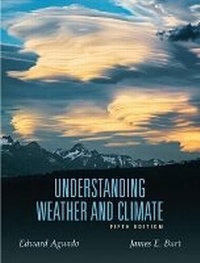
Understanding Weather and Climate
United States Edition
5th Edition
Published on 22. June 2009
Book
Mixed media product
608 pages
978-0-321-59550-8 (ISBN)
Description
For introductory courses in Meteorology and Weather & Climate.
A first-rate textbook and inspired technology tutorials work together to engage students in the process of learning about atmospheric behavior. The authors use everyday occurrences to illustrate meteorology and climatology. Dynamic illustrations from the book come to life in the fully integrated student website, where a narrator guides students through animated tutorials, video footage and satellite loops of atmospheric phenomena.
A first-rate textbook and inspired technology tutorials work together to engage students in the process of learning about atmospheric behavior. The authors use everyday occurrences to illustrate meteorology and climatology. Dynamic illustrations from the book come to life in the fully integrated student website, where a narrator guides students through animated tutorials, video footage and satellite loops of atmospheric phenomena.
More details
Edition
5th edition
Language
English
Place of publication
United States
Publishing group
Pearson Education (US)
Target group
College/higher education
Dimensions
Height: 220 mm
Width: 276 mm
Thickness: 21 mm
Weight
1206 gr
ISBN-13
978-0-321-59550-8 (9780321595508)
Copyright in bibliographic data and cover images is held by Nielsen Book Services Limited or by the publishers or by their respective licensors: all rights reserved.
Schweitzer Classification
Other editions
New editions
Edward Aguado | James E. Burt
Understanding Weather and Climate Plus NEW MyMeteorologyLab -- Access Card Package
Book
06/2012
6th Edition
Prentice Hall
€133.84
Article exhausted; check for reprint
Edward Aguado | James E. Burt
Understanding Weather and Climate
Book
12/2011
6th Edition
Pearson
€128.74
Article exhausted; check for reprint
Persons
Ed Aguado is a Professor of Geography at San Diego State University. He earned his Ph.D. at the University of Wisconsin in 1983, and his research interests include Precipitation and Hydrology of Western U.S. Mountains. He is also involved in consulting and is an expert witness on climatology and weather.
Jim Burt is a Professor of Geography at the University of Wisconsin, Madison. He earned his Ph.D. in Geography from UCLA in 1980, and his research areas include Physical Geography, Climatology, Quantitative Methods, and Geovisualization. He is the Co-principal investigator for SoLIM (Soil Land Inference Model) for soil mapping based on recent developments in geographic information science (GISc), artificial intelligence (AI), and information representation theory.
Jim Burt is a Professor of Geography at the University of Wisconsin, Madison. He earned his Ph.D. in Geography from UCLA in 1980, and his research areas include Physical Geography, Climatology, Quantitative Methods, and Geovisualization. He is the Co-principal investigator for SoLIM (Soil Land Inference Model) for soil mapping based on recent developments in geographic information science (GISc), artificial intelligence (AI), and information representation theory.
Content
I. ENERGY AND MASS.
1. Composition and Structure of the Atmosphere.
2. Solar Radiation and the Seasons.
3. Energy Balance and Temperature.
4. Atmospheric Pressure and Wind.
II. WATER IN THE ATMOSPHERE.
5. Atmospheric Moisture.
6. Cloud Development and Forms.
7. Precipitation Processes.
III. DISTRIBUTION AND MOVEMENT OF AIR.
8. Atmospheric Circulation and Pressure Distributions.
9. Air Masses and Fronts.
IV. DISTURBANCES.
10. Mid-Latitude Cyclones.
11. Lightning, Thunder, and Tornadoes.
12. Tropical Storms and Hurricanes.
V. HUMAN ACTIVITIES AND SPECIAL TOPICS.
13. Weather Forecasting and Analysis.
14. Human Effects: Air Pollution and Heat Islands.
VI. CURRENT, PAST AND FUTURE CLIMATES.
15. Earth's Climates.
16. Climate Changes: Past and Future.
VII. SPECIAL TOPICS AND APPENDICES.
17. Atmospheric Optics.
Appendix A: Unit of Measurement and Conversions.
Appendix B: The Standard Atmosphere.
Appendix C: Weather Map Symbols.
Appendix D: Weather Extremes.
Glossary.
Index.
1. Composition and Structure of the Atmosphere.
2. Solar Radiation and the Seasons.
3. Energy Balance and Temperature.
4. Atmospheric Pressure and Wind.
II. WATER IN THE ATMOSPHERE.
5. Atmospheric Moisture.
6. Cloud Development and Forms.
7. Precipitation Processes.
III. DISTRIBUTION AND MOVEMENT OF AIR.
8. Atmospheric Circulation and Pressure Distributions.
9. Air Masses and Fronts.
IV. DISTURBANCES.
10. Mid-Latitude Cyclones.
11. Lightning, Thunder, and Tornadoes.
12. Tropical Storms and Hurricanes.
V. HUMAN ACTIVITIES AND SPECIAL TOPICS.
13. Weather Forecasting and Analysis.
14. Human Effects: Air Pollution and Heat Islands.
VI. CURRENT, PAST AND FUTURE CLIMATES.
15. Earth's Climates.
16. Climate Changes: Past and Future.
VII. SPECIAL TOPICS AND APPENDICES.
17. Atmospheric Optics.
Appendix A: Unit of Measurement and Conversions.
Appendix B: The Standard Atmosphere.
Appendix C: Weather Map Symbols.
Appendix D: Weather Extremes.
Glossary.
Index.