

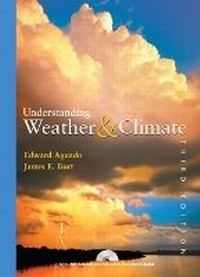
Understanding Weather and Climate
3rd Edition
Published on 24. July 2003
Book
Mixed media product
592 pages
978-0-13-101582-1 (ISBN)
Description
For courses in Introductory Meteorology.
This meteorology text focuses on explanation about-rather than description of-the processes that produce Earth's weather and climate. It emphasizes a non-mathematical understanding of physical principles as a vehicle for learning about atmospheric processes. Additionally, difficult-to-visualize topics are reinforced with a series of software tutorials presented on a CD-ROM packaged with the book.
This meteorology text focuses on explanation about-rather than description of-the processes that produce Earth's weather and climate. It emphasizes a non-mathematical understanding of physical principles as a vehicle for learning about atmospheric processes. Additionally, difficult-to-visualize topics are reinforced with a series of software tutorials presented on a CD-ROM packaged with the book.
More details
Edition
3rd edition
Language
English
Place of publication
United States
Publishing group
Pearson Education (US)
Target group
Professional and scholarly
Dimensions
Width: 282 mm
Thickness: 21 mm
Weight
1475 gr
ISBN-13
978-0-13-101582-1 (9780131015821)
Copyright in bibliographic data and cover images is held by Nielsen Book Services Limited or by the publishers or by their respective licensors: all rights reserved.
Schweitzer Classification
Other editions
New editions

Edward Aguado | James E. Burt
Understanding Weather and Climate
Book
06/2006
4th Edition
Pearson
€55.99
Article exhausted; check for reprint
Previous edition
Edward Aguado | James E. Burt
Understanding Weather and Climate
Book
08/2000
2nd Edition
Pearson
€50.87
Article exhausted; check for reprint
Content
I. ENERGY AND MASS.
1. Composition and Structure of the Atmosphere.
2. Solar Radiation and the Seasons.
3. Energy Balance and Temperature.
4. Atmospheric Pressure and Wind.
II. WATER IN THE ATMOSPHERE.
5. Atmospheric Moisture.
6. Cloud Development and Forms.
7. Precipitation Processes.
III. DISTRIBUTION AND MOVEMENT OF AIR.
8. Atmospheric Circulation and Pressure Distributions.
9. Air Masses and Fronts.
IV. DISTURBANCES.
10. Mid-Latitude Cyclones.
11. Lightning, Thunder, and Tornadoes.
12. Tropical Storms and Hurricanes.
V. HUMAN ACTIVITIES AND SPECIAL TOPICS.
13. Weather Forecasting and Analysis.
14. Human Effects: Air Pollution and Heat Islands.
VI. CURRENT, PAST AND FUTURE CLIMATES.
15. Earth's Climates.
16. Climate Changes: Past and Future.
VII. SPECIAL TOPICS AND APPENDICES.
17. Atmospheric Optics.
Appendix A: Unit of Measurement and Conversions.
Appendix B: The Standard Atmosphere.
Appendix C: Weather Map Symbols.
Appendix D: Weather Extremes.
Glossary.
Index.
1. Composition and Structure of the Atmosphere.
2. Solar Radiation and the Seasons.
3. Energy Balance and Temperature.
4. Atmospheric Pressure and Wind.
II. WATER IN THE ATMOSPHERE.
5. Atmospheric Moisture.
6. Cloud Development and Forms.
7. Precipitation Processes.
III. DISTRIBUTION AND MOVEMENT OF AIR.
8. Atmospheric Circulation and Pressure Distributions.
9. Air Masses and Fronts.
IV. DISTURBANCES.
10. Mid-Latitude Cyclones.
11. Lightning, Thunder, and Tornadoes.
12. Tropical Storms and Hurricanes.
V. HUMAN ACTIVITIES AND SPECIAL TOPICS.
13. Weather Forecasting and Analysis.
14. Human Effects: Air Pollution and Heat Islands.
VI. CURRENT, PAST AND FUTURE CLIMATES.
15. Earth's Climates.
16. Climate Changes: Past and Future.
VII. SPECIAL TOPICS AND APPENDICES.
17. Atmospheric Optics.
Appendix A: Unit of Measurement and Conversions.
Appendix B: The Standard Atmosphere.
Appendix C: Weather Map Symbols.
Appendix D: Weather Extremes.
Glossary.
Index.