

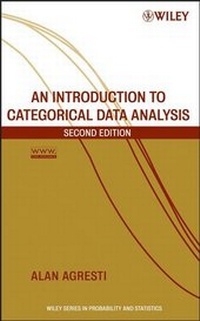
An Introduction to Categorical Data Analysis
2nd Edition
Published on 17. April 2007
Book
Hardback
400 pages
978-0-471-22618-5 (ISBN)
Description
Praise for the First Edition
"This is a superb text from which to teach categorical data analysis, at a variety of levels. . . [t]his book can be very highly recommended."
--Short Book Reviews
"Of great interest to potential readers is the variety of fields that are represented in the examples: health care, financial, government, product marketing, and sports, to name a few."
--Journal of Quality Technology
"Alan Agresti has written another brilliant account of the analysis of categorical data."
--The Statistician
The use of statistical methods for categorical data is ever increasing in today's world. An Introduction to Categorical Data Analysis, Second Edition provides an applied introduction to the most important methods for analyzing categorical data. This new edition summarizes methods that have long played a prominent role in data analysis, such as chi-squared tests, and also places special emphasis on logistic regression and other modeling techniques for univariate and correlated multivariate categorical responses.
This Second Edition features:
* Two new chapters on the methods for clustered data, with an emphasis on generalized estimating equations (GEE) and random effects models
* A unified perspective based on generalized linear models
* An emphasis on logistic regression modeling
* An appendix that demonstrates the use of SAS(r) for all methods
* An entertaining historical perspective on the development of the methods
* Specialized methods for ordinal data, small samples, multicategory data, and matched pairs
* More than 100 analyses of real data sets and nearly 300 exercises
Written in an applied, nontechnical style, the book illustrates methods using a wide variety of real data, including medical clinical trials, drug use by teenagers, basketball shooting, horseshoe crab mating, environmental opinions, correlates of happiness, and much more.
An Introduction to Categorical Data Analysis, Second Edition is an invaluable tool for social, behavioral, and biomedical scientists, as well as researchers in public health, marketing, education, biological and agricultural sciences, and industrial quality control.
Reviews / Votes
"Yes, I fully recommend the text as a basis for introductory course, for students, as well as non-specialists in statistics. The wealth of examples provided in the text is, from my point of view, a rich source of motivating ones own studies and work." (Biometrical Journal, December 2008) "This text does a good job of achieving its state goal, and we enthusiastically recommend it." (Journal of the American Statistical Association, September 2008) "This book is very well-written and it is obvious that the author knows the subject inside out." (Journal of Applied Statistics, April 2008) "Provides an applied introduction to the most important methods for analyzing categorical data, such as chi-squared tests and logical regression." (Statistica 2008) "This is an introductory book and as such it is marvelous...essential for a novice..." (MAA Reviews, June 26, 2007)More details
Series
Edition
2. Auflage
Language
English
Place of publication
United States
Publishing group
John Wiley & Sons Inc
Target group
Professional and scholarly
Edition type
New edition
Illustrations
Photos: 1 B&W, 0 Color; Drawings: 2 B&W, 0 Color; Graphs: 23 B&W, 0 Color
Dimensions
Height: 23.9 cm
Width: 16.4 cm
Thickness: 2.4 cm
Weight
628 gr
ISBN-13
978-0-471-22618-5 (9780471226185)
Schweitzer Classification
Other editions
New editions
Alan Agresti
An Introduction to Categorical Data Analysis
Book
01/2019
3rd Edition
Wiley
€150.50
Shipment within 15-20 days
Previous edition

Alan Agresti
Introduction to Categorical Data Analysis
Book
02/1996
Wiley
€79.17
Article exhausted; check for reprint
Person
ALAN AGRESTI, PhD, is Distinguished Professor Emeritus in the Department of Statistics at the University of Florida. He has presented short courses on categorical data methods in thirty countries. Dr. Agresti was named "Statistician of the Year" by the Chicago chapter of the American Statistical Association in 2003. He is the author of two advanced texts, including the bestselling Categorical Data Analysis (Wiley) and is also the coauthor of Statistics: The Art and Science of Learning from Data and Statistical Methods for the Social Sciences.
Content
Preface to the Second Edition.
1. Introduction.
1.1 Categorical Response Data.
1.2 Probability Distributions for Categorical Data.
1.3 Statistical Inference for a Proportion.
1.4 More on Statistical Inference for Discrete Data.
Problems.
2. Contingency Tables.
2.1 Probability Structure for Contingency Tables.
2.2 Comparing Proportions in Two-by-Two Tables.
2.3 The Odds Ratio.
2.4 Chi-Squared Tests of Independence.
2.5 Testing Independence for Ordinal Data.
2.6 Exact Inference for Small Samples.
2.7 Association in Three-Way Tables.
Problems.
3. Generalized Linear Models.
3.1 Components of a Generalized Linear Model.
3.2 Generalized Linear Models for Binary Data.
3.3 Generalized Linear Models for Count Data.
3.4 Statistical Inference and Model Checking.
3.5 Fitting Generalized Linear Models.
Problems.
4. Logistic Regression.
4.1 Interpreting the Logistic Regression Model.
4.2 Inference for Logistic Regression.
4.3 Logistic Regression with Categorical Predictors.
4.4 Multiple Logistic Regression.
4.5 Summarizing Effects in Logistic Regression.
Problems.
5. Building and Applying Logistic Regression Models.
5.1 Strategies in Model Selection.
5.2 Model Checking.
5.3 Effects of Sparse Data.
5.4 Conditional Logistic Regression and Exact Inference.
5.5 Sample Size and Power for Logistic Regression.
Problems.
6. Multicategory Logit Models.
6.1 Logit Models for Nominal Responses.
6.2 Cumulative Logit Models for Ordinal Responses.
6.3 Paired-Category Ordinal Logits.
6.4 Tests of Conditional Independence.
Problems.
7. Loglinear Models for Contingency Tables.
7.1 Loglinear Models for Two-Way and Three-Way Tables.
7.2 Inference for Loglinear Models.
7.3 The Loglinear-Logistic Connection.
7.4 Independence Graphs and Collapsibility.
7.5 Modeling Ordinal Associations.
Problems.
8. Models for Matched Pairs.
8.1 Comparing Dependent Proportions.
8.2 Logistic Regression for Matched Pairs.
8.3 Comparing Margins of Square Contingency Tables.
8.4 Symmetry and Quasi-Symmetry Models for Square Tables.
8.5 Analyzing Rater Agreement.
8.6 Bradley-Terry Model for Paired Preferences.
Problems.
9. Modeling Correlated, Clustered Responses.
9.1 Marginal Models Versus Conditional Models.
9.2 Marginal Modeling: The GEE Approach.
9.3 Extending GEE: Multinomial Responses.
9.4 Transitional Modeling, Given the Past.
Problems.
10. Random Effects: Generalized Linear Mixed Models.
10.1 Random Effects Modeling of Clustered Categorical Data.
10.2 Examples of Random Effects Models for Binary Data.
10.3 Extensions to Multinomial Responses or Multiple Random Effect Terms.
10.4 Multilevel (Hierarchical) Models.
10.5 Model Fitting and Inference for GLMMS.
Problems.
11. A Historical Tour of Categorical Data Analysis.
11.1 The Pearson-Yule Association Controversy.
11.2 R. A. Fisher's Contributions.
11.3 Logistic Regression.
11.4 Multiway Contingency Tables and Loglinear Models.
11.5 Final Comments.
Appendix A: Software for Categorical Data Analysis.
Appendix B: Chi-Squared Distribution Values.
Bibliography.
Index of Examples.
Subject Index.
Brief Solutions to Some Odd-Numbered Problems.