

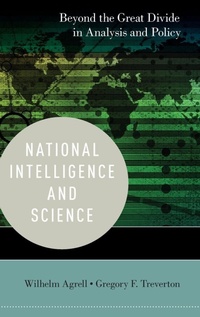
National Intelligence and Science
Beyond the Great Divide in Analysis and Policy
Published on 15. January 2015
Book
Hardback
234 pages
978-0-19-936086-4 (ISBN)
Description
Intelligence is currently facing increasingly challenging cross-pressures from both a need for accurate and timely assessments of potential or imminent security threats and the unpredictability of many of these emerging threats. We are living in a social environment of growing security and intelligence challenges, yet the traditional, narrow intelligence process is becoming increasingly insufficient for coping with diffuse, complex, and rapidly-transforming threats. The essence of intelligence is no longer the collection, analysis, and dissemination of secret information, but has become instead the management of uncertainty in areas critical for overriding security goals---not only for nations, but also for the international community as a whole. For its part, scientific research on major societal risks like climate change is facing a similar cross-pressure from demand on the one hand and incomplete data and developing theoretical concepts on the other. For both of these knowledge-producing domains, the common denominator is the paramount challenges of framing and communicating uncertainty and of managing the pitfalls of politicization
National Intelligence and Science is one of the first attempts to analyze these converging domains and the implications of their convergence, in terms of both more scientific approaches to intelligence problems and intelligence approaches to scientific problems. Science and intelligence constitute, as the book spells out, two remarkably similar and interlinked domains of knowledge production, yet ones that remain traditionally separated by a deep political, cultural, and epistemological divide.
Looking ahead, the two twentieth-century monoliths---the scientific and the intelligence estates---are becoming simply outdated in their traditional form. The risk society is closing the divide, though in a direction not foreseen by the proponents of turning intelligence analysis into a science, or the new production of scientific knowledge.
National Intelligence and Science is one of the first attempts to analyze these converging domains and the implications of their convergence, in terms of both more scientific approaches to intelligence problems and intelligence approaches to scientific problems. Science and intelligence constitute, as the book spells out, two remarkably similar and interlinked domains of knowledge production, yet ones that remain traditionally separated by a deep political, cultural, and epistemological divide.
Looking ahead, the two twentieth-century monoliths---the scientific and the intelligence estates---are becoming simply outdated in their traditional form. The risk society is closing the divide, though in a direction not foreseen by the proponents of turning intelligence analysis into a science, or the new production of scientific knowledge.
More details
Language
English
Place of publication
New York
United States
Target group
College/higher education
Professional and scholarly
Dimensions
Height: 240 mm
Width: 161 mm
Thickness: 18 mm
Weight
563 gr
ISBN-13
978-0-19-936086-4 (9780199360864)
Copyright in bibliographic data and cover images is held by Nielsen Book Services Limited or by the publishers or by their respective licensors: all rights reserved.
Schweitzer Classification
Other editions
Additional editions
Wilhelm Agrell | Gregory F. Treverton
National Intelligence and Science
Beyond the Great Divide in Analysis and Policy
E-Book
12/2014
1st Edition
OUP eBook
€30.49
Available for download
Wilhelm Agrell | Gregory F. Treverton
National Intelligence and Science
Beyond the Great Divide in Analysis and Policy
E-Book
12/2014
1st Edition
OUP eBook
€30.49
Available for download
Persons
Wilhelm Agrell is Professor of Intelligence Analysis at Lund University, Sweden and Visiting Professor at the Swedish National Defence College, Stockholm. He has a background in Swedish intelligence and military service in the Middle East. As an academic scholar, he received a Ph.D. in history at Lund University in 1985 and has written over 25 books, primarily dealing with Cold War history and Swedish security. He has been active in establishing intelligence analysis as an academic field and became the first Scandinavian professor in the subject in 2006. In addition to his academic work, he has also written several novels, some of which were translated into Finnish and German.
Gregory Treverton is Director of the RAND Corporation's Center for Global Risk and Security and a Visiting Scholar at the Swedish National Defence College, Stockholm. In government, he has served the first Senate Select Committee on Intelligence, the National Security Council, and as Vice Chair of the National Intelligence Council. He has taught at Harvard University and Columbia University as well as the RAND Graduate School. He is the author or editor of three dozen books and major monographs, principally on intelligence, strategy, nuclear issues, Europe, and Latin America.
Gregory Treverton is Director of the RAND Corporation's Center for Global Risk and Security and a Visiting Scholar at the Swedish National Defence College, Stockholm. In government, he has served the first Senate Select Committee on Intelligence, the National Security Council, and as Vice Chair of the National Intelligence Council. He has taught at Harvard University and Columbia University as well as the RAND Graduate School. He is the author or editor of three dozen books and major monographs, principally on intelligence, strategy, nuclear issues, Europe, and Latin America.
Author
Professor in Intelligence AnalysisProfessor in Intelligence Analysis, Research Policy Institute, Lund University, Sweden, and Guest Professor, Swedish National Defence College
Senior Policy Analyst and DirectorSenior Policy Analyst and Director, Center for Global Risk and Security, RAND, Santa Monica, California
Content
1. Introduction: The Odd Twins of Uncertainty ; 2. Framing the Divide ; 3. What Is Analysis? Roads Not Taken ; 4. Intelligence Challenges in Scientific Research ; 5. Exploring Other Domains ; 6. Common Core Issues: Intelligence Analysis, Medicine, and Policy Analysis ; 7. Challenges for Intelligence ; 8. Politicization: Disseminating and Distorting Knowledge ; 9. Beyond the Divide: Framing and Assessing Risks under Prevailing Uncertainty