

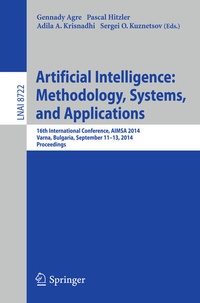
Artificial Intelligence: Methodology, Systems, and Applications
16th International Conference, AIMSA 2014, Varna, Bulgaria, September 11-13, 2014, Proceedings
Published on 23. September 2014
Book
Paperback/Softback
XIX, 302 pages
978-3-319-10553-6 (ISBN)
Description
This book constitutes the refereed proceedings of the 16th International Conference on Artificial Intelligence: Methodology, Systems, and Applications, AIMSA 2014, held in Varna, Bulgaria in September 2014. The 14 revised full papers and 9 short papers presented were carefully reviewed and selected from 53 submissions. The range of topics is almost equally broad, from traditional areas such as computer vision and natural language processing to emerging areas such as mining the behavior of Web-based communities.
More details
Series
Edition
2014 ed.
Language
English
Place of publication
Cham
Switzerland
Publishing group
Springer International Publishing
Target group
Professional and scholarly
Research
Illustrations
80 s/w Abbildungen
XIX, 302 p. 80 illus.
Dimensions
Height: 235 mm
Width: 155 mm
Thickness: 18 mm
Weight
493 gr
ISBN-13
978-3-319-10553-6 (9783319105536)
DOI
10.1007/978-3-319-10554-3
Schweitzer Classification
Other editions
Additional editions

Gennady Agre | Pascal Hitzler | Adila a. Krisnadhi
Artificial Intelligence: Methodology, Systems, and Applications
16th International Conference, AIMSA 2014, Varna, Bulgaria, September 11-13, 2014, Proceedings
E-Book
09/2014
Springer
€53.49
Available for download
Persons
Content
Learning Probabilistic Semantic Network of Object-oriented Action and Activity.- Semantic-aware Expert Partitioning.- User-Level Opinion Propagation Analysis in Discussion Forum Threads.- Social News Feed Recommender.- Boolean Matrix Factorisation for Collaborative Filtering: An FCA-Based Approach.- Semi-Supervised Image Segmentation.- Analysis of Rumor Spreading in Communities Based on Modified SIR Model in Microblog.- Modeling a System for Decision Support in Snow Avalanche Warning.- Using Balanced Random Forest and Weighted Random Forest.- Applying Language Technologies on Healthcare Patient Records for Better Treatment of Bulgarian Diabetic Patients.- Incrementally Building Partially Path Consistent Qualitative Constraint Networks.- A Qualitative Spatio-Temporal Framework Based on Point Algebra.- Training Datasets Collection and Evaluation of Feature Selection Methods for Web Content Filtering.- Feature Selection by Distributions Contrasting.- Educational Data Mining for Analysis of Students' Solutions.