

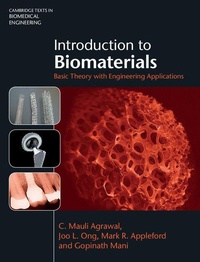
Introduction to Biomaterials
Basic Theory with Engineering Applications
Published on 7. November 2013
Book
Hardback
419 pages
978-0-521-11690-9 (ISBN)
Description
This succinct textbook gives students the perfect introduction to the world of biomaterials, linking the fundamental properties of metals, polymers, ceramics and natural biomaterials to the unique advantages and limitations surrounding their biomedical applications. Clinical concerns such as sterilization, surface modification, cell-biomaterial interactions, drug delivery systems and tissue engineering are discussed in detail, giving students practical insight into the real-world challenges associated with biomaterials engineering; key definitions, equations and concepts are concisely summarised alongside the text, allowing students to quickly and easily identify the most important information; and bringing together elements from across the book, the final chapter discusses modern commercial implants, challenging students to consider future industrial possibilities. Concise enough to be taught in a single semester, and requiring only a basic understanding of biology, this balanced and accessible textbook is the ideal introduction to biomaterials for students of engineering and materials science.
Reviews / Votes
'This is a book that is destined to be a classic in biomaterials education. Written by leading bioengineers and scientists, it can serve not only as a textbook to support a semester-long undergraduate course, but also as an introduction to graduate-level classes. It is a well-written, comprehensive compendium of traditional and also modern knowledge on all aspects of biomaterials, and I am sure that both students and instructors will embrace it and use it widely.' Kyriacos A. Athanasiou, University of California, Davis 'This well compiled book is readily accessible to a wide readership, as the authors do not assume background knowledge of any particular field of study. Moreover, Introduction to Biomaterials strikes a pleasing balance between life science and engineering, so that both scientific principles and engineering applications are presented with a view to blending theory and practice.' Andrew Taylor-Robinson, The BiologistMore details
Series
Language
English
Place of publication
Cambridge
United Kingdom
Target group
College/higher education
Professional and scholarly
Product notice
sewn/stitched
Cloth over boards
Illustrations
Worked examples or Exercises; 100 Halftones, unspecified; 138 Line drawings, unspecified
Dimensions
Height: 260 mm
Width: 208 mm
Thickness: 27 mm
Weight
1122 gr
ISBN-13
978-0-521-11690-9 (9780521116909)
Copyright in bibliographic data and cover images is held by Nielsen Book Services Limited or by the publishers or by their respective licensors: all rights reserved.
Schweitzer Classification
Other editions
New editions
C. Mauli Agrawal | Joo L. Ong | Mark R. Appleford
Introduction to Biomaterials
Basic Theory with Engineering Applications
Book
11/2025
2nd Edition
Cambridge University Press
€121.00
Shipment within 15-20 days
Additional editions
C. Mauli Agrawal | Joo L. Ong | Mark R. Appleford
Introduction to Biomaterials
Basic Theory with Engineering Applications
E-Book
11/2013
1st Edition
Cambridge University Press
€66.49
Available for download
E-Book
11/2013
Cambridge University Press
€56.49
Available for download
Persons
C. M. Agrawal is the Vice President for Research at the University of Texas at San Antonio, and the Peter Flawn Professor of Biomedical Engineering, specializing in orthopaedic and cardiovascular biomaterials and implants. He is a member of the International College of Fellows of Biomaterials Science and Engineering, a Fellow of the American Institute for Medical and Biological Engineering, a former President of the Society for Biomaterials, and was awarded the 2010 Julio Palmaz Award for Innovation in Healthcare and the Biosciences. J. L. Ong is Chair of the Department of Biomedical Engineering and the USAA Foundation Distinguished Professor at the University of Texas, San Antonio, where his research focuses on modification and characterization of biomaterials surfaces for dental and orthopaedic applications, tissue engineering ceramic scaffolds, protein-biomaterial interactions and bone-biomaterial interactions. He is a Fellow of the American Institute for Medical and Biological Engineering. Mark Appleford is an Assistant Professor of Biomedical Engineering at the University of Texas, San Antonio, focusing on tissue-biomaterial interactions, cellular engineering, reconstructive tissue engineering, and biocompatibility. Gopinath Mani is an Assistant Professor of Biomedical Engineering at the University of South Dakota, focusing on surface modification and characterization of biomaterials, nanomaterials and nanomedicine, biodegradable metals and drug delivery systems. He is the Program Chair for the Surface Characterization and Modification Special Interest Group of the Society for Biomaterials, and has developed and taught numerous graduate-level programs in biomaterials engineering.
Content
1. Introduction; 2. Basic properties of materials; 3. Biological systems; 4. Characterization of biomaterials; 5. Metals: structure and properties; 6. Polymers; 7. Ceramics; 8. Natural biomaterials; 9. Surface modification; 10. Sterilization of biomedical implants; 11. Cell-biomaterial interactions; 12. Drug delivery systems; 13. Tissue engineering; 14. Clinical applications.