

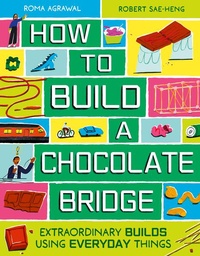
How to Build a Chocolate Bridge
Extraordinary Builds Using Everyday Things
1st Edition
Published on 9. April 2026
Book
Hardback
48 pages
978-1-5102-3158-0 (ISBN)
Description
> Faktenreiche, praxisnahe Einführung in ein wichtiges MINT-Thema, das Kinder zum Bauen und Experimentieren anregt
> Enthält sieben faszinierende Bauprojekte
> Mit farbenfrohen Illustrationen und Schritt-für-Schritt-Anleitungen
Kann man aus Nudeln einen Wolkenkratzer bauen? Wie wäre es mit einer Rakete aus Baiser? Oer einer Brücke aus Schokolade? Das mag unmöglich (und köstlich) klingen, aber man kann sich nicht sicher sein, bis man es versucht hat! In diesem Buch finden Kinder anhand von sieben interaktiven Bauprojekten heraus, ob diese Bau-Ideen möglich sind, und entdecken gleichzeitig die Wissenschaft hinter beeindruckenden Erfindungen. Sie lernen dabei außerdem einige Wissenschaftler*innen kennen, die mit ungewöhnlichen Materialien experimentiert haben, um etwas Großartiges zu schaffen.
Die preisgekrönten Ingenieurin Roma Agrawal ermutigt Kinder, einige unerwartete Materialien auf die Probe zu stellen - der perfekte Weg, um Kinder für die Wissenschaft zu begeistern und dabei eine Menge Spaß zu haben!
Reviews / Votes
I am a great believer in learning by doing, and this fantastic STEM-themed book not only has a title that will capture children's attention, but is filled with practical ideas to engage the learning of engineering principles. This is the second children's non-fiction title that I have read which has been authored by Roma Agrawal, and I love the way that this prize-winning structural engineer is able to make complex engineering accessible for anyone.The book begins by describing why specific materials need to be chosen for manufacturing different products or for building certain structures. The author then explains the physics concepts behind engineering in child-friendly language, starting with bridge building. There is then a fascinating challenge set - to build a bridge with a chocolate bar, and after testing the strength of the bridge, children are then encouraged to reinforce melted chocolate with gummy laces, reflecting the way that concrete is reinforced with steel. I know that when my children were at primary school they worked on a bridge-building project as part of the science curriculum, and I imagine that this book will give teachers an exciting new perspective on teaching this topic. The engineering does not stop with bridges. Rockets, insulation, trumpets, pianos, bubbles, plastic and skyscrapers are all explored, both with facts and practical experiments which can be performed at school or in the home. There are also spreads covering scientists and engineers who made surprising or accidental discoveries and a look at materials being developed now to tackle challenges of the future, such as degradable plastics.
There are so many aspects of this book that I loved. Firstly, the information is presented in small accessible panels on full colour pages (where there is always a good contrast between text and background colours) and therefore easily digestible. The illustrations by Robert Sae-Heng are distinctive and always add to the understanding of the facts or principles being described. I loved the emphasis on learning from mistakes, which helps children to feel able to experiment freely, without the anxiety that they might get it wrong. I think that Roma Agrawal has an amazing ability to explain the principles of her complex profession in terms and with examples that can be understood by anyone.
How to Build a Chocolate Bridge is a book which I would recommend to teachers, librarians, parents and caregivers of all primary school children. With the long summer holidays approaching, there are ideas here for activities that could entertain and educate young brains, and perhaps inspire future scientists and engineers. * V'S Views from the Bookcase *
More details
Language
English
Place of publication
London
United Kingdom
Publishing group
Hachette Children's Group
Target group
Children/juvenile
Kleine Nachwuchs-Wissenschaftler*innen
Product notice
Trade binding
Illustrations
Farbig illustriert
Dimensions
Height: 296 mm
Width: 228 mm
Thickness: 11 mm
Weight
498 gr
ISBN-13
978-1-5102-3158-0 (9781510231580)
Schweitzer Classification
Other editions
Additional editions
E-Book
04/2026
Laurence King Publishing
€9.49
Available for download
Persons
Roma Agrawal (Author)
Roma Agrawal (MBE) is an award-winning engineer, author and broadcaster. She spent six years working on the Shard, designing its foundations and spire.
She has featured on BBC World News, BBC Daily Politics, The Evening Standard, The Sunday Times, Guardian, Telegraph, Independent, Cosmopolitan and Stylist Magazine. She has even featured as a judge of Lego Masters and is winner of a Royal Academy of Engineering Award, ACE Engineering Excellent Awards, Institute of Structural Engineers Lewis Kent Medal and Young Structural Engineer of the Year, Management Today and Women in Construction awards.
She is a tireless promoter of engineering and technical careers for young people, particularly under-represented groups such as women. She has advised policymakers and governments on science education and has given talks to thousands around the world at universities, schools and organisations, including two for TEDx.
Robert Sae-Heng (Illustrator)
Robert Sae-Heng is an illustrator and artist living in London, UK with his fantastically large cheese plant, Elvis. He has Mexican and Thai origins, and began his childhood on a tiny farm in Mexico before moving to London as a teenager. Robert uses colour, texture and playfulness to portray emotion and narrative. This began in childhood as he spent his early years unable to hear. His favourite things to draw are quaint chairs and silly seals.
He has a BA degree in Illustration and more than 10 years experience across branding, packaging, publishing and advertising industries.
Robert loves to travel and explore, all while documenting what he experiences with pencil and paper. By doing this he absorbs cultures, which helps him to better understand his place in the world.
Roma Agrawal (MBE) is an award-winning engineer, author and broadcaster. She spent six years working on the Shard, designing its foundations and spire.
She has featured on BBC World News, BBC Daily Politics, The Evening Standard, The Sunday Times, Guardian, Telegraph, Independent, Cosmopolitan and Stylist Magazine. She has even featured as a judge of Lego Masters and is winner of a Royal Academy of Engineering Award, ACE Engineering Excellent Awards, Institute of Structural Engineers Lewis Kent Medal and Young Structural Engineer of the Year, Management Today and Women in Construction awards.
She is a tireless promoter of engineering and technical careers for young people, particularly under-represented groups such as women. She has advised policymakers and governments on science education and has given talks to thousands around the world at universities, schools and organisations, including two for TEDx.
Robert Sae-Heng (Illustrator)
Robert Sae-Heng is an illustrator and artist living in London, UK with his fantastically large cheese plant, Elvis. He has Mexican and Thai origins, and began his childhood on a tiny farm in Mexico before moving to London as a teenager. Robert uses colour, texture and playfulness to portray emotion and narrative. This began in childhood as he spent his early years unable to hear. His favourite things to draw are quaint chairs and silly seals.
He has a BA degree in Illustration and more than 10 years experience across branding, packaging, publishing and advertising industries.
Robert loves to travel and explore, all while documenting what he experiences with pencil and paper. By doing this he absorbs cultures, which helps him to better understand his place in the world.