

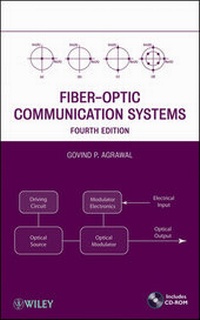
Fiber-Optic Communication Systems
4th Edition
Published on 2. November 2010
Book
Hardback
626 pages
978-0-470-50511-3 (ISBN)
Description
This book provides a comprehensive account of fiber-optic communication systems. The 3rd edition of this book is used worldwide as a textbook in many universities. This 4th edition incorporates recent advances that have occurred, in particular two new chapters. One deals with the advanced modulation formats (such as DPSK, QPSK, and QAM) that are increasingly being used for improving spectral efficiency of WDM lightwave systems. The second chapter focuses on new techniques such as all-optical regeneration that are under development and likely to be used in future communication systems. All other chapters are updated, as well.
Reviews / Votes
"Despite the otherwise excellent quality of the book, there are also several typos, in the text as well as in the problems." (Optics and Photonics News, 13 May 2011)More details
Product info
Book with CD-ROM
Series
Edition
4. Auflage
Language
English
Place of publication
New York
United States
Target group
Professional and scholarly
Illustrations
Charts: 0 B&W, 0 Color
Dimensions
Height: 23.9 cm
Width: 16.5 cm
Thickness: 3.6 cm
Weight
1034 gr
ISBN-13
978-0-470-50511-3 (9780470505113)
Schweitzer Classification
Other editions
New editions
Govind P. Agrawal
Fiber-Optic Communication Systems
Book
06/2021
5th Edition
Wiley-Blackwell
€164.50
Shipment within 15-20 days
Additional editions
Govind P. Agrawal
Fiber-Optic Communication Systems
E-Book
02/2012
4th Edition
Wiley
€122.99
Available for download
Govind P. Agrawal
Fiber-Optic Communication Systems
E-Book
11/2010
4th Edition
Wiley
€122.99
Available for download
Previous edition
Govind P. Agrawal
Fiber-Optic Communication Systems
Book
06/2002
3rd Edition
Wiley
€122.00
Article exhausted; check for reprint
Person
Govind P. Agrawal is a professor at the Institute of Optics at the University of Rochester and a Fellow of both the Optical Society of America and the Institute of Electrical and Electronics Engineering. He is also a Senior Scientist at the Laboratory for Laser Energetics. Dr. Agrawal is author or coauthor of more than 300 research papers, book chapters, and monographs.
Content
Preface.
1 Introduction.
1.1 Historical Perspective.
1.2 Basic Concepts.
1.3 Optical Communication Systems.
1.4 Lightwave System Components.
Problems.
References.
2 Optical Fibers.
2.1 Geometrical-Optics Description.
2.2 Wave Propagation.
2.3 Dispersion in Single-Mode Fibers.
2.4 Dispersion-Induced Limitations.
2.5 Fiber Losses.
2.6 Nonlinear Optical Effects.
2.7 Fiber Design and Fabrication.
Problems.
References.
3 Optical Transmitters.
3.1 Semiconductor Laser Physics.
3.2 Single-Mode Semiconductor Lasers.
3.3 Laser Characteristics.
3.4 Optical Signal Generation.
3.5 Light-Emitting Diodes.
3.6 Transmitter Design.
Problems.
References.
4 Optical Receivers.
4.1 Basic Concepts.
4.2 Common Photodetectors.
4.3 Receiver Design.
4.4 Receiver Noise.
4.5 Coherent Detection.
4.6 Receiver Sensitivity.
4.7 Sensitivity Degradation.
4.8 Receiver Performance.
Problems.
References.
5 Lightwave Systems.
5.1 System Architectures.
5.2 Design Guidelines.
5.3 Long-Haul Systems.
5.4 Sources of Power Penalty.
5.5 Forward Error Correction.
5.6 Computer-Aided Design.
Problems.
References.
6 Multichannel Systems.
6.1 WDM Lightwave Systems.
6.2 WDM Components.
6.3 System Performance Issues.
6.4 Time-Division Multiplexing.
6.5 Subcarrier Multiplexing.
6.6 Code-Division Multiplexing.
Problems.
References.
7 Loss Management.
7.1 Compensation of Fiber Losses.
7.2 Erbium-Doped Fiber Amplifiers.
7.3 Raman Amplifiers.
7.4 Optical Signal-To-Noise Ratio.
7.5 Electrical Signal-To-Noise Ratio.
7.6 Receiver Sensitivity and Q Factor.
7.7 Role of Dispersive and Nonlinear Effects.
7.8 Periodically Amplified Lightwave Systems.
Problems.
References.
8 Dispersion Management.
8.1 Dispersion Problem and Its Solution.
8.2 Dispersion-Compensating Fibers.
8.3 Fiber Bragg Gratings.
8.4 Dispersion-Equalizing Filters.
8.5 Optical Phase Conjugation.
8.6 Channels at High Bit Rates.
8.7 Electronic Dispersion Compensation.
Problems.
References.
9 Control of Nonlinear Effects.
9.1 Impact of Fiber Nonlinearity.
9.2 Solitons in Optical Fibers.
9.3 Dispersion-Managed Solitons.
9.4 Pseudo-linear Lightwave Systems.
9.5 Control of Intrachannel Nonlinear Effects.
Problems.
References.
10 Advanced Lightwave Systems.
10.1 Advanced Modulation Formats.
10.2 Demodulation Schemes.
10.3 Shot Noise and Bit-Error Rate.
10.4 Sensitivity Degradation Mechanisms.
10.5 Impact of Nonlinear Effects.
10.6 Recent Progress.
10.7 Ultimate Channel Capacity.
Problems.
References.
11 Optical Signal Processing.
11.1 Nonlinear Techniques and Devices.
11.2 All-Optical Flip-Flops.
11.3 Wavelength Converters.
11.4 Ultrafast Optical Switching.
11.5 Optical Regenerators.
Problems.
References.
A System of Units.
B Acronyms.
C General Formula for Pulse Broadening.
D Software Package.
1 Introduction.
1.1 Historical Perspective.
1.2 Basic Concepts.
1.3 Optical Communication Systems.
1.4 Lightwave System Components.
Problems.
References.
2 Optical Fibers.
2.1 Geometrical-Optics Description.
2.2 Wave Propagation.
2.3 Dispersion in Single-Mode Fibers.
2.4 Dispersion-Induced Limitations.
2.5 Fiber Losses.
2.6 Nonlinear Optical Effects.
2.7 Fiber Design and Fabrication.
Problems.
References.
3 Optical Transmitters.
3.1 Semiconductor Laser Physics.
3.2 Single-Mode Semiconductor Lasers.
3.3 Laser Characteristics.
3.4 Optical Signal Generation.
3.5 Light-Emitting Diodes.
3.6 Transmitter Design.
Problems.
References.
4 Optical Receivers.
4.1 Basic Concepts.
4.2 Common Photodetectors.
4.3 Receiver Design.
4.4 Receiver Noise.
4.5 Coherent Detection.
4.6 Receiver Sensitivity.
4.7 Sensitivity Degradation.
4.8 Receiver Performance.
Problems.
References.
5 Lightwave Systems.
5.1 System Architectures.
5.2 Design Guidelines.
5.3 Long-Haul Systems.
5.4 Sources of Power Penalty.
5.5 Forward Error Correction.
5.6 Computer-Aided Design.
Problems.
References.
6 Multichannel Systems.
6.1 WDM Lightwave Systems.
6.2 WDM Components.
6.3 System Performance Issues.
6.4 Time-Division Multiplexing.
6.5 Subcarrier Multiplexing.
6.6 Code-Division Multiplexing.
Problems.
References.
7 Loss Management.
7.1 Compensation of Fiber Losses.
7.2 Erbium-Doped Fiber Amplifiers.
7.3 Raman Amplifiers.
7.4 Optical Signal-To-Noise Ratio.
7.5 Electrical Signal-To-Noise Ratio.
7.6 Receiver Sensitivity and Q Factor.
7.7 Role of Dispersive and Nonlinear Effects.
7.8 Periodically Amplified Lightwave Systems.
Problems.
References.
8 Dispersion Management.
8.1 Dispersion Problem and Its Solution.
8.2 Dispersion-Compensating Fibers.
8.3 Fiber Bragg Gratings.
8.4 Dispersion-Equalizing Filters.
8.5 Optical Phase Conjugation.
8.6 Channels at High Bit Rates.
8.7 Electronic Dispersion Compensation.
Problems.
References.
9 Control of Nonlinear Effects.
9.1 Impact of Fiber Nonlinearity.
9.2 Solitons in Optical Fibers.
9.3 Dispersion-Managed Solitons.
9.4 Pseudo-linear Lightwave Systems.
9.5 Control of Intrachannel Nonlinear Effects.
Problems.
References.
10 Advanced Lightwave Systems.
10.1 Advanced Modulation Formats.
10.2 Demodulation Schemes.
10.3 Shot Noise and Bit-Error Rate.
10.4 Sensitivity Degradation Mechanisms.
10.5 Impact of Nonlinear Effects.
10.6 Recent Progress.
10.7 Ultimate Channel Capacity.
Problems.
References.
11 Optical Signal Processing.
11.1 Nonlinear Techniques and Devices.
11.2 All-Optical Flip-Flops.
11.3 Wavelength Converters.
11.4 Ultrafast Optical Switching.
11.5 Optical Regenerators.
Problems.
References.
A System of Units.
B Acronyms.
C General Formula for Pulse Broadening.
D Software Package.