

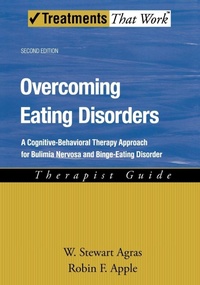
Overcoming Eating Disorders
A Cognitive-Behavioral Therapy Approach for Bulimia Nervosa and Binge-Eating Disorder, Therapist Guide
2nd Edition
Published on 20. September 2007
Book
Paperback/Softback
144 pages
978-0-19-531169-3 (ISBN)
Description
The Overcoming Eating Disorders, Second Edition program addresses the cognitive-behavioral treatment of Bulimia Nervosa and Binge Eating Disorder. CBT has been proven the most effective treatment for helping patients improve their eating habits and overcome their disorder.
The treatment described is divided into three overlapping phases: behavior change, identifying binge triggers, and relapse prevention. The main focus of the program is the normalization of eating. Patients use self-monitoring forms to track their eating habits on a daily basis while they work toward establishing a pattern of 3 meals and 2 snacks per day eaten at regular intervals. Once a regular pattern of eating has been established, patients move on to recognizing and eliminating their triggers for binging and purging. CBT techniques like problem-solving and cognitive restructuring help patients deal with negative mood states, faulty interpersonal interactions, and errors in thinking. The final phase of treatment consists of a review of the positive changes that have occurred during treatment, as well as a discussion of any residual problems and ways to handle setbacks or lapses. Homework exercises are assigned at each session and play an important role in keeping patients motivated throughout the duration of treatment.
This newly revised and updated Therapist Guide includes expanded information regarding weight and shape concerns and an entirely new chapter on adapting the treatment for use as a time-limited, therapist-assisted self-help program. Complete with step-by-step instructions for delivering the treatment, this guide is an indispensable resource that no clinician can do without.
The treatment described is divided into three overlapping phases: behavior change, identifying binge triggers, and relapse prevention. The main focus of the program is the normalization of eating. Patients use self-monitoring forms to track their eating habits on a daily basis while they work toward establishing a pattern of 3 meals and 2 snacks per day eaten at regular intervals. Once a regular pattern of eating has been established, patients move on to recognizing and eliminating their triggers for binging and purging. CBT techniques like problem-solving and cognitive restructuring help patients deal with negative mood states, faulty interpersonal interactions, and errors in thinking. The final phase of treatment consists of a review of the positive changes that have occurred during treatment, as well as a discussion of any residual problems and ways to handle setbacks or lapses. Homework exercises are assigned at each session and play an important role in keeping patients motivated throughout the duration of treatment.
This newly revised and updated Therapist Guide includes expanded information regarding weight and shape concerns and an entirely new chapter on adapting the treatment for use as a time-limited, therapist-assisted self-help program. Complete with step-by-step instructions for delivering the treatment, this guide is an indispensable resource that no clinician can do without.
More details
Series
Edition
2nd Revised edition
Language
English
Place of publication
New York
United States
Target group
Professional and scholarly
Edition type
Revised edition
Illustrations
13 black and white illustrations
Dimensions
Height: 254 mm
Width: 178 mm
Thickness: 8 mm
Weight
286 gr
ISBN-13
978-0-19-531169-3 (9780195311693)
Copyright in bibliographic data and cover images is held by Nielsen Book Services Limited or by the publishers or by their respective licensors: all rights reserved.
Schweitzer Classification
Other editions
Previous edition
W.Stewart Agras
Overcoming Eating Disorders: A Cognitive-Behavioral Treatment for Bulimia Nervosa and Bing-Eating Disorder
A cognitive-behavioral treatment for Bulimia Nervosa and binge-eating disorder
Book
11/2004
Oxford University Press Inc
€24.79
Article exhausted; check for reprint
Persons
W. Stewart Agras is Professor Emeritus of Psychiatry and Behavioral Sciences at Stanford School of Medicine.
Robin F. Apple is Clinical Associate Professor of Psychiatry and Behavioral Sciences at Stanford School of Medicine.
Robin F. Apple is Clinical Associate Professor of Psychiatry and Behavioral Sciences at Stanford School of Medicine.
Author
Professor Emeritus of Psychiatry and Behavioral SciencesProfessor Emeritus of Psychiatry and Behavioral Sciences, Stanford School of Medicine, Stanford, California, USA
Clinical Associate Professor of Psychiatry and Behavioral SciencesClinical Associate Professor of Psychiatry and Behavioral Sciences, Stanford School of Medicine, Stanford, California, USA
Content
TREATMENT PHASE 1 - BEHAVIOR CHANGE; TREATMENT PHASE 2 - IDENTIFYING BINGE TRIGGERS; TREATMENT PHASE 3 - MAINTAINING CHANGE; GUIDED SELF-HELP