

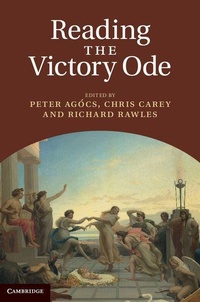
Reading the Victory Ode
Published on 9. August 2012
Book
Hardback
444 pages
978-1-107-00787-1 (ISBN)
Description
The victory ode was a short-lived poetic genre in the fifth century BC, but its impact has been substantial. Pindar, Bacchylides and others are now among the most widely read Greek authors precisely because of their significance for the literary development of poetry between Homer and tragedy and their historical involvement in promoting Greek rulers. Their influence was so great that it ultimately helped to define the European notion of lyric from the Renaissance onwards. This collection of essays by international experts examines the victory ode from a range of angles: its genesis and evolution, the nature of the commissioning process, the patrons, context of performance and re-performance, and the poetics of the victory ode and its exponents. From these different perspectives the contributors offer both a panoramic view of the genre and an insight into the modern research positions on this complex and fascinating subject.
More details
Language
English
Place of publication
Cambridge
United Kingdom
Target group
Professional and scholarly
Illustrations
10 Halftones, black and white; 5 Line drawings, black and white
Dimensions
Height: 235 mm
Width: 157 mm
Thickness: 28 mm
Weight
790 gr
ISBN-13
978-1-107-00787-1 (9781107007871)
Copyright in bibliographic data and cover images is held by Nielsen Book Services Limited or by the publishers or by their respective licensors: all rights reserved.
Schweitzer Classification
Other editions
Additional editions
Peter Agocs | Chris Carey | Richard Rawles
Reading the Victory Ode
Book
09/2016
Cambridge University Press
€55.80
Shipment within 15-20 days
Peter Agocs | Chris Carey | Richard Rawles
Reading the Victory Ode
E-Book
09/2012
1st Edition
Cambridge University Press
€26.49
Available for download
Peter Agocs
Reading the Victory Ode
E-Book
08/2012
Cambridge University Press
€23.49
Available for download
Persons
Peter Agocs is an Affiliated Lecturer in the Faculty of Classics at the University of Cambridge. He spent the last four years as a Junior Research Fellow at Christ's College, Cambridge. Chris Carey is Professor of Greek at University College London. Richard Rawles is a lecturer in Classics in the School of History, Classics and Archaeology at the University of Edinburgh.
Content
Part I. The Lost History of Epinician: 1. Early Epinician: Ibycus and Simonides Richard Rawles; 2. The lost Isthmian Odes of Pindar Giovan Battista D'Alessio; 3. Epinician sounds: Pindar and musical innovation Lucia Prauscello; 4. Pindar and his patrons Ewen Bowie; 5. What happened later to the families of Pindaric patrons - and to Epinician poetry? Simon Hornblower; Part II. Contexts of Performance and Re-Performance: 6. Performance, re-performance, and Pindar's audiences A. D. Morrison; 7. Performance and re-performance: the Siphnian treasury evoked Lucia Athanassaki; 8. Representations of cult in Epinician poetry Franco Ferrari; 9. Epinician and the Symposion: a comparison with the Enkomia Felix Budelmann; 10. Performance and genre: reading Pindar's ????? Peter Agocs; 11. Pindar's 'difficulty' and the performance of Epinician poetry: some suggestions from ethnography Rosalind Thomas; Part III. Critical Approaches to the Victory Ode: Rhetoric, Imagery, and Narrative: 12. Poet and public: communicative strategies in Pindar and Bacchylides Glenn W. Most; 13. Image and world in Epinician poetry G. O. Hutchinson; 14. Metaphorical travel and ritual performance in Epinician poetry Claude Calame; 15. Bacchylidean myths David Fearn; 16. Reading Pindar Michael Silk.