

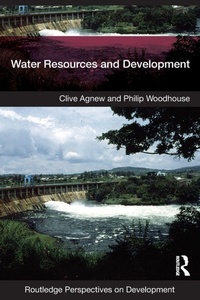
Water Resources and Development
1st Edition
Published on 1. November 2010
Book
Paperback/Softback
346 pages
978-0-415-45139-0 (ISBN)
Description
Since the start of the twenty-first century there has been an unprecedented focus upon water as a key factor in the future of both society and environment. Water management lies at the heart of strategies of development as does the added the hazard of climate change.
Water Resources and Development provides a stimulating interdisciplinary introduction to the role of water resources in shaping opportunities and constraints for development. The book begins by charting the evolution of approaches to water management. It identifies an emerging polarization in the late twentieth century between 'technical' and 'social' strategies. In the past decade these two axes of policy debate have been further intersected by discussion of the scale at which management decisions should be made: the relative effectiveness of 'global' and 'local' governance of water. A variety of case studies elaborate this analytical framework, exemplifying four key development challenges: economic growth, poverty reduction, competition and conflict over water, and adaptation to climate change. Current 'best practice' for water management is examined, addressing strategies of water supply augmentation, the ecological implications of intensified use, and strategies of demand management guided by economic or political principles. It is argued defining 'successful' water management and best practice requires first the establishment of development goals and the implicit trade-offs between water consumption and conservation.
This engaging and insightful text offers a unique interdisciplinary analysis by integrating scientific, engineering, social and political perspectives. This is an essential text for courses on development studies, geography, earth sciences and the environment.
Water Resources and Development provides a stimulating interdisciplinary introduction to the role of water resources in shaping opportunities and constraints for development. The book begins by charting the evolution of approaches to water management. It identifies an emerging polarization in the late twentieth century between 'technical' and 'social' strategies. In the past decade these two axes of policy debate have been further intersected by discussion of the scale at which management decisions should be made: the relative effectiveness of 'global' and 'local' governance of water. A variety of case studies elaborate this analytical framework, exemplifying four key development challenges: economic growth, poverty reduction, competition and conflict over water, and adaptation to climate change. Current 'best practice' for water management is examined, addressing strategies of water supply augmentation, the ecological implications of intensified use, and strategies of demand management guided by economic or political principles. It is argued defining 'successful' water management and best practice requires first the establishment of development goals and the implicit trade-offs between water consumption and conservation.
This engaging and insightful text offers a unique interdisciplinary analysis by integrating scientific, engineering, social and political perspectives. This is an essential text for courses on development studies, geography, earth sciences and the environment.
Reviews / Votes
"In this meticulous volume Agnew and Woodhouse...review water scarcity issues and analyze the links between water resources and development in wealthy societies and developing countries."-B. F. Hope, California State University, Chico, Recommended Review, CHOICEMore details
Series
Language
English
Place of publication
London
United Kingdom
Publishing group
Taylor & Francis Ltd
Target group
College/higher education
Illustrations
68 s/w Abbildungen, 2 s/w Photographien bzw. Rasterbilder, 66 s/w Zeichnungen, 59 s/w Tabellen
59 Tables, black and white; 66 Line drawings, black and white; 2 Halftones, black and white; 68 Illustrations, black and white
Dimensions
Height: 234 mm
Width: 156 mm
Thickness: 20 mm
Weight
559 gr
ISBN-13
978-0-415-45139-0 (9780415451390)
Copyright in bibliographic data and cover images is held by Nielsen Book Services Limited or by the publishers or by their respective licensors: all rights reserved.
Schweitzer Classification
Other editions
Additional editions
Clive Agnew | Philip Woodhouse
Water Resources and Development
E-Book
11/2010
1st Edition
Routledge
€59.49
Available for download
Clive Agnew | Philip Woodhouse
Water Resources and Development
E-Book
11/2010
1st Edition
Routledge
€59.49
Available for download
Clive Agnew | Philip Woodhouse
Water Resources and Development
Book
10/2010
1st Edition
Routledge
€237.61
Shipment within 15-20 days
Persons
Clive Agnew is a Professor of Physical Geography at the School of Environment and Development, University of Manchester, UK. He is a physical geographer working on problems of environmental degradation and water management and has worked on the management of water scarcity across Africa and the Middle East. Over the last ten years he has been Head of Geography and Head of the School of Environment and Development at the University of Manchester.
Philip Woodhouse is Senior Lecturer in Environment and Rural Development, Institute for Development Policy and Management, University of Manchester, UK. He is trained as an agricultural scientist and has worked for more than thirty years on land and water management in developing countries. His recent research has focused on the interaction between political, economic and technological factors in changing land and water use, particularly in sub-Saharan Africa.
Philip Woodhouse is Senior Lecturer in Environment and Rural Development, Institute for Development Policy and Management, University of Manchester, UK. He is trained as an agricultural scientist and has worked for more than thirty years on land and water management in developing countries. His recent research has focused on the interaction between political, economic and technological factors in changing land and water use, particularly in sub-Saharan Africa.
Content
1. Water Management Best Practice in the Twenty-First Century 2. Economic Growth, Environmental Limits and Increasing Water Demand 3. Climate Change and Fresh Water Resources 4. Water Resources in Colonial and Post-Independence Agricultural Development 5. Water Supply 6. Water Demand 7. Catchments and Conflicts 8. Water Management. Conclusions