

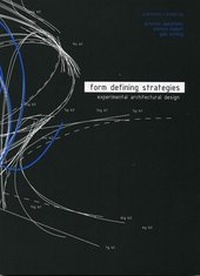
Form Defining Strategies
Experimental Architectural Design
3rd Edition
Published on 7. November 2011
Book
Paperback/Softback
126 pages
978-3-8030-0746-9 (ISBN)
Description
This book examines experimental design methodologies in the field of architecture and their implementation in academic settings. Theoretical considerations by guest essayists and numerous examples of conceptual designs compliment our holistic approach to the subject matter.
The studies collected here emerged during a two day workshop in 2006 with architecture students at the Technical University of Darmstadt. Due to this short time frame, parameters such as functional specifications and local context were not considered. The models that emerged are organizational systems that have been developed through diagrammatic thinking and are therefore capable of representing processed data and strategies.
The starting point of the teaching concept was a divergence from the usual methods and ways of thinking, allowing for new, innovative solutions to emerge during the design process. The development of novel spatial modules, in coherence with material and structural considerations, was actively encouraged.
During the workshop various design techniques were applied that enabled the development of integrative spatial concepts. Geometry played an essential role here. Studies were later developed by following given rules, converting them into diagrams, then finally and perhaps most importantly, through the use of physical models.
Thereby the question of materiality becomes a crucial consideration: the characteristics of different materials that were used for the models did not just influence geometrical possibilities, but brought with them material specific effects, with which spatial qualities could be intensified, explored and organised.
This methodology is based on our conviction that working with physical models is indispensable even in today's all-digital climate. Architects are able to explore unpredictable, unimagined, unexpected and exciting spatiality that can emerge organically during the design process. Novel, innovative spatial structures and systems are discovered and inform this process and subsequent decisions.
It becomes clear that the design process in architecture has to be understood as a conscious, sensible yet ambitious process to investigate and apply innovative notions of space to construction.
The studies collected here emerged during a two day workshop in 2006 with architecture students at the Technical University of Darmstadt. Due to this short time frame, parameters such as functional specifications and local context were not considered. The models that emerged are organizational systems that have been developed through diagrammatic thinking and are therefore capable of representing processed data and strategies.
The starting point of the teaching concept was a divergence from the usual methods and ways of thinking, allowing for new, innovative solutions to emerge during the design process. The development of novel spatial modules, in coherence with material and structural considerations, was actively encouraged.
During the workshop various design techniques were applied that enabled the development of integrative spatial concepts. Geometry played an essential role here. Studies were later developed by following given rules, converting them into diagrams, then finally and perhaps most importantly, through the use of physical models.
Thereby the question of materiality becomes a crucial consideration: the characteristics of different materials that were used for the models did not just influence geometrical possibilities, but brought with them material specific effects, with which spatial qualities could be intensified, explored and organised.
This methodology is based on our conviction that working with physical models is indispensable even in today's all-digital climate. Architects are able to explore unpredictable, unimagined, unexpected and exciting spatiality that can emerge organically during the design process. Novel, innovative spatial structures and systems are discovered and inform this process and subsequent decisions.
It becomes clear that the design process in architecture has to be understood as a conscious, sensible yet ambitious process to investigate and apply innovative notions of space to construction.
More details
Edition
3., veränderte Auflage
Language
English
Place of publication
Turbingen
Germany
Target group
Professional and scholarly
Edition type
Revised edition
Illustrations
355 z.T. farb. Abb.
Dimensions
Height: 19 cm
Width: 14 cm
Weight
225 gr
ISBN-13
978-3-8030-0746-9 (9783803007469)
Schweitzer Classification
Other editions
Previous edition
Asterios Agkathidis | Markus Hudert | Gabi Schillig
Form Defining Strategies
Experimental Architectural Design
Book
07/2009
2nd Edition
Wasmuth Verlag
€16.80
Article exhausted; check for reprint