

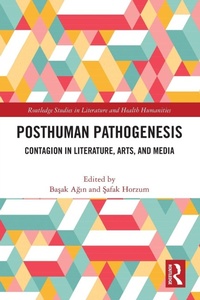
Posthuman Pathogenesis
Contagion in Literature, Arts, and Media
1st Edition
Published on 29. January 2024
Book
Paperback/Softback
258 pages
978-1-032-26428-8 (ISBN)
Description
This multi-vocal assemblage of literary and cultural responses to contagions provides insights into the companionship of posthumanities, environmental humanities, and medical humanities to shed light on how we deal with complex issues like communicable diseases in contemporary times. Examining imaginary and real contagions, ranging from Jeep and SHEVA to plague, HIV/AIDS, and COVID-19, Posthuman Pathogenesis discusses the inextricable links between nature and culture, matter and meaning-making practices, and the human and the nonhuman. Dissecting pathogenic nonhuman bodies in their interactions with their human counterparts and the environment, the authors of this volume raise their diverse voices with two primary aims: to analyse how contagions trigger a drive to survival, and chaotic, liberating, and captivating impulses, and to focus on the viral interpolations in socio-political and environmental systems as a meeting point of science, technology, and fiction, blending social reality and myth. Following the premises of the post-qualitative turn and presenting a differentiated experience of contagion, this 'rhizomatic' compilation thus offers a non-hierarchised array of essays, composed of a multiplicity of genders, geographies, and generations.
More details
Series
Language
English
Place of publication
London
United Kingdom
Publishing group
Taylor & Francis Ltd
Target group
College/higher education
Postgraduate and Undergraduate Advanced
Illustrations
6 s/w Abbildungen, 6 s/w Photographien bzw. Rasterbilder, 4 s/w Tabellen
4 Tables, black and white; 6 Halftones, black and white; 6 Illustrations, black and white
Dimensions
Height: 229 mm
Width: 152 mm
Thickness: 15 mm
Weight
407 gr
ISBN-13
978-1-032-26428-8 (9781032264288)
Copyright in bibliographic data and cover images is held by Nielsen Book Services Limited or by the publishers or by their respective licensors: all rights reserved.
Schweitzer Classification
Other editions
Additional editions
E-Book
07/2022
1st Edition
Routledge
€55.49
Available for download
Book
07/2022
1st Edition
Routledge
€206.60
Shipment within 10-20 days
E-Book
07/2022
1st Edition
Routledge
€55.49
Available for download
Persons
Basak AGIN, Ph.D., is Associate Professor of English Literature and faculty member at TED University, Ankara, Turkey. She is the founder of "PENTACLE: Posthuman Entanglements of Culture, Literature, and Environment," the first Turkish website dedicated to posthumanities (https://thepentacle.org). Her monograph, Posthuemanizm: Kavram, Kuram, Bilim-Kurgu (["Posthumanism: Concept, Theory, Science-Fiction"] 2020, Siyasal), is the first Turkish work to explore science fiction literary/filmic narratives in light of posthumanist-new materialist theories. Dr. Agin edited M. Sibel Dincel's Turkish translation of Simon C. Estok's The Ecophobia Hypothesis (2018, Routledge), which came out in 2021 as Ekofobi Hipotezi (Cappadocia UP), and is currently editing a Turkish handbook of environmental, medical, digital, and posthumanities. She is also co-editing an international volume, Ecofeminism and World Literature: African, Middle Eastern, and Asian Perspectives, with Douglas Vakoch. Her articles appeared in scholarly journals like Neohelicon, CLCWeb, Translation Review, and Ecozon@.
Safak HORZUM, Ph.D., is an independent scholar based in Ankara, Turkey. A former Fulbright Visiting Fellow at Harvard University, Department of English, he focuses on the human-nonhuman relations in fantasy fiction, specifically in the works of Jonathan Swift and Lewis Carroll in his doctoral dissertation. Horzum was awarded in 2016 the ASLE grant for his Turkish-English translation of Oya Baydar's postapocalyptic novel The General of the Garbage Dump, which awaits its publisher. Having received the travel grant from the Ehrenpreis Center for Swift Studies, he will join Westfaelische Wilhelms-Universitaet Muenster in 2022. Horzum's publications in edited volumes and peer-reviewed journals concentrate on translation studies, the theories of men and masculinities as well as queer sexualities in British drama and fiction from the seventeenth century onwards. Horzum is also one of the editors of "PENTACLE: Posthuman Entanglements of Culture, Literature, and Environment," the first Turkish website dedicated to posthumanities (https://thepentacle.org).
Safak HORZUM, Ph.D., is an independent scholar based in Ankara, Turkey. A former Fulbright Visiting Fellow at Harvard University, Department of English, he focuses on the human-nonhuman relations in fantasy fiction, specifically in the works of Jonathan Swift and Lewis Carroll in his doctoral dissertation. Horzum was awarded in 2016 the ASLE grant for his Turkish-English translation of Oya Baydar's postapocalyptic novel The General of the Garbage Dump, which awaits its publisher. Having received the travel grant from the Ehrenpreis Center for Swift Studies, he will join Westfaelische Wilhelms-Universitaet Muenster in 2022. Horzum's publications in edited volumes and peer-reviewed journals concentrate on translation studies, the theories of men and masculinities as well as queer sexualities in British drama and fiction from the seventeenth century onwards. Horzum is also one of the editors of "PENTACLE: Posthuman Entanglements of Culture, Literature, and Environment," the first Turkish website dedicated to posthumanities (https://thepentacle.org).
Content
Foreword: Posthumanism in the Year of COVID-19
Pramod K. Nayar
An Implosive Introduction: Haunted Experiences, Affective Assemblages, and Collective Imaginings
Basak Agin and Safak Horzum
Part I: Discontents of the Human and Its Others
Yearning for the Human in Posthuman Times: On Camus' Tragic Humanism
Stefan Herbrechter
Viruses as Posthuman Biocultural Creatures: Parasites, Biopolitics, and Contemporary Literary Reflections
Kerim Can Yazguenoglu
Part II: Pathogenic Temporalities
Viral Temporalities: Literatures of Disease and Posthuman Conceptions of Time
Ruth Clemens and Max Casey
Pathogenic Hugs and Ambiguous Times: The Joy Epidemic in Gumball
Andre Vasques Vital
Part III: Pestilentia Loquens: Narrative Agency of Disease
Symbiotic Adaptation in Posthuman Feminist Environs: Viral Becomings in Nicola Griffith's Ammonite
Safak Horzum
Power or Despair: Contagious Diseases in Turkish History and Miniature Paintings
Z. Gizem Yilmaz Karahan
Part IV: Contagious Networks of Communication
Hyperobjects, Network Ontologies, and the Pandemic Response in Greg Bear's Darwin's Radio
Jayde Martin and Ben Horn
Entangled Humans, Entangled Languages: A Posthumanist Applied Linguistic Analysis of COVID-19 on Reddit
Tan Arda Gedik and Zeynep Arpaoezue
Part V: From Medical Humanities to Medical Posthumanities
HIV, Dependency, and Prophylactic Narrative in Bryan Washington's "Waugh"
Stian Kristensen
The Vampire as Posthumanist Pharmakon: Towards a Critical Medical Humanities
Ronja Tripp-Bodola
CODA: Affirming the Pathogenesis
Basak Agin
Afterword: Posthuman Healing and Revealing
Francesca Ferrando
Pramod K. Nayar
An Implosive Introduction: Haunted Experiences, Affective Assemblages, and Collective Imaginings
Basak Agin and Safak Horzum
Part I: Discontents of the Human and Its Others
Yearning for the Human in Posthuman Times: On Camus' Tragic Humanism
Stefan Herbrechter
Viruses as Posthuman Biocultural Creatures: Parasites, Biopolitics, and Contemporary Literary Reflections
Kerim Can Yazguenoglu
Part II: Pathogenic Temporalities
Viral Temporalities: Literatures of Disease and Posthuman Conceptions of Time
Ruth Clemens and Max Casey
Pathogenic Hugs and Ambiguous Times: The Joy Epidemic in Gumball
Andre Vasques Vital
Part III: Pestilentia Loquens: Narrative Agency of Disease
Symbiotic Adaptation in Posthuman Feminist Environs: Viral Becomings in Nicola Griffith's Ammonite
Safak Horzum
Power or Despair: Contagious Diseases in Turkish History and Miniature Paintings
Z. Gizem Yilmaz Karahan
Part IV: Contagious Networks of Communication
Hyperobjects, Network Ontologies, and the Pandemic Response in Greg Bear's Darwin's Radio
Jayde Martin and Ben Horn
Entangled Humans, Entangled Languages: A Posthumanist Applied Linguistic Analysis of COVID-19 on Reddit
Tan Arda Gedik and Zeynep Arpaoezue
Part V: From Medical Humanities to Medical Posthumanities
HIV, Dependency, and Prophylactic Narrative in Bryan Washington's "Waugh"
Stian Kristensen
The Vampire as Posthumanist Pharmakon: Towards a Critical Medical Humanities
Ronja Tripp-Bodola
CODA: Affirming the Pathogenesis
Basak Agin
Afterword: Posthuman Healing and Revealing
Francesca Ferrando