

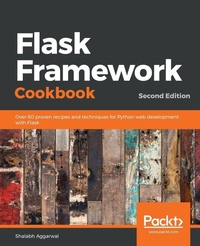
Flask Framework Cookbook
Over 80 proven recipes and techniques for Python web development with Flask
2nd Edition
Published on 17. July 2019
Book
Paperback/Softback
302 pages
978-1-78995-129-5 (ISBN)
Description
Build state-of-the-art web applications quickly and efficiently using Flask and related technologies with Python 3
Key Features
Explore Flask 1.0.3 and Python 3.7, along with useful insights into microservices
Get the most out of the powerful Flask framework and maintain the flexibility of your design choices
Write cleaner and maintainable code with the help of sample apps
Book DescriptionFlask, the lightweight Python web framework, is popular thanks to its powerful modular design that lets you build scalable web apps. With this recipe-based guide, you'll explore modern solutions and best practices for Flask web development.
Updated to the latest version of Flask and Python 3, this second edition of Flask Framework Cookbook moves away from some of the old and obsolete libraries and introduces new recipes on cutting-edge technologies. You'll discover different ways of using Flask to create, deploy, and manage microservices. This Flask Python book starts by covering the different configurations that a Flask application can make use of, and then helps you work with templates and learn about the ORM and view layers. You'll also be able to write an admin interface and get to grips with debugging and logging errors. Finally, you'll learn a variety of deployment and post-deployment techniques for platforms such as Apache, Tornado, and Heroku.
By the end of this book, you'll have gained all the knowledge you need to confidently write Flask applications and scale them using standard industry practices.What you will learn
Explore web application development in Flask, right from installation to post-deployment stages
Make use of advanced templating and data modeling techniques
Discover effective debugging, logging, and error handling techniques in Flask
Integrate Flask with different technologies such as Redis, Sentry, and MongoDB
Deploy and package Flask applications with Docker and Kubernetes
Design scalable microservice architecture using AWS Lambda continuous integration and continuous deployment
Who this book is forIf you are a web developer who wants to learn more about developing scalable and production-ready applications in Flask, this is the book for you. You'll also find this book useful if you are already aware of Flask's major extensions and want to use them for better application development. Basic Python programming experience along with basic understanding of Flask is assumed.
Key Features
Explore Flask 1.0.3 and Python 3.7, along with useful insights into microservices
Get the most out of the powerful Flask framework and maintain the flexibility of your design choices
Write cleaner and maintainable code with the help of sample apps
Book DescriptionFlask, the lightweight Python web framework, is popular thanks to its powerful modular design that lets you build scalable web apps. With this recipe-based guide, you'll explore modern solutions and best practices for Flask web development.
Updated to the latest version of Flask and Python 3, this second edition of Flask Framework Cookbook moves away from some of the old and obsolete libraries and introduces new recipes on cutting-edge technologies. You'll discover different ways of using Flask to create, deploy, and manage microservices. This Flask Python book starts by covering the different configurations that a Flask application can make use of, and then helps you work with templates and learn about the ORM and view layers. You'll also be able to write an admin interface and get to grips with debugging and logging errors. Finally, you'll learn a variety of deployment and post-deployment techniques for platforms such as Apache, Tornado, and Heroku.
By the end of this book, you'll have gained all the knowledge you need to confidently write Flask applications and scale them using standard industry practices.What you will learn
Explore web application development in Flask, right from installation to post-deployment stages
Make use of advanced templating and data modeling techniques
Discover effective debugging, logging, and error handling techniques in Flask
Integrate Flask with different technologies such as Redis, Sentry, and MongoDB
Deploy and package Flask applications with Docker and Kubernetes
Design scalable microservice architecture using AWS Lambda continuous integration and continuous deployment
Who this book is forIf you are a web developer who wants to learn more about developing scalable and production-ready applications in Flask, this is the book for you. You'll also find this book useful if you are already aware of Flask's major extensions and want to use them for better application development. Basic Python programming experience along with basic understanding of Flask is assumed.
More details
Edition
2nd Revised edition
Language
English
Place of publication
Birmingham
United Kingdom
Target group
Professional and scholarly
US School Grade: College Graduate Student
Edition type
Revised edition
Dimensions
Height: 235 mm
Width: 191 mm
Thickness: 17 mm
Weight
568 gr
ISBN-13
978-1-78995-129-5 (9781789951295)
Copyright in bibliographic data and cover images is held by Nielsen Book Services Limited or by the publishers or by their respective licensors: all rights reserved.
Schweitzer Classification
Other editions
Additional editions
Shalabh Aggarwal
Flask Framework Cookbook
Over 80 proven recipes and techniques for Python web development with Flask
E-Book
09/2024
2nd Edition
Packt Publishing
€23.49
Available for download
Person
Shalabh Aggarwal is a seasoned engineering leader who develops and manages enterprise systems and web and mobile applications for small- and large-scale organizations. He started his career working with Python, and although he now works on multiple technologies, he remains a Python developer at heart. He is passionate about open source technologies and writes highly readable and high-quality code. Throughout his career, he has built software products and engineering teams for companies moving from 0 to 1, 1 to 10, and 10 to 100 levels.
He is also active in voluntary training for engineering students and young engineers on non-conventional and open source topics. When not working with full-time assignments, he consults for start-ups on starting or scaling up while leveraging different technologies. When not writing code, he dedicates his time to his young kid and occasional travels.
He is also active in voluntary training for engineering students and young engineers on non-conventional and open source topics. When not working with full-time assignments, he consults for start-ups on starting or scaling up while leveraging different technologies. When not writing code, he dedicates his time to his young kid and occasional travels.
Content
Table of Contents
Flask Configurations
Templating with Jinja2
Data Modeling in Flask
Working with Views
Webforms with WTForms
Authenticating in Flask
RESTful API Building
Admin Interface for Flask Apps
Internationalization and Localization
Debugging, Error Handling, and Testing
Deployment and Post-Deployment
Microservices and Containers
Other Tips and Tricks
Flask Configurations
Templating with Jinja2
Data Modeling in Flask
Working with Views
Webforms with WTForms
Authenticating in Flask
RESTful API Building
Admin Interface for Flask Apps
Internationalization and Localization
Debugging, Error Handling, and Testing
Deployment and Post-Deployment
Microservices and Containers
Other Tips and Tricks