

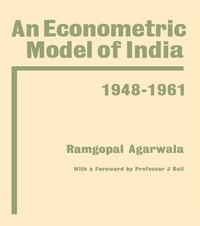
Econometric Model of India
1st Edition
Published on 19. June 1970
Book
Hardback
204 pages
978-0-7146-1200-3 (ISBN)
Description
First Published in 1970. Econometric model-building, on the other hand, has been largely confined to the advanced industrialised countries. In the few cases where macro-models have been built for underdeveloped countries (e.g. the Narasimham model (112) for India) the underlying assumptions have been largely of the Keynesian type, and thus in the authors opinion unconnected with the theory of economic development. This study is a modest attempt at econometric model-building on the basis of a model of development of an underdeveloped country.
More details
Language
English
Place of publication
London
United Kingdom
Publishing group
Taylor & Francis Ltd
Target group
College/higher education
Product notice
sewn/stitched
Cloth over boards
With dust jacket
Dimensions
Height: 222 mm
Width: 145 mm
Thickness: 16 mm
Weight
438 gr
ISBN-13
978-0-7146-1200-3 (9780714612003)
Copyright in bibliographic data and cover images is held by Nielsen Book Services Limited or by the publishers or by their respective licensors: all rights reserved.
Schweitzer Classification
Other editions
Additional editions
Ramgopal Agarwala
Econometric Model of India
E-Book
10/2013
1st Edition
Routledge
€60.49
Available for download
Ramgopal Agarwala
Econometric Model of India
E-Book
10/2013
1st Edition
Routledge
€60.49
Available for download
Person
Agarwala, Ramgopal
Content
Part 1 Introduction: the macro-model; the data; the outline. Part 2 A theory of stagnation and growth: a macro-model in a closed economy; money in growth; growth and the foreign sector; the summary. Part 3 The statistical form of the model: production functions; employment functions; investment functions; money, wages and prices; miscellaneous equations; the model as a whole; method of estimation of the parameters of the model - ordinary least squares v. simultaneous equation methods. Part 4 Production and employment: agricultural production function; food-grains production function; employment function; non-agricultural production function. Part 5 Money, wages and prices: the money supply and the absolute price level; money wages and prices; miscellaneous price equations. Part 6 Investment and foreign trade: investment in the agricultural sector; investment in non-agricultural sector; foreign trade sector. Part 7 Summary of the results: the model; the test statistics; results of simultaneous equation methods. Part 8 Applications of the model - a simulation approach: a note on simulation approach; prediction within and beyond the sample; planning for a target rate of growth; analysis of the effects of variation in exogenous variables. Part 9 A note on India's third five year plan. Appendix - the compilation of the data.