

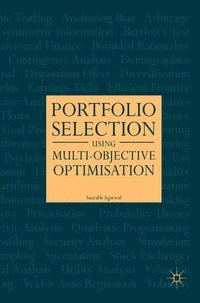
Portfolio Selection Using Multi-Objective Optimisation
Published on 7. September 2017
Book
Hardback
XX, 230 pages
978-3-319-54415-1 (ISBN)
Description
This book explores the risk-return paradox in portfolio selection by incorporating multi-objective criteria. Empirical research is presented on the development of alternate portfolio models and their relative performance in the risk/return framework to provide solutions to multi-objective optimization. Next to outlining techniques for undertaking individual investor's profiling and portfolio programming, it also offers a new and practical approach for multi-objective portfolio optimization. This book will be of interest to Foreign Institutional Investors (FIIs), Mutual Funds, investors, and researchers and students in the field.
More details
Edition
1st ed. 2017
Language
English
Place of publication
Cham
Switzerland
Publishing group
Springer International Publishing
Target group
Professional and scholarly
Illustrations
21 s/w Abbildungen
XX, 230 p. 21 illus.
Dimensions
Height: 216 mm
Width: 153 mm
Thickness: 19 mm
Weight
443 gr
ISBN-13
978-3-319-54415-1 (9783319544151)
DOI
10.1007/978-3-319-54416-8
Schweitzer Classification
Other editions
Additional editions
Saurabh Agarwal
Portfolio Selection Using Multi-Objective Optimisation
Book
08/2018
Palgrave Macmillan
€128.39
Shipment within 10-15 days
Saurabh Agarwal
Portfolio Selection Using Multi-Objective Optimisation
E-Book
08/2017
Palgrave Macmillan
€117.69
Available for download
Person
Saurabh Agarwal
is a Professor of Accounting and Finance at the Indian Institute of Finance, India. He holds a PhD from the University of Delhi, India and is a member of the Associated Chambers of Commerce & Industry of India (ASSOCHAM), Professor's Forum of India, as well as the Indian Econometric Association. Professor Agarwal has published articles on portfolio management in a number of journals.
Content
Chapter 1: Introduction.- Chapter 2: Theoretical Underpinnings and Policy Issues.- Chapter 3 - Review of Existing Literature.- Chapter 4: Research Methodology. Chapter 5: Empirical Observations: Questionnaire for Retail Investor and Expert Opinion. - Chapter 6: - Empirical Results: Questionnaire Survey and Goal Programming Portfolio Selection.- Chapter 7: Conclusions and Suggestions for Future Research.