

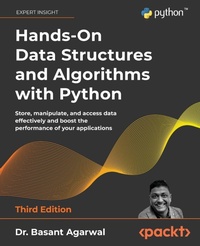
Hands-On Data Structures and Algorithms with Python
Store, manipulate, and access data effectively and boost the performance of your applications
3rd Edition
Published on 29. July 2022
Book
Paperback/Softback
496 pages
978-1-80107-344-8 (ISBN)
Description
Understand how implementing different data structures and algorithms intelligently can make your Python code and applications more maintainable and efficient
Key Features
Explore functional and reactive implementations of traditional and advanced data structures
Apply a diverse range of algorithms in your Python code
Implement the skills you have learned to maximize the performance of your applications
Book DescriptionChoosing the right data structure is pivotal to optimizing the performance and scalability of applications. This new edition of Hands-On Data Structures and Algorithms with Python will expand your understanding of key structures, including stacks, queues, and lists, and also show you how to apply priority queues and heaps in applications. You'll learn how to analyze and compare Python algorithms, and understand which algorithms should be used for a problem based on running time and computational complexity. You will also become confident organizing your code in a manageable, consistent, and scalable way, which will boost your productivity as a Python developer.
By the end of this Python book, you'll be able to manipulate the most important data structures and algorithms to more efficiently store, organize, and access data in your applications.
What you will learn
Understand common data structures and algorithms using examples, diagrams, and exercises
Explore how more complex structures, such as priority queues and heaps, can benefit your code
Implement searching, sorting, and selection algorithms on number and string sequences
Become confident with key string-matching algorithms
Understand algorithmic paradigms and apply dynamic programming techniques
Use asymptotic notation to analyze algorithm performance with regard to time and space complexities
Write powerful, robust code using the latest features of Python
Who this book is forThis book is for developers and programmers who are interested in learning about data structures and algorithms in Python to write complex, flexible programs. Basic Python programming knowledge is expected.
Key Features
Explore functional and reactive implementations of traditional and advanced data structures
Apply a diverse range of algorithms in your Python code
Implement the skills you have learned to maximize the performance of your applications
Book DescriptionChoosing the right data structure is pivotal to optimizing the performance and scalability of applications. This new edition of Hands-On Data Structures and Algorithms with Python will expand your understanding of key structures, including stacks, queues, and lists, and also show you how to apply priority queues and heaps in applications. You'll learn how to analyze and compare Python algorithms, and understand which algorithms should be used for a problem based on running time and computational complexity. You will also become confident organizing your code in a manageable, consistent, and scalable way, which will boost your productivity as a Python developer.
By the end of this Python book, you'll be able to manipulate the most important data structures and algorithms to more efficiently store, organize, and access data in your applications.
What you will learn
Understand common data structures and algorithms using examples, diagrams, and exercises
Explore how more complex structures, such as priority queues and heaps, can benefit your code
Implement searching, sorting, and selection algorithms on number and string sequences
Become confident with key string-matching algorithms
Understand algorithmic paradigms and apply dynamic programming techniques
Use asymptotic notation to analyze algorithm performance with regard to time and space complexities
Write powerful, robust code using the latest features of Python
Who this book is forThis book is for developers and programmers who are interested in learning about data structures and algorithms in Python to write complex, flexible programs. Basic Python programming knowledge is expected.
More details
Edition
3rd Revised edition
Language
English
Place of publication
Birmingham
United Kingdom
Target group
US School Grade: College Graduate Student
Edition type
Revised edition
Dimensions
Height: 235 mm
Width: 191 mm
Thickness: 27 mm
Weight
917 gr
ISBN-13
978-1-80107-344-8 (9781801073448)
Copyright in bibliographic data and cover images is held by Nielsen Book Services Limited or by the publishers or by their respective licensors: all rights reserved.
Schweitzer Classification
Person
Dr. Basant Agarwal works as an Assistant Professor at the Indian Institute of Information Technology Kota. He holds a PhD and MTech from the Department of Computer Science and Engineering, Malaviya National Institute of Technology, Jaipur, India. Basant has 10+ years of experience in academia and research, and he was awarded the prestigious PostDoc Fellowship by the European Research Consortium for Informatics and Mathematics through the Alain Bensoussan Fellowship Programme. He has been teaching a course on data structures and algorithms to undergraduates for a while now and is highly experienced in working with Python for developing real-world applications. His research interests include NLP, machine learning, and deep learning.
Content
Table of Contents
Python Data Types and Structures
Introduction to Algorithm Design
Algorithm Design Techniques and Strategies
Linked Lists
Stacks and Queues
Trees
Heaps and Priority Queues
Hash Tables
Graphs and Algorithms
Searching
Sorting
Selection Algorithms
String Matching Algorithms
Appendix: Answers to the Questions
Python Data Types and Structures
Introduction to Algorithm Design
Algorithm Design Techniques and Strategies
Linked Lists
Stacks and Queues
Trees
Heaps and Priority Queues
Hash Tables
Graphs and Algorithms
Searching
Sorting
Selection Algorithms
String Matching Algorithms
Appendix: Answers to the Questions