


Engineering Chemistry
Fundamentals and Applications
2nd Edition
Published on 23. May 2019
Book
Paperback/Softback
1500 pages
978-1-108-72444-9 (ISBN)
Description
Gain a detailed understanding of the fundamental concepts of chemistry and their engineering applications with this fully revised second edition. Catering to the needs of first and second semester undergraduate students from all branches of engineering taking courses on engineering chemistry, it offers new material on topics such as periodic properties, structure and bonding, gaseous states, ionic equilibrium, oxidation and reduction, Werner's coordination theory, Sidgwick coordination theory, valence bond theory, crystal field theory, bonding in coordination compounds, and isomerism in coordination compounds. Lucid language and an easy-to-learn approach help students to understand the basic concepts, use them to construct engineering materials, and solve problems associated with them. Each chapter is further strengthened by numerous examples and review questions.
More details
Edition
2nd Revised edition
Language
English
Place of publication
Cambridge
United Kingdom
Target group
College/higher education
Edition type
Revised edition
Product notice
Paperback (trade)
Illustrations
Worked examples or Exercises
Dimensions
Height: 240 mm
Width: 181 mm
Thickness: 50 mm
Weight
1780 gr
ISBN-13
978-1-108-72444-9 (9781108724449)
Copyright in bibliographic data is held by Nielsen Book Services Limited or its licensors: all rights reserved.
Schweitzer Classification
Other editions
Additional editions
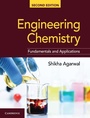
E-Book
04/2019
2nd Edition
Cambridge University Press
€100.99
Available for download
Previous edition
Book
03/2016
Cambridge University Press
€99.11
Article exhausted; check for reprint
Person
Shikha Agarwal is an assistant professor in the department of chemistry at the Government Engineering College, Ajmer. She has taught courses on engineering chemistry, environmental science, spectroscopy, photochemistry and reaction mechanisms at the undergraduate and postgraduate level for several years. Her areas of interest include organic chemistry, inorganic chemistry and environmental science.
Content
Preface; Acknowledgements; 1. Fuels; 2. Water; 3. Corrosion; 4. Phase rule; 5. Engineering materials; 6. Polymers; 7. Lubricants; 8. Periodic properties; 9. Acid base, oxidation reduction and intermolecular forces; 10. Structure and bonding; 11. Solid state; 12. Liquid crystals; 13. Chemical kinetics; 14. Surface chemistry; 15. Thermodynamics; 16. Electrochemistry; 17. Spectroscopy; 18. Photochemistry; 19. Fundamentals of organic chemistry; 20. Coordination compounds; 21. Organometallic compounds; 22. Green chemistry; 23. Nanochemistry; 24. Basics of environment science; 25. Chemical aspects of biotechnology; 26. Analytical techniques in chemistry; 27. Chemistry of carbon and hydrogen; References; Index.