

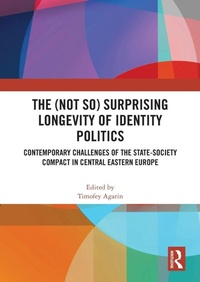
The (Not So) Surprising Longevity of Identity Politics
Contemporary Challenges of the State-Society Compact in Central Eastern Europe
1st Edition
Published on 29. January 2024
Book
Paperback/Softback
168 pages
978-1-032-22263-9 (ISBN)
Description
This book assesses the underpinning role 'references to identity' played and continue to play as the powerful mobilising force in domestic politics across the East European region stretching from Estonia to Bulgaria.
The EU membership of postcommunist states was to ensure stability, prevent conflict and eventually guarantee equality of all citizens regardless of their political preferences or ethnic identities. However, the promotion of such norms and values has been secondary to consolidation of state institutions and the societies they serve around ethnocentric narratives of states' core ethnic groups. The sequel of financial, then 'refugee' crises has further dented the appeal of the EU's norms across the region. Even the rhetoric commitment to respect cultural diversity and human rights has been promptly replaced with references to identity and interests of politically relevant groups. Yet, nativist and populist rhetoric has been the staple of politics since before the EU accession.
The chapters in this edited volume zoom in on politics which forge and live-off their societies' preoccupation with ethnocentric narratives, vesting national identity with persistent relevance and considerable weight across the postcommunist region.
The chapters in this book were originally published in the journal, East European Politics.
The EU membership of postcommunist states was to ensure stability, prevent conflict and eventually guarantee equality of all citizens regardless of their political preferences or ethnic identities. However, the promotion of such norms and values has been secondary to consolidation of state institutions and the societies they serve around ethnocentric narratives of states' core ethnic groups. The sequel of financial, then 'refugee' crises has further dented the appeal of the EU's norms across the region. Even the rhetoric commitment to respect cultural diversity and human rights has been promptly replaced with references to identity and interests of politically relevant groups. Yet, nativist and populist rhetoric has been the staple of politics since before the EU accession.
The chapters in this edited volume zoom in on politics which forge and live-off their societies' preoccupation with ethnocentric narratives, vesting national identity with persistent relevance and considerable weight across the postcommunist region.
The chapters in this book were originally published in the journal, East European Politics.
More details
Language
English
Place of publication
London
United Kingdom
Publishing group
Taylor & Francis Ltd
Target group
College/higher education
Postgraduate and Undergraduate
Dimensions
Height: 246 mm
Width: 174 mm
Thickness: 10 mm
Weight
332 gr
ISBN-13
978-1-032-22263-9 (9781032222639)
Copyright in bibliographic data and cover images is held by Nielsen Book Services Limited or by the publishers or by their respective licensors: all rights reserved.
Schweitzer Classification
Other editions
Additional editions
Timofey Agarin
The (Not So) Surprising Longevity of Identity Politics
Contemporary Challenges of the State-Society Compact in Central Eastern Europe
Book
04/2022
1st Edition
Routledge
€205.90
Shipment within 10-20 days
Timofey Agarin
The (Not So) Surprising Longevity of Identity Politics
Contemporary Challenges of the State-Society Compact in Central Eastern Europe
E-Book
04/2022
1st Edition
Routledge
€59.49
Available for download
Timofey Agarin
The (Not So) Surprising Longevity of Identity Politics
Contemporary Challenges of the State-Society Compact in Central Eastern Europe
E-Book
04/2022
1st Edition
Routledge
€59.49
Available for download
Person
Timofey Agarin teaches Comparative Politics at Queen's University Belfast, where he is also the Director of the Centre for the Study of Ethnic Conflict. His research interests are ethnic politics and their impact on societal transition, including majority-minority relations, non-discrimination, migration and civil society, with a particular focus on post communist states in Central Eastern Europe.
Content
Introduction: The (not so) surprising longevity of identity politics: contemporary challenges of the state- society compact in Central Eastern Europe 1. Authoritarian footprints in Central and Eastern Europe 2. Weak pluralism and shallow democracy: the rise of identity politics in Bulgaria and Romania 3. Caesarean politics in Hungary and Poland 4. In Europe's Closet: the rights of sexual minorities in the Czech Republic and Slovakia 5. Nation before democracy? Placing the rise of the Slovak extreme right into context 6. Latgale and Latvia's post- Soviet democracy: the territorial dimension of regime consolidation 7. Consolidated technocratic and ethnic hollowness, but no backsliding: reassessing Europeanisation in Estonia and Latvia