

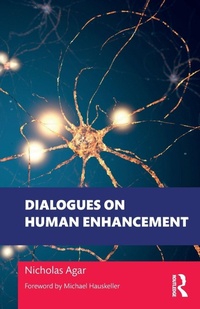
Dialogues on Human Enhancement
1st Edition
Published on 14. September 2023
Book
Paperback/Softback
200 pages
978-1-032-34225-2 (ISBN)
Description
We face an emerging range of technologies that can be applied to our human natures with the goal of enhancing us. There are nootropic smart drugs and gene editing that influence the development of the brain. The near future promises cybernetic technologies that can be grafted onto our brains and bodies. The challenge for readers of Dialogues on Human Enhancement is to decide how to respond to these and other coming enhancement technologies.
As you read these dialogues you will meet passionate advocates for a variety of responses to enhancement tech, ranging from blanket rejection to ecstatic endorsement. You'll encounter Olen, for whom there is no such thing as too much enhancement. You'll meet Winston, a bioconservative who fiercely but also imaginatively opposes any human enhancement. And there is the moderate Eugenie, who strives to distinguish between enhancement technologies that should and should not be accepted. As these characters philosophically engage with each other they will benefit from the supervisory presence of Sophie, the philosopher.
Dialogues on Human Enhancement does not arrive at a single conclusion. Olen's transhumanism, Eugenie's moderation, and Winston's bioconservatism are presented as viable and necessary views as we enter a future made uncertain by human enhancement tech.
And the book also welcomes the voices of students, even - and especially - if they challenge the opinions of our age's experts. As students join the conversations in this book, they will formulate their own views about how humanity could or should be in our Age of Human Enhancement.
As you read these dialogues you will meet passionate advocates for a variety of responses to enhancement tech, ranging from blanket rejection to ecstatic endorsement. You'll encounter Olen, for whom there is no such thing as too much enhancement. You'll meet Winston, a bioconservative who fiercely but also imaginatively opposes any human enhancement. And there is the moderate Eugenie, who strives to distinguish between enhancement technologies that should and should not be accepted. As these characters philosophically engage with each other they will benefit from the supervisory presence of Sophie, the philosopher.
Dialogues on Human Enhancement does not arrive at a single conclusion. Olen's transhumanism, Eugenie's moderation, and Winston's bioconservatism are presented as viable and necessary views as we enter a future made uncertain by human enhancement tech.
And the book also welcomes the voices of students, even - and especially - if they challenge the opinions of our age's experts. As students join the conversations in this book, they will formulate their own views about how humanity could or should be in our Age of Human Enhancement.
More details
Series
Language
English
Place of publication
London
United Kingdom
Publishing group
Taylor & Francis Ltd
Target group
College/higher education
Professional and scholarly
General, Professional Practice & Development, Undergraduate Advanced, and Undergraduate Core
Dimensions
Height: 216 mm
Width: 140 mm
Thickness: 13 mm
Weight
303 gr
ISBN-13
978-1-032-34225-2 (9781032342252)
Copyright in bibliographic data and cover images is held by Nielsen Book Services Limited or by the publishers or by their respective licensors: all rights reserved.
Schweitzer Classification
Other editions
Additional editions
Nicholas Agar
Dialogues on Human Enhancement
E-Book
09/2023
1st Edition
Routledge
€49.99
Available for download
Nicholas Agar
Dialogues on Human Enhancement
E-Book
09/2023
1st Edition
Routledge
€49.99
Available for download
Nicholas Agar
Dialogues on Human Enhancement
Book
09/2023
1st Edition
Routledge
€195.90
Shipment within 10-20 days
Person
Nicholas Agar is Professor of Ethics at the University of Waikato in Aotearoa, New Zealand. He has written extensively on the philosophical debate about human enhancement including three books on the topic - Liberal Eugenics (2004), Humanity's End (2010), and Truly Human Enhancement (2013).
Content
Night 1: What should we say about gene-edited twins who may have been enhanced? Night 2: Enhancement technologies, doping athletes, and the meaning of human enhancement Night 3: From Francis Galton's eugenics to liberal eugenics Night 4: Radical versus moderate enhancement and cognition Night 5: SENS and radical life extension Night 6: Enhanced moods and morality Night 7: How do we decide which aspects of human nature to preserve? Night 8: A species relativist rejection of radical enhancement Night 9: Three contrasting nightmares about the Age of Human Enhancement