

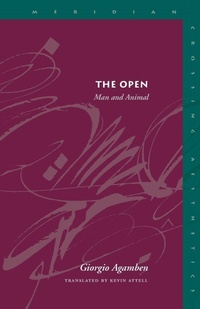
The Open
Man and Animal
Published on 23. October 2003
Book
Paperback/Softback
120 pages
978-0-8047-4738-7 (ISBN)
Description
The end of human history is an event that has been foreseen or announced by both messianics and dialecticians. But who is the protagonist of that history that is coming-or has come-to a close? What is man? How did he come on the scene? And how has he maintained his privileged place as the master of, or first among, the animals?
In The Open, contemporary Italian philosopher Giorgio Agamben considers the ways in which the "human" has been thought of as either a distinct and superior type of animal, or a kind of being that is essentially different from animal altogether. In an argument that ranges from ancient Greek, Christian, and Jewish texts to twentieth-century thinkers such as Heidegger, Benjamin, and Kojeve, Agamben examines the ways in which the distinction between man and animal has been manufactured by the logical presuppositions of Western thought, and he investigates the profound implications that the man/animal distinction has had for disciplines as seemingly disparate as philosophy, law, anthropology, medicine, and politics.
In The Open, contemporary Italian philosopher Giorgio Agamben considers the ways in which the "human" has been thought of as either a distinct and superior type of animal, or a kind of being that is essentially different from animal altogether. In an argument that ranges from ancient Greek, Christian, and Jewish texts to twentieth-century thinkers such as Heidegger, Benjamin, and Kojeve, Agamben examines the ways in which the distinction between man and animal has been manufactured by the logical presuppositions of Western thought, and he investigates the profound implications that the man/animal distinction has had for disciplines as seemingly disparate as philosophy, law, anthropology, medicine, and politics.
Reviews / Votes
"[The Open] turns to perhaps the most basic distinction of existence: that between human beings and animals. The thin volume provides an impressive historical survey of the problem, offering a dizzying scope of debate over the nature of animality, including expositions of figures as diverse as Thomas Aquinas, Georges Bataille, Heidegger, Alexander Kojeve, Benjamin, and the German zoologist Jakob von Uexkuell."-Radical Philosophy ReviewMore details
Series
Edition
New edition
Language
English
Place of publication
Palo Alto
United States
Target group
Professional and scholarly
College/higher education
Edition type
New edition
Product notice
Paperback (trade)
Dimensions
Height: 235 mm
Width: 160 mm
Thickness: 8 mm
Weight
154 gr
ISBN-13
978-0-8047-4738-7 (9780804747387)
Copyright in bibliographic data and cover images is held by Nielsen Book Services Limited or by the publishers or by their respective licensors: all rights reserved.
Schweitzer Classification
Persons
Giorgio Agamben is Professor of Philosophy at the University of Venice. This is the fifth of his books published by Stanford; previous titles are Homo Sacer: Sovereign Power and Bare Life (1998), The Man Without Content (1999), The End of the Poem (1999), and Potentialities (1999).
Content
@fmct:Contents @toc4:Translator's Note iii @toc2:1 Theromorphous 00 2 Acephalous 00 3 Snob 00 4 Mysterium disiunctionis 00 5 Physiology of the Blessed 00 6 Cognitio experimentalis 00 7 Taxonomies 00 8 Without Rank 00 9 Anthropological Machine 00 10 Umwelt 00 11 Tick 00 12 Poverty in World 00 13 The Open 00 14 Profound Boredom 00 15 World and Earth 00 16 Animalization 00 17 Anthropogenesis 00 18 Between 00 19 Desuvrement 000 20 Outside of Being 000 @toc4:Notes 000 Index 000 Library of Congress Subject Headings for this publication: Philosophical anthropology, Human beings Animal nature