

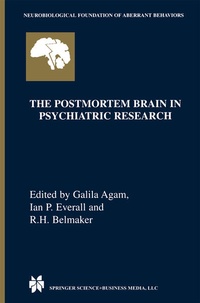
The Postmortem Brain in Psychiatric Research
Published on 30. November 2001
Book
Hardback
IX, 404 pages
978-0-7923-7554-8 (ISBN)
Description
Because of the dearth of experimental animal models of psychiatric disorders, the study of the effect of the disease state is only possible in tissue derived from patients vs. controls, especially in the target tissue of disease-related changes in the brain. The human postmortem brain offers the most appropriate experimental paradigm towards understanding the etiology of psychiatric disorders. The availability of post-mortem human samples from psychiatric patients and comparison groups in recent years has contributed prominently to the accumulating body of information leading to a better understanding of these disorders.
This is the first book to summarize this research approach and the meaningful data which has recently been acquired.
This is the first book to summarize this research approach and the meaningful data which has recently been acquired.
More details
Series
Edition
2002 ed.
Language
English
Place of publication
New York
United States
Target group
Professional and scholarly
Illustrations
IX, 404 p. 23 illus., 1 illus. in color.
Dimensions
Height: 235 mm
Width: 157 mm
Thickness: 31 mm
Weight
832 gr
ISBN-13
978-0-7923-7554-8 (9780792375548)
DOI
10.1007/978-1-4757-3631-1
Schweitzer Classification
Other editions
Additional editions
Galila Agam | Ian P. Everall | Robert Haim Belmaker
The Postmortem Brain in Psychiatric Research
E-Book
03/2013
Springer
€149.79
Available for download
Galila Agam | Ian P. Everall | Robert Haim Belmaker
The Postmortem Brain in Psychiatric Research
Book
12/2010
Springer
€160.49
Shipment within 15-20 days
Content
Methodology and General Findings.- 1. Psychiatric Brain Banks: Situation in Europe and Asia.- 2. Methodological and Stereological Considerations in Postmortem Psychiatric Brain Research.- 3. Imaging vs. Postmortem Receptor Studies: What You See is What You Get?.- 4. Glial Pathology and Major Psychiatric Disorders.- 5. Indications of Abnormal Connectivity in Neuropsychiatric Disorders in Postmortem Studies.- 6. Studies in the Human Frontal Cortex: Evidence for Changes in Neurochemical Markers in Schizophrenia and Bipolar Disorder.- 7. Summary of Prefrontal Molecular Abnormalities in the Stanley Foundation Neuropathology Consortium.- Schizophrenia.- 8. Macroanatomical Findings in Postmortem Brain Tissue from Schizophrenic Patients.- 9. Microanatomical Findings in Postmortem Brain Tissue from Subjects with Schizophrenia: Disturbances in Thalamocortical and Corticocortical in Schizophrenia.- 10. In Situ/Histological Approaches to Neurotransmitter-Specific Postmortem Brain Studies of Schizophrenia.- 11. Defining the Role of Specific Limbic Circuitry in the Pathophysiology of Schizophrenia and Bipolar Disorder.- 12. Dorsolateral Prefrontal Cortical Parallel Circuit in Schizophrenia: Postmortem Abnormalities.- 13. Postmortem Studies of the Hippocampal Formation in Schizophrenia.- 14. GSK-3 and WNT Markers of Neurodevelopmental Abnormalities in Schizophrenia.- Affective Disorders.- 15. Macroanatomical Findings in Postmortem Brain Tissue.- 16. Quantitative Cytoarchitectonic Findings in Postmortem Brain Tissue from Mood Disorder Patients.- 17. Phosphoinositide Signal Transduction System in Postmortem Human Brain.- 18. cAMP Signal Transduction Abnormalities in the Pathophysiology of Mood Disorders: Contributions from Postmortem Brain Studies.- 19. Monoamine Receptors in PostmortemBrain: Do Postmortem Brain Studies Cloud or Clarify our Understanding of the Affective Disorders?.- 20. Non-Monoaminergig Transmitters, Glia Cell Markers, Cell Adhesion Molecules and Synaptic Proteins in Postmortem Brain Tissue.- Concluding Remarks.